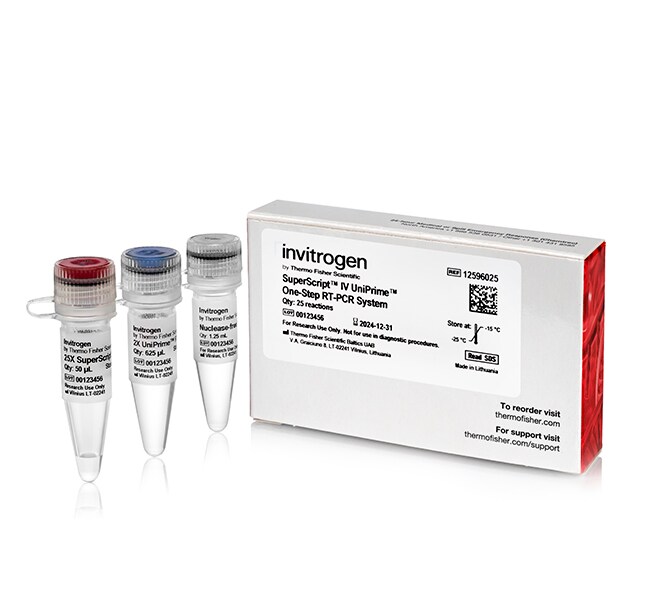
SuperScript IV UniPrime 一步法 RT-PCR 系统
Invitrogen™

SuperScript IV UniPrime 一步法 RT-PCR 系统

Invitrogen SuperScript IV UniPrime 一步法 RT-PCR 系统是一种便捷的一步法配方,可在单管中进行快速 cDNA 合成和 PCR 扩增。
Have Questions?
更改视图buttonViewtableView
货号描述反应次数
12596025无染料25 × 50 μL 反应
12597025显色25 × 50 μL 反应
12596100无染料100 × 50 μL 反应
12597100显色100 × 50 μL 反应
12596500无染料500 × 50 μL 反应
12597500显色500 × 50 μL 反应
货号 12596025
价格(CNY)
4,334.00
Each
添加至购物车
描述:
无染料
反应次数:
25 × 50 μL 反应
价格(CNY)
4,334.00
Each
添加至购物车
Invitrogen SuperScript IV UniPrime 一步法 RT-PCR 系统是一种便捷的一步法配方,可在单管中进行快速 cDNA 合成和 PCR 扩增。它将高持续性的 SuperScript IV 反转录酶 (RT) 与新型 UniPrime RT-PCR 预混液相结合,与其他一步法 RT-PCR 试剂盒相比,使用更简单,性能出众。

Invitrogen SuperScript IV UniPrime 一步法 RT-PCR 系统通过便利的一步流程可在单管中进行快速 cDNA 合成和 PCR 扩增。它将高持续性的 SuperScript IV 反转录酶 (RT) 与新型 UniPrime RT-PCR 预混液相结合,与其他一步法 RT-PCR 试剂盒相比,更易于使用,性能出众。

产品优势
简化工作流程—采用通用的引物退火温度 60°C,可减少优化时间
容易移液—彩色缓冲液,可视觉追踪反应体系配制和将样品直接上样至凝胶上
适合自动化—两相热启动激活机制,可实现室温设置和长达24小时的台式稳定性
出色的性能—即使使用具有挑战性的 RNA 样品,也能获得高得率和可靠的靶标检测

优质酶的组合
SuperScript IV UniPrime 一步法 RT-PCR 系统利用优质酶的组合。SuperScript IV 反转录酶混合物通过其高的热稳定性、持续性和从各种 RNA 样品合成 cDNA 的能力,有助于执行有效的反转录步骤,而其高灵敏度有助于确保可靠的靶标检测,即使在 RNA 上样量有限的情况下(低至 0.01 pg RNA)也是如此。

2X UniPrime RT-PCR 预混液内含改良的 Platinum SuperFi II DNA 聚合酶,该聚合酶可实现高特异性和高得率,非常适合需要序列准确性的应用。这种新型的预混液配方能够使按照常规设计规则设计的大多数引物对在 60°C 下进行通用引物退火,有助于尽可能减少优化步骤、节省时间并避免 RT-PCR 运行中的错误。

两相热启动
创新的两相热启动机制通过反转录酶和 DNA 聚合酶活性的时间分离,有助于在一步法 RT-PCR 中实现高特异性和高得率。这不仅使得可以在室温下配制反应体系,还有助于确保组装反应体系的稳定性,对于 ≤3 kb 的靶标长达24小时,而对于 >3 kb 的靶标长达4小时。

彩色形式
SuperScript IV UniPrime 一步法 RT-PCR 系统有标准无染料规格或含示踪染料的彩色规格可供选择。当 SuperScript IV RT 混合物中的红色示踪染料和 UniPrime RT-PCR 预混液中的蓝色示踪染料在反应体系配制期间相结合时,最终反应混合物变为紫色。这样可实现对反应体系配制的简单视觉追踪,有助于防止移液错误。最终反应产物也可以直接上样到琼脂糖凝胶上,更加简化实验流程。

仅供科研使用。不可用于诊断程序。
规格
描述无染料
产品规格一步法 RT-PCR 试剂盒
热启动内置热启动
多路传输能力
反应次数25 × 50 μL 反应
最佳反应温度50°C 至 65°C
数量25 reactions
反应形式预混液
试剂类型反转录
逆转录酶SuperScript IV
尺寸(最终产品)长达 13 kb
原始材料RNA
技术1 步法 RT-PCR
检测方法引物-探针
高 GC PCR 扩增效果
PCR 方法1 步法 RT-PCR
Unit SizeEach
内容与储存
• SuperScript IV RT 混合物,50 μL
• 2X UniPrime RT-PCR 预混液,625 μL
• 无核酸酶水,1.25 mL

储存在 -15 至 -25°C 下。

常见问题解答 (FAQ)

Can I set up my reactions at room temperature using SuperScript IV UniPrime One-Step RT-PCR System?

Yes, reaction setup with SuperScript IV UniPrime One-Step RT-PCR System can be performed at room temperature. Moreover, the innovative two-phase hot start mechanism allows preassembled reactions to remain stable at room temperature for up to 24 hrs for targets up to 3 kb and for up to 4 hrs for targets >3 kb.

Find additional tips, troubleshooting help, and resources within our PCR and cDNA Synthesis Support Center.

Which DNA polymerase is included in SuperScript IV UniPrime One-Step RT-PCR System?

SuperScript IV UniPrime One-Step RT-PCR System includes 2X UniPrime RT-PCR master mix containing modified Platinum SuperFi II DNA Polymerase, which provides high specificity and high yields, and is ideally suited for applications that require sequence accuracy. On the contrary to common proofreading enzymes, this polymerase is compatible with dUTP.

Find additional tips, troubleshooting help, and resources within our PCR and cDNA Synthesis Support Center.

Do the tracking dyes in the colored format of SuperScript IV UniPrime One-Step RT-PCR System interfere with electrophoresis in E-Gel agarose gels?

Red and blue tracking dyes included in the colored format of SuperScript IV UniPrime One-Step RT-PCR System do not interfere with electrophoresis in E-Gel agarose gels. Please note that the reaction product obtained with both the colored and dye-free format should be diluted 2- to 30-fold for optimal separation using E-Gel agarose gels.

Find additional tips, troubleshooting help, and resources within our PCR and cDNA Synthesis Support Center.

What is a two-phase, hot-start activation mechanism?

The two-phase hot-start mechanism, utilized in the SuperScript IV One-Step RT-PCR System and SuperScript IV UniPrime One-Step RT-PCR System, ensures sequential activation of RT and PCR enzymes in the one-step RT-PCR workflow. At ambient temperature, SuperScript IV RT is maintained inactive with a heat-sensitive RT-blocker. During the first hot-start activation phase at approximately 45 degrees C, the RT-blocker is released and the first-strand cDNA synthesis is initiated. During the second activation phase, the reaction is heated to 98 degrees C to activate DNA Polymerase and simultaneously inactivate SuperScript IV RT. This mechanism separates the RT and PCR enzymes' activities, delivering the highest RT-PCR specificity and yield.

I am having difficulties performing one-step RT-PCR with long targets. What are your recommendations?

Good laboratory practices are important for long fragment, one-step RT-PCR. These include using high-quality templates (pure, fresh, and intact) and fresh primer solutions. Optimization steps to consider include use of longer extension times and increasing template amounts. Learn more about RT-PCR reaction optimization and setup by visiting our reverse transcription educational resources (https://www.thermofisher.com/us/en/home/life-science/cloning/cloning-learning-center/invitrogen-school-of-molecular-biology/rt-education.html).