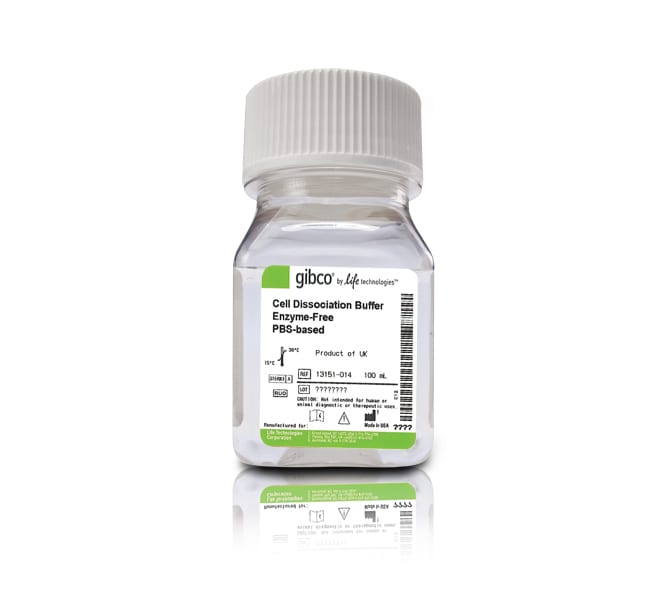
Cell Dissociation Buffer, enzyme-free, PBS
Invitrogen17万+抗体限时买二赠一,靶点广,灵活用!
Cell Dissociation Buffer, enzyme-free, PBS
Gibco™

Cell Dissociation Buffer, enzyme-free, PBS

Cell Dissociation Buffer is a membrane-filtered, isotonic, and enzyme-free solution of salts, chelating agents, and cell-conditioning agents in calcium-free and magnesium-free phosphate-buffered saline (PBS).
Have Questions?
Catalog NumberQuantity
13151014100 mL
Catalog number 13151014
Price (CNY)
800.00
Each
Add to cart
Quantity:
100 mL
Price (CNY)
800.00
Each
Add to cart

Gibco Cell Dissociation Buffer is a membrane-filtered, isotonic, and enzyme-free solution of salts, chelating agents, and cell-conditioning agents in calcium-free and magnesium-free phosphate-buffered saline (PBS). It is suitable for the gentle dissociation of mammalian cells for studies such as ligand binding, flow cytometry, and immunohistochemistry, that require intact cell surface proteins. Cell Dissociation Buffer works well with lightly adherent cell lines, such as HeLa and NIH 3T3, but is not recommended for the routine passaging of strongly adherent cells.

Gibco Cell Dissociation Buffer is a membrane-filtered, isotonic, and enzyme-free solution of salts, chelating agents, and cell-conditioning agents in calcium-free and magnesium-free phosphate-buffered saline (PBS). Gibco Cell Dissociation Buffer is suitable for the gentle dissociation of mammalian cells for studies such as ligand binding, flow cytometry, and immunohistochemistry, that require intact cell surface proteins. Gibco Cell Dissociation Buffer works well with lightly adherent cell lines, such as HeLa and NIH 3T3, but is not recommended for the routine passaging of strongly adherent cells.

Cell Culture, Mammalian Cell Culture

For Research Use Only. Not for use in diagnostic procedures.
Specifications
Cell LineHeLa, NIH 3T3
ChelatorsEDTA
Quantity100 mL
RemarksRoom Temperature Stable
Shelf Life24 Months
Shipping ConditionRoom Temperature
ClassificationAnimal Origin-free
Product TypeCell Culture Dissociation Reagent
SterilitySterile-filtered
With AdditivesEDTA
Unit SizeEach
Contents & Storage
Storage conditions: 15°C to 30°C
Shipping conditions: Room temperature
Shelf life: 24 months from date of manufacture

Frequently asked questions (FAQs)

What is the osmolality and pH range for Cell Dissociation Buffer, enzyme-free, PBS (Cat. No. 13151014)

Below are QC test specifications for pH and osmolality for this product:

- pH: 6.9 to 7.9
- Osmolality: 289 to 321 mOsm/kg

Find additional tips, troubleshooting help, and resources within our Cell Culture Support Center.

At what confluency should cells be at prior to their dissociation using the Cell Association Buffer, enzyme-free, PBS?

The buffer should be used with cells that are sub-confluent (60-80%). If cells are more than 80% confluent, it will be hard to detach them.

Find additional tips, troubleshooting help, and resources within our Cell Culture Support Center.

Will the Cell Dissociation Buffer, enzyme-free, PBS damage cell surface markers/receptors?

This buffer is very gentle. It should preserve the structural and functional integrity of cell surface proteins. However, we recommend that the customer test their cells and proteins.

Find additional tips, troubleshooting help, and resources within our Cell Culture Support Center.

Can I use the Cell Dissociation Buffer, enzyme-free, PBS to dissociate cells?

This Enzyme-Free Cell Dissociation Buffer does not rely on proteolysis for its action. Therefore, it is not suitable for strongly adherent cells, or for routine passage of some cell types (e.g., A431, Hep2, A549, MDCK, WI-38). This product is intended to gently dissociate cells from attachment substrates and each other while maintaining surface protein integrity.

Find additional tips, troubleshooting help, and resources within our Cell Culture Support Center.

What reagents do you offer for cell dissociation, and what are the main differences between them?

Please use this selection chart that compares our cell dissociation reagents (https://www.thermofisher.com/us/en/home/life-science/cell-culture/mammalian-cell-culture/reagents/trypsin.html).

Find additional tips, troubleshooting help, and resources within ourMammalian Cell Culture Basics Support Center.

Citations & References (3)

Citations & References
Abstract
Hematopoietic differentiation and production of mature myeloid cells from human pluripotent stem cells.
Authors:Choi KD, Vodyanik M, Slukvin II,
Journal:Nat Protoc
PubMed ID:21372811
'In this paper, we describe a protocol for hematopoietic differentiation of human pluripotent stem cells (hPSCs) and generation of mature myeloid cells from hPSCs through expansion and differentiation of hPSC-derived lin(-)CD34(+)CD43(+)CD45(+) multipotent progenitors. The protocol comprises three major steps: (i) induction of hematopoietic differentiation by coculture of hPSCs with OP9 ... More
Long term non-invasive imaging of embryonic stem cells using reporter genes.
Authors:Sun N, Lee A, Wu JC,
Journal:Nat Protoc
PubMed ID:19617890
'Development of non-invasive and accurate methods to track cell fate after delivery will greatly expedite transition of embryonic stem (ES) cell therapy to the clinic. In this protocol, we describe the in vivo monitoring of stem cell survival, proliferation and migration using reporter genes. We established stable ES cell lines ... More
Functional evidence for the mediation of diabetogenic T cell responses by HLA-A2.1 MHC class I molecules through transgenic expression in NOD mice.
Authors: Marron Michele P; Graser Robert T; Chapman Harold D; Serreze David V;
Journal:Proc Natl Acad Sci U S A
PubMed ID:12361980
Particular major histocompatibility complex (MHC) class II alleles clearly contribute to T cell-mediated autoimmune type 1 diabetes (T1D) in both humans and nonobese diabetic (NOD) mice. However, studies in NOD mice indicate MHC class I-restricted T cell responses are also essential to T1D development. In humans, epidemiological studies have suggested ... More