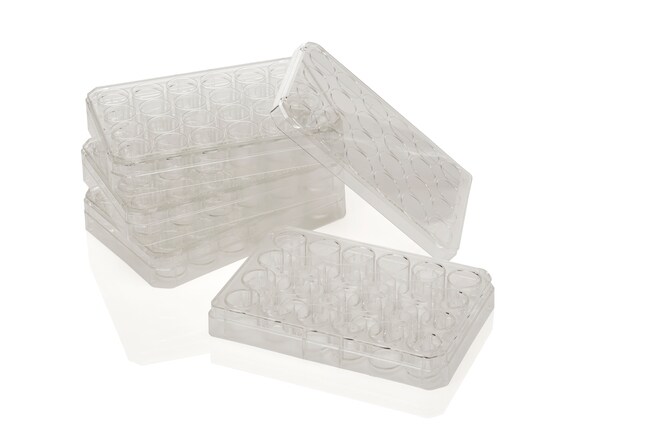
多孔板中 Nunc™ 聚碳酸酯插入式细胞培养器
Invitrogen17万+抗体限时买二赠一,靶点广,灵活用!
多孔板中 Nunc™ 聚碳酸酯插入式细胞培养器
Thermo Scientific™

多孔板中 Nunc™ 聚碳酸酯插入式细胞培养器

采用 Thermo Scientific™ Nunc™ 插入式细胞培养器 - 聚碳酸酯膜时,无需基质涂层即可培养大多数细胞类型。
Have Questions?
更改视图buttonViewtableView
货号孔径盘类型培养面积
1406200.4 μm24 孔板0.47cm2
1406273 μm24 孔板0.47cm2
1406298 μm24 孔板0.47cm2
1406400.4 μm6 孔板3.14cm2
1406423 μm6 孔板3.14cm2
1406448 μm6 孔板3.14cm2
1406520.4 μm12 孔板1.13cm2
1406543 μm12 孔板1.13cm2
1406568 μm12 孔板1.13cm2
1406600.4 μm6 孔板4.1cm2
1406633 μm6 孔板4.1cm2
1406688 μm6 孔板4.1cm2
货号 140620
价格(CNY)
2,795.00
Case of 48
添加至购物车
孔径:
0.4 μm
盘类型:
24 孔板
培养面积:
0.47cm2
价格(CNY)
2,795.00
Case of 48
添加至购物车
采用 Thermo Scientific™ Nunc™ 插入式细胞培养器 - 聚碳酸酯膜时,无需基质涂层即可培养大多数细胞类型。
特点:
  • 经组织培养处理的多孔膜,可优化细胞贴壁
  • 三种孔径:0.4、3 和 8 微米
  • 采用经 Nunclon™ δ 处理的无菌多孔板预填充
  • 无毒性且无热原

应用:

  • 肿瘤迁移和浸润检测
  • 上皮细胞(如 Caco-2)和内皮细胞(如脑微血管内皮细胞)屏障测定
  • 真皮/表皮和上皮组织模型(如,人造皮肤模型)
  • 趋化作用研究
  • 共培养

质保期:90 天


对内部研究使用限制的免责声明:关于买方仅可将产品用于内部研究的任何限制事项并不适用于与此声明相关的网页上的产品。

一般参考文献:

  1. Mardi A Crane-Godreau et.al (2005).由原代子宫上皮细胞对脂多糖或 Pam3Cys 处理的响应产生的 CCL20/巨噬细胞炎性蛋白 3α 和肿瘤坏死因子 α PMID: 15618187
  2. Rettinger CL et. al (2018).猪离体视神经视网膜模型中视网膜移植体活力的定量评估. PMID:29924674
  3. Mardi A Crane-Godreau et.al (2004).大肠杆菌和鼠李糖乳杆菌对培养物中极化大鼠子宫上皮细胞释放的巨噬细胞炎性蛋白 3 α、肿瘤坏死因子 α 和转化生长因子 β 的影响. PMID: 15039305
  4. Soboll G et. al (2006).雌二醇对培养物中小鼠子宫上皮细胞产生 PAMP-介导的 CCL20/MIP-3 α 的影响. PMID: 16771853
  5. Mardi A Crane-Godreau et. al (2009).暴露于香烟烟雾会破坏呼吸道上皮细胞中 CCL20 介导的抗菌活性. PMID: 19966927
  6. .Wildemann B et. al (2005).使用从聚乳酸载体中释放的不同生长因子刺激后人破骨细胞融合和再吸收活性的差异. PMID: 15477999
  7. Sugita Y et. al (1997).色素上皮细胞衍生因子 (PEDF) 直接影响小胶质细胞的代谢和增殖并且间接影响星形胶质细胞. PMID: 9335258
  8. van Schilfgaarde M et. al (1999).位于上皮细胞层的流感嗜血杆菌不受抗生素和抗体介导的杀菌活性的影响. PMID: 10222210
  9. Chung HC et. al (2014).通过高效多靶向 RNA 干扰抑制 PK15 细胞系中猪内源性逆转录病毒. PMID: 24138389
  10. Ode A et. al (2010).骨再生中的仿生材料:间充质干细胞在广谱细胞外基质组分上的功能行为. PMID:20878902
规格
颜色清除
描述0.4 微米孔径的聚碳酸酯插入式细胞培养器,适用于 24 孔板
盘类型24 孔板
每箱数量48
每架数量12
表面处理经细胞培养处理
培养面积0.47cm2
适用于24 孔多孔培养皿
每板插件数12
材质聚碳酸酯(膜)
孔数量24
孔密度<0.85x10^8
孔径0.4 μm
无菌无菌
类型插入式培养器
工作容积(公制)0.5mL
Unit SizeCase of 48

常见问题解答 (FAQ)

What is the difference between the 24-well plate format for the Nunc Polycarbonate Cell Culture Inserts in Multi-Well Plates (Cat. No. 140620) and the 24-well plate format for the Nunc Cell Culture Inserts in Carrier Plate Systems (Cat. No. 141002)?

The difference between the two 24-well plate formats is as follows:

  • Nunc Polycarbonate Cell Culture Inserts in Multi-Well Plates (Cat. No. 140620): There are only 12 inserts in the 24-well multi-well plate, leaving every second column free without an insert. This is a preferred configuration for some co-culture experiments, as it makes it easy to access the culture grown in the multi-well plate for media changes, etc., by placing the insert in the empty well next to it. The inserts are placed directly into the wells here, leaving a 0.9 mm gap between the bottom of the well and the insert membrane.
  • Nunc Cell Culture Inserts in Carrier Plate Systems (Cat. No. 141002): There are 24 inserts in the 24-well carrier plate. The carrier plate with the hanging slots allows for adjustment of the insert height. The three hanging positions in the carrier plate allow for distance of approximately 0.9 mm, 3.3 mm, or 6.3 mm between the well-bottom and insert growth surface for both 12- and 24-well plate formats. This configuration is preferred when customer needs more versatility, for example to facilitate air-liquid interface culture, and other co-culture applications.


Note: details on plate configuration can also be found within the following product brochure (pg 3).

With the Nunc Polycarbonate Cell Culture Inserts in Multi-Well Plates, what is the distance between the cell culture membrane and the bottom of the multi-well dish?

The membrane is approximately 1.0 mm above the bottom of the dish for the Nunc Polycarbonate Cell Culture Inserts.

Can I observe cells on the cell culture membrane when the Nunc Polycarbonate Cell Culture Insert is inside of a multi-well plate?

Due to the large pore size of the Nunc polycarbonate inserts, spots or holes are observed and they represent the membrane. In this plane of focus, the most visible cells are the ones located on the membrane, whereas the slightly blurred backdrop are the cells on the dish that are in a different plane of focus. These cells do not photograph with great resolution due to the slightly opaque quality of the membrane. However, these cells are visible in culture.

What is the recommended Multidish chamber media volume per carrier plate insert and height position?

Low position: 2 mL (12-well), 1 mL (24-well), Medium position: 3 mL (12-well), 1.5 mL (24-well), High position: 4 mL (12-well), 2 mL (24-well). Some optimization may be necessary for development purposes.

Why are only 12 inserts provided with standard membrane insert products in the 24-well format?

This has emerged as the industry standard. In many cases having empty wells facilitates media changes and other experimental steps.