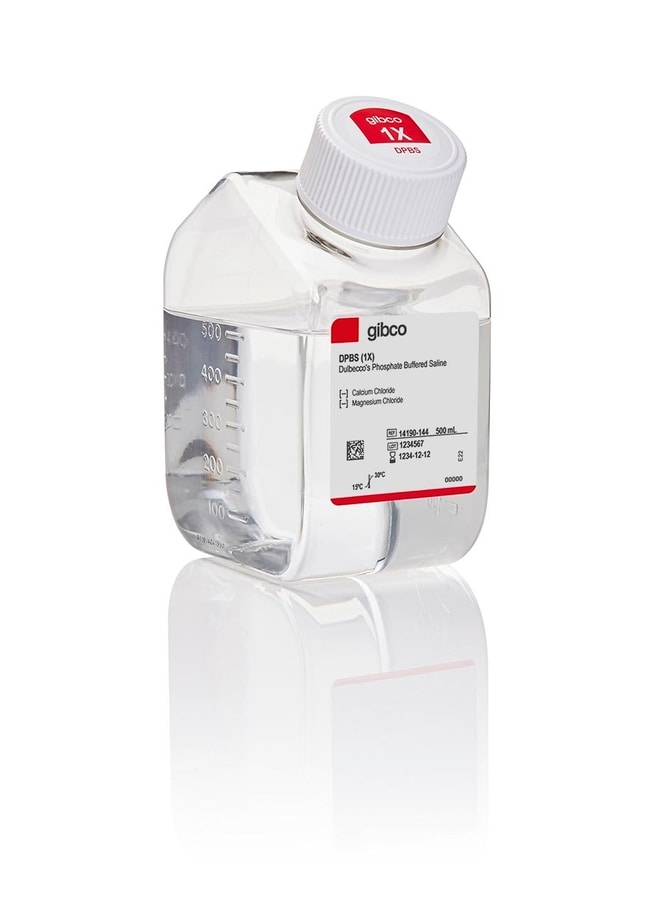
DPBS,无钙、无镁
Invitrogen17万+抗体限时买二赠一,靶点广,灵活用!
DPBS,无钙、无镁
Gibco™

DPBS,无钙、无镁

Dulbecco 磷酸盐缓冲溶液 (DPBS) 是一种平衡盐溶液,适用于各种细胞培养应用,例如解离前清洗细胞、运输细胞或组织样品、稀释细胞进行计数和制备试剂。细胞解离前,需采用不含钙和镁的制剂从培养物中冲洗掉螯合剂。我们针对广泛的细胞培养应用,提供了大量 Gibco™ DPBS了解更多信息
Have Questions?
更改视图buttonViewtableView
货号数量包装
14190144500 mLBottle
1419025010 x 500 mLBottle
141901361000 mLBottle
141902356 x 1000 mLBottle
141903425 LBag
1419035910 LBag
1419036720 LBag
货号 14190144
价格(CNY)
338.00
飞享价
Ends: 31-Dec-2025
430.00
共减 92.00 (21%)
Each
添加至购物车
数量:
500 mL
包装:
Bottle
Customize this product
价格(CNY)
338.00
飞享价
Ends: 31-Dec-2025
430.00
共减 92.00 (21%)
Each
添加至购物车
Dulbecco 磷酸盐缓冲溶液 (DPBS) 是一种平衡盐溶液,适用于各种细胞培养应用,例如解离前清洗细胞、运输细胞或组织样品、稀释细胞进行计数和制备试剂。细胞解离前,需采用不含钙和镁的制剂从培养物中冲洗掉螯合剂。

我们针对广泛的细胞培养应用,提供了大量 Gibco™ DPBS 制剂

DPBS 的改良方式如下:

不含
•钙
•镁离子
• 酚红

查看完整配方

cGMP 生产和质量体系
Gibco™ DPBS 在位于纽约格兰德岛、符合 cGMP 要求的工厂生产。该工厂是在FDA登记的医疗器械生产商,且通过ISO 13485标准认证。为确保供应链的稳定,我们同时提供由我们苏格兰工厂生产的完全相同的 Gibco™ DPBS 产品 (14190-240)。后者亦是在FDA登记的医疗仪器生产商,且符合ISO 13485标准。
仅用于研究和生产用途。不可用于临床诊断或直接用于人类或动物。
规格
化学名称或材料Dulbecco 的磷酸盐缓冲液 (DPBS)
颜色清除
包括不含丙酮酸钠
生产质量cGMP-compliant under the ISO 13485 standard
渗透压270 - 300 mOsm/kg
包装Bottle
建议的储存条件储存条件:15°C 至 30°C
运输条件:室温
有效期:自生产之日起 36 个月
无菌无菌过滤
最大浓度1X
适用于(应用)哺乳动物细胞培养
物理形态液体
产品线Gibco™
数量500 mL
溶液类型Dulbecco 的磷酸盐缓冲液
pH7.0 - 7.3
Unit SizeEach

常见问题解答 (FAQ)

你们推荐使用多大浓度的EDTA对培养在Gibco Essential 8培养基和玻连蛋白(VTN-N)中的细胞进行传代?

我们推荐您使用以不含钙或镁的Dulbecco氏磷酸缓冲盐溶液(DPBS)制备的 0.5 mM EDTA溶液。(货号14190-144(在欧洲,货号为14190-094))

What procedures are recommended for the preparation of beta amyloid-containing samples?

Following are procedures which researchers have followed for handling beta amyloid in tissue and cell samples:

Kienlen-Campard, P, S. Miolet, B. Tasiaux, and J.-N. Octave (2002) Intracellular amyloid beta 1-42, but not extracellular soluble amyloid beta peptides, induces neuronal apoptosis. J. Biol. Chem. 277(18):15666-15670. These authors performed formic acid extraction of whole cells. Neurons (approximately 107) were scraped in ice cold PBS. Cell pellets were solubilized in 300 microliters of 70% formic acid. Formic acid-solubilized cell pellets were cleared by centrifuging at 16,000 x g for 5 minutes at 4 degrees C, and the supernatants were centrifuged at 21,000 x g for 20 minutes at 4 degrees C. The supernatants were vacuum dried and the resulting pellet was resuspended in 1 mL of alkaline carbonate buffer (2% Na2CO3, 0.1 N NaOH) and centrifuged 16,000 x g for 3 minutes at 4 degrees C. Protein concentration was determined by the BCA assay. For immunoprecipitation, 800 microliters of the supernatant was neutralized with 800 microliters of 1 M Tris-HCl, pH 6.8, and diluted 1:3 in H2O containing 10% FCS, 0.5% Triton X-100, and 0.5% Nonident P-40 (final concentrations). Beta amyloid 1-40 and Beta amyloid 1-42 concentrations were determined by ELISA using 100 microliters of neutralized extract.

Fagan, A.M., M. Watson, M. Parsadanian, K.R. Bales, S.M. Paul, and D.M. Holtzman (2002) Human and murine ApoE markedly alters A beta metabolism before and after plaque formation in a mouse model of Alzheimer"s disease. Neurobiol. Dis. 9(3):305-318. This paper discusses analyzing beta amyloid by ELISA. This paper has an interesting variation on the measurement of beta amyloid: they looked at soluble beta amyloid and also insoluble beta amyloid. Here are the key points of their protocol: For analysis of total beta amyloid levels, half of the hippocampus from each animal was Dounce homogenized in 5 M guandine (50 nM Tris-HCl, pH 8.0) and beta amyloid ELISA was performed as described previously (Johnson-Wood, et al. 1997). For analysis of soluble beta amyloid, the other half of the hippocampus was homogenized on ice in 400 microliters TBS (25 mM Tris-HCl, 150 mM NaCl, 3 mM EDTA, pH 7.4) containing protease inhibitors (20 micrograms/mL aprotinin, and 10 micrograms/mL leupeptin). Homogenates were spun at 125,000xg in polyallomer tubes in a Sorvall RP100 AT4-406 rotor for 1 hour at 4 degrees C and levels of beta amyloid total in the resultant supernatant (defines as soluble Abeta total) were obtained by beta amyloid ELISA. Percentage of soluble Abeta total was defined as the soluble (TBS-extractable) value divided by the total tissue (guanidine-extractable) value.

For Brain Tissue Homogenization, Prepare the Following Solutions: 5 M guanidine HCl 50 mM TrisHCl, pH 8.0. Reaction Buffer BSAT-DPBS (Dulbecco’s phosphate buffered saline with 5% BSA and 0.03% Tween-20, see formulation below) supplemented with 1x Protease Inhibitor Cocktail from Calbiochem (catalog code 539131; contains AEBSF, aprotinin, E64, EDTA, and leupeptin). BSAT-DPBS Formulation 0.2 g/L KCl 0.2 g/L KH2PO4 8.0 g/L NaCl 1.150 g/L Na2HPO4 5% BSA 0.03% Tween-20 to 1 L ultrapure water and adjust the pH to 7.4. Protocol: Determine the wet mass of the mouse hemibrain (100 mg) or a human brain sample in an Eppendorf tube (Fisher K749520-0000). Add 8 x mass of cold 5 M guanidineHCl / 50 mM Tris-HCl (Solution "A", above) to the tube by 50 - 100 µL aliquots and grind thoroughly with a hand-held motor (Fisher K749540-0000) after each addition. (Optional: transfer the homogenate from above to 1 mL Dounce homogenizer and homogenize thoroughly.) Mix the homogenate at room temperature for 3 - 4 hours. The sample is stable and can be freeze-thawed many times at this stage. Dilute the sample with cold Reaction Buffer (Solution "B"). Centrifuge (microfuge or Sorvall) at 16,000 x g for 20 minutes at 4°C. Save the supernatant for the assay.

What is the shelf life of DPBS after it has been opened?

We cannot provide an official expiration date for open bottles as this depends on the customer's use. Once opened, Thermo Fisher Scientific can no longer guarantee the performance of any product. However, if the storage conditions are followed as recommended, the stated expiration date (36 months from the date of manufacture) should apply to opened bottles as DPBS is extremely stable.

Find additional tips, troubleshooting help, and resources within our Cell Culture Support Center.

What is the shelf life of DPBS (Cat. No. 14190136)?

DPBS has a shelf life of 36 months from the date of manufacture, when stored as recommended (15-30 degrees C).

Does Diploid Growth Serum-Reduced Medium (SRM) contain L-glutamine?

The basal Diploid Growth Serum-Reduced Medium already contains 6 mM L-glutamine.

Find additional tips, troubleshooting help, and resources within our Cell Culture Support Center.