Search


引用和文献 (13)
Invitrogen™
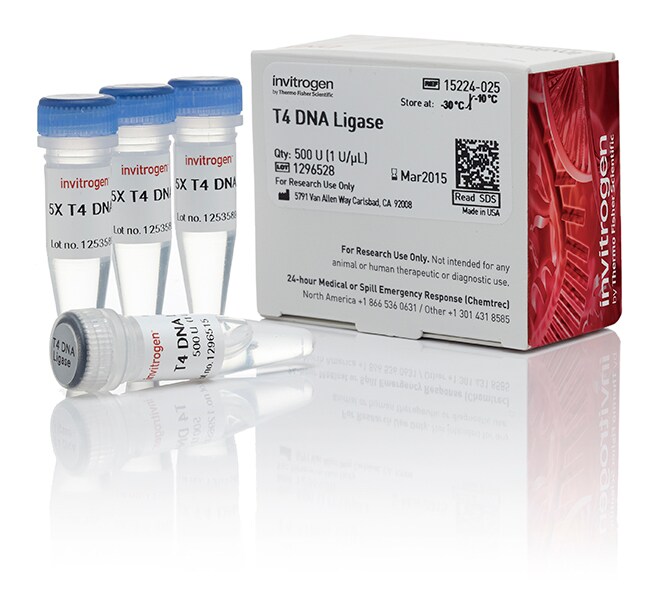
T4 DNA 连接酶 (1 U/μL)
有 ATP 存在时,T4 DNA 连接酶在双链 DNA 的 3´羟基和 5´磷酸末端之间形成磷酸二酯键。了解更多信息
Have Questions?
更改视图

| 货号 | 数量 |
|---|---|
| 15224017 | 100 U |
| 15224025 | 500 U |
| 15224090 | 4 x 500 U |
货号 15224017
价格(CNY)
406.00
飞享价
Ends: 31-Dec-2026
541.00共减 135.00 (25%)
Each
数量:
100 U
价格(CNY)
406.00
飞享价
Ends: 31-Dec-2026
541.00共减 135.00 (25%)
Each
有 ATP 存在时,T4 DNA 连接酶在双链 DNA 的 3´羟基和 5´磷酸末端之间形成磷酸二酯键。 独特的 T4 DNA 连接酶缓冲液优化了连接过程,5 分钟内即可完成连接 (1)。 单链核酸不是这种酶的底物。 提供 T4 DNA 连接酶技术公告。
应用: 克隆(平末端或粘末端连接)(2)。 向平末端 DNA 添加连接头或接头 (2)。
来源: 纯化自大肠杆菌œ溶素原 NM989。
性能和质量测试: 脱氧核糖核酸内切酶,3´ 和 5´ 脱氧核糖核酸外切酶实验;通过连接效率测试。
单位定义: 一个单位的酶量可以在 37°C 的环境中在 20 分钟内催化 1 nmol 32P-标记焦磷酸通过置换反应进入 ATP。(一个单位等于约 300 粘末端连接单位。)
单位反应条件: 66 mM Tris-HCl (pH 7.6),6.6 mM MgCl2,10 mM DTT,66 μM ATP,3.3 μM 32 P-标记焦磷酸及酶,共 0.1 ml,在 37°C 反应 20分钟。
应用: 克隆(平末端或粘末端连接)(2)。 向平末端 DNA 添加连接头或接头 (2)。
来源: 纯化自大肠杆菌œ溶素原 NM989。
性能和质量测试: 脱氧核糖核酸内切酶,3´ 和 5´ 脱氧核糖核酸外切酶实验;通过连接效率测试。
单位定义: 一个单位的酶量可以在 37°C 的环境中在 20 分钟内催化 1 nmol 32P-标记焦磷酸通过置换反应进入 ATP。(一个单位等于约 300 粘末端连接单位。)
单位反应条件: 66 mM Tris-HCl (pH 7.6),6.6 mM MgCl2,10 mM DTT,66 μM ATP,3.3 μM 32 P-标记焦磷酸及酶,共 0.1 ml,在 37°C 反应 20分钟。
仅供科研使用。不可用于诊断程序。
规格
兼容缓冲液DNA 连接酶缓冲液、5X 反应缓冲液
产品类型T4 DNA 连接酶
数量100 U
运输条件干冰
最大浓度1 U/μL
酶连接酶
Unit SizeEach
内容与储存
T4 DNA 连接酶随附一瓶 5X 反应缓冲液 [250 mM Tris-HCl(pH 值 7.6)、50 mM MgCl2、5 mM ATP、5 mM DTT、25% (w/v) 聚乙二醇-8000] 中提供。在 -20°C 条件下储存。
常见问题解答 (FAQ)
T4 DNA连接酶和E. coli DNA连接酶有什么区别?
我如何优化我的连接反应?
我不能立即转化我的细胞。我可以存储我的连接反应产物吗?如果可以,应该存储在什么温度?
限制性内切酶克隆需要设置哪些对照?
T4 DNA常见的抑制剂有哪些?
引用和文献 (13)
引用和文献
Abstract
DNA sequence variation in the promoter region of the VEGF gene impacts VEGF gene expression and maximal oxygen consumption.
Journal:Am J Physiol Heart Circ Physiol
PubMed ID:16339827
'In its role as an endothelial cell proliferation and migration factor, vascular endothelial growth factor (VEGF) can affect peripheral circulation, and therefore impact maximal oxygen consumption (Vo2max). Because of the role of VEGF, and because variation in the VEGF gene has the ability to alter VEGF gene expression and VEGF
Identification of coenzyme M biosynthetic phosphosulfolactate synthase: a new family of sulfonate-biosynthesizing enzymes.
Journal:J Biol Chem
PubMed ID:11830598
'The hyperthermophilic euryarchaeon Methanococcus jannaschii uses coenzyme M (2-mercaptoethanesulfonic acid) as the terminal methyl carrier in methanogenesis. We describe an enzyme from that organism, (2R)-phospho-3-sulfolactate synthase (ComA), that catalyzes the first step in coenzyme M biosynthesis. ComA catalyzed the stereospecific Michael addition of sulfite to phosphoenolpyruvate over a broad range
Biosynthesis of riboflavin in archaea studies on the mechanism of 3,4-dihydroxy-2-butanone-4-phosphate synthase of Methanococcus jannaschii.
Journal:J Biol Chem
PubMed ID:12200440
'The hypothetical protein predicted by the open reading frame MJ0055 of Methanococcus jannaschii was expressed in a recombinant Escherichia coli strain under the control of a synthetic gene optimized for translation in an eubacterial host. The recombinant protein catalyzes the formation of the riboflavin precursor 3,4-dihydroxy-2-butanone 4-phosphate from ribulose 5-phosphate
Characterization of the SECIS binding protein 2 complex required for the co-translational insertion of selenocysteine in mammals.
Journal:Nucleic Acids Res
PubMed ID:16155186
'Selenocysteine is incorporated into at least 25 human proteins by a complex mechanism that is a unique modification of canonical translation elongation. Selenocysteine incorporation requires the concerted action of a kink-turn structural RNA (SECIS) element in the 3'' untranslated region of each selenoprotein mRNA, a selenocysteine-specific translation elongation factor (eEFSec)
Substantially enhanced cloning efficiency of SAGE (Serial Analysis of Gene Expression) byadding a heating step to the original protocol.
Journal:Nucleic Acids Res
PubMed ID:9889294
'The efficiency of the original SAGE (Serial Analysis of Gene Expression) protocol was limited by a small average size of cloned concatemers. We describe a modification of the technique that overcomes this problem. Ligation of ditags yields concatemers of various sizes. Small concatemers may aggregate and migrate with large ones