Search


引用和文献 (6)
Invitrogen™
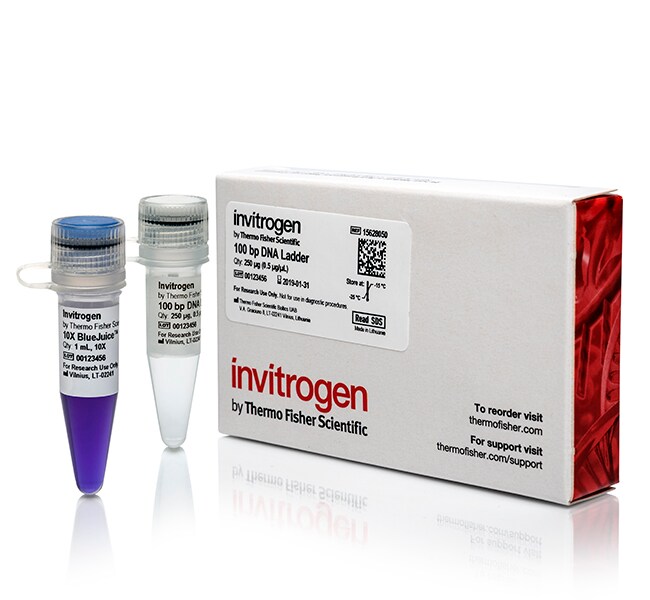
100 bp DNA 分子量标准
Invitrogen 100 bp DNA 分子量标准设计用于 100 bp 至 2,000 bp了解更多信息
Have Questions?
更改视图

| 货号 | 数量 |
|---|---|
| 15628050 | 500 μL DNA 分子量标准,1 mL 10X 上样缓冲液 |
| 15628019 | 100 μL DNA 分子量标准,1 mL 10X 上样缓冲液,100 次应用 |
货号 15628050
价格(CNY)
2,394.00
飞享价
Ends: 31-Dec-2026
7,981.00共减 5,587.00 (70%)
Each
数量:
500 μL DNA 分子量标准,1 mL 10X 上样缓冲液
价格(CNY)
2,394.00
飞享价
Ends: 31-Dec-2026
7,981.00共减 5,587.00 (70%)
Each
Invitrogen 100 bp DNA 分子量标准设计用于 100 bp 至 2,000 bp 内双链 DNA 片段的大小鉴定和近似定量。100 bp DNA 分子量标准由 13 个层析纯化的个体 DNA 片段组成,参比条带分别为 2000、1500 和 600 bp,便于轻松定向。
100 bp DNA 分子量标准非常适合利用 1–2% 琼脂糖凝胶进行 DNA 片段分离。
100 bp DNA 分子量标准的特点:
•明显、清晰的条带—层析纯化片段可获得一致和可靠的结果
• 便利—已经预混了 10X BlueJuice 凝胶上样缓冲液,便于追踪样品 DNA 迁移
• 精确—可获得每条带中的 DNA 精确量
产品用途
溴化乙锭或 SYBR Safe 染色后,可在 1–2% 琼脂糖凝胶上观测到双链 DNA 分子量标准。该分子量标准设计有强度均匀的 DNA 条带,便于清楚查看每一条带。每个条带中确切量的 DNA 可实现样品 DNA 近似定量。
该分子量标准可使用 T4 多聚核苷酸激酶或 T4 DNA 聚合酶进行放射性标记。
100 bp DNA 分子量标准非常适合利用 1–2% 琼脂糖凝胶进行 DNA 片段分离。
100 bp DNA 分子量标准的特点:
•明显、清晰的条带—层析纯化片段可获得一致和可靠的结果
• 便利—已经预混了 10X BlueJuice 凝胶上样缓冲液,便于追踪样品 DNA 迁移
• 精确—可获得每条带中的 DNA 精确量
产品用途
溴化乙锭或 SYBR Safe 染色后,可在 1–2% 琼脂糖凝胶上观测到双链 DNA 分子量标准。该分子量标准设计有强度均匀的 DNA 条带,便于清楚查看每一条带。每个条带中确切量的 DNA 可实现样品 DNA 近似定量。
该分子量标准可使用 T4 多聚核苷酸激酶或 T4 DNA 聚合酶进行放射性标记。
仅供科研使用。不可用于诊断程序。
规格
最大浓度0.5 μg/μL
凝胶兼容性琼脂糖凝胶
套装内容500 μL DNA Ladder, 1 mL 10X Loading Buffer
反应次数500应用
数量500 μL DNA 分子量标准,1 mL 10X 上样缓冲液
即用型否
上样容量1 mL
运输条件经批准可在室温或干冰上运输
技术层析纯化的个体 DNA 片段
容积(公制)500 µL
凝胶类型琼脂糖
产品类型DNA 分子量标准品
大小范围100 bp-2,000 bp
Unit SizeEach
内容与储存
• 500 µL 100 bp DNA 分子量标准
• 1 mL 10X BlueJuice 凝胶上样缓冲液
储存于 -20°C。
• 1 mL 10X BlueJuice 凝胶上样缓冲液
储存于 -20°C。
常见问题解答 (FAQ)
为什么我的分子量ladder 的DNA条带出现了弥散现象?
我的DNA ladder出现异常迁移。这是为什么?
TrackIt DNA梯度标准品与其他DNA梯度标准品有何区别?
Can I know the sequences of Invitrogen DNA ladders?
Are Invitrogen DNA ladders composed of linear or circular/supercoiled DNA?
引用和文献 (6)
引用和文献
Abstract
A duplex PCR-based assay for measuring the amount of bacterial contamination in a nucleic acid extract from a culture of free-living protists.
Journal:PLoS One
PubMed ID:23593495
'Cultures of heterotrophic protists often require co-culturing with bacteria to act as a source of nutrition. Such cultures will contain varying levels of intrinsic bacterial contamination that can interfere with molecular research and cause problems with the collection of sufficient material for sequencing. Measuring the levels of bacterial contamination for
Identification and characterization of non-saccharomyces spoilage yeasts isolated from Brazilian wines.
Journal:World J Microbiol Biotechnol
PubMed ID:23355138
'The industry of fine wines and also locally consumed table wines is emerging in Brazil with an increasing volume and economic impact. Enologists in this region currently lack information about the prevalence and characteristics of spoilage yeasts, which may contaminate and potentially undervalue Brazilian wines. Herein, we analyzed 50 local
Systemically administered gp100 encoding DNA vaccine for melanoma using water-in-oil-in-water multiple emulsion delivery systems.
Journal:
PubMed ID:23702000
'The purpose of this study was to develop a water-in-oil-in-water (W/O/W) multiple emulsions-based vaccine delivery system for plasmid DNA encoding the gp100 peptide antigen for melanoma immunotherapy. The gp100 encoding plasmid DNA was encapsulated in the inner-most aqueous phase of squalane oil containing W/O/W multiple emulsions using a two-step emulsification
Multiplex PCR assay targeting a diguanylate cyclase-encoding gene, cgcA, to differentiate species within the genus Cronobacter.
Journal:Appl Environ Microbiol
PubMed ID:23144142
In a comparison to the widely used Cronobacter rpoB PCR assay, a highly specific multiplexed PCR assay based on cgcA, a diguanylate cyclase gene, that identified all of the targeted six species among 305 Cronobacter isolates was designed. This assay will be a valuable tool for identifying suspected Cronobacter isolates
Mycobacterial interspersed repetitive-unit-variable-number tandem-repeat (MIRU-VNTR) genotyping of mycobacterium intracellulare for strain comparison with establishment of a PCR-based database.
Journal:J Clin Microbiol
PubMed ID:23175249
Strain comparison is important to population genetics and to evaluate relapses in patients with Mycobacterium avium complex (MAC) lung disease, but the "gold standard" of pulsed-field gel electrophoresis (PFGE) is time-consuming and complex. We used variable-number tandem repeats (VNTR) for fingerprinting of respiratory isolates of M. intracellulare from patients with