Search


引用和文献 (6)
Gibco™
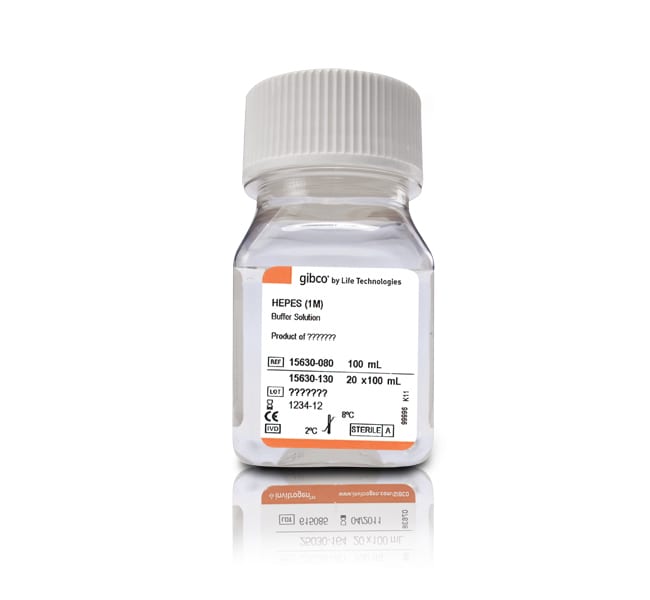
HEPES (1M)
Gibco™ HEPES(N-2-羟乙基哌嗪-N-2-乙烷磺酸)是一种两性离子有机化学缓冲剂,常用于细胞培养基中。当需要在 CO2 培养箱外长时间处理细胞培养物时,添加 10–25 mM HEPES了解更多信息
Have Questions?
更改视图

| 货号 | 数量 |
|---|---|
| 15630080 | 100 mL |
| 15630106 | 20 mL |
| 15630130 | 20 x 100 mL |
货号 15630080
价格(CNY)
1,177.00
飞享价
Ends: 31-Dec-2026
1,490.00共减 313.00 (21%)
Each
数量:
100 mL
价格(CNY)
1,177.00
飞享价
Ends: 31-Dec-2026
1,490.00共减 313.00 (21%)
Each
Gibco™ HEPES(N-2-羟乙基哌嗪-N-2-乙烷磺酸)是一种两性离子有机化学缓冲剂,常用于细胞培养基中。当需要在 CO2 培养箱外长时间处理细胞培养物时,添加 10–25 mM HEPES 可提供额外的缓冲能力。HEPES 具有膜不透性、对生化反应的影响有限、化学和酶学稳定性、极低的可见光和紫外光吸光度等优点,因此是许多细胞培养系统的良好缓冲选择。
两地 cGMP 生产和质量体系
Gibco™ HEPES 在 cGMP 合规机构生产,公司地址为英国苏格兰的 Paisley。该工厂是在 FDA 注册的医疗器械生产商,且通过 ISO 13485 标准认证。为确保供应链的稳定,我们同时提供由我们格兰德岛工厂生产的等同 Gibco™ HEPES 产品 (15630-080)。本工厂者亦是在 FDA 登记的医疗器械生产商,且符合 ISO 13485 标准。
两地 cGMP 生产和质量体系
Gibco™ HEPES 在 cGMP 合规机构生产,公司地址为英国苏格兰的 Paisley。该工厂是在 FDA 注册的医疗器械生产商,且通过 ISO 13485 标准认证。为确保供应链的稳定,我们同时提供由我们格兰德岛工厂生产的等同 Gibco™ HEPES 产品 (15630-080)。本工厂者亦是在 FDA 登记的医疗器械生产商,且符合 ISO 13485 标准。
仅用于研究和生产用途。不可用于临床诊断或直接用于人类或动物。
规格
CAS7365-45-9
化学名称或材料Zwitterionic Organic Chemical Buffer
颜色澄清溶液
配方N-2-Hydroxyethylpiperazine-N-2-Ethane Sulfonic Acid
建议的储存条件储存条件:2°C 至8°C, 运输条件:室温, 有效期:自生产之日起24个月
无菌Sterile
灭菌方法Sterile-filtered
最大浓度1 M
适用于(应用)染色质生物学、哺乳动物细胞培养
分级生化
分子量 (g/mol)238.3 g/mol
物理形态液体
数量100 mL
溶液类型Buffer
pH7 – 7.5
Unit SizeEach
常见问题解答 (FAQ)
Based on the Sodium bicarbonate levels in the medium, what CO2 % is recommended?
Do high or low levels of sodium bicarbonate affect the pH of my tissue culture media?
My Gibco HEPES (1M) (Cat. No. 15630080) was accidentally frozen. Can I still use it?
Is HEPES (1 M) in distilled water or in saline solution?
What is the endotoxin specification for HEPES (1 M) (Cat. Nos. 15630080, 15630106, and 15630130)?
引用和文献 (6)
引用和文献
Abstract
A comparison between different human hepatocyte models reveals profound differences in net glucose production, lipid composition and metabolism in vitro.
Journal:Experimental cell research
PubMed ID:38499143
Preparation and characterization of toxic Abeta aggregates for structural and functional studies in Alzheimer's disease research.
Journal:Nat Protoc
PubMed ID:20539293
'The amyloid cascade hypothesis, supported by strong evidence from genetics, pathology and studies using animal models, implicates amyloid-beta (Abeta) oligomerization and fibrillogenesis as central causative events in the pathogenesis of Alzheimer''s disease (AD). Today, significant efforts in academia, biotechnology and the pharmaceutical industry are devoted to identifying the mechanisms by
Investigating conversion of mechanical force into biochemical signaling in three-dimensional chondrocyte cultures.
Journal:Nat Protoc
PubMed ID:19478808
The culture of chondrocytes embedded within agarose hydrogels maintains chondrocytic phenotype over extended periods and allows analysis of the chondrocyte response to mechanical forces. The mechanisms involved in the transduction of a mechanical stimulus to a physiological process are not completely deciphered. We present protocols to prepare and characterize constructs
Molecular rearrangements of the extracellular vestibule in NMDAR channels during gating.
Journal:Neuron
PubMed ID:11779481
Many N-methyl-D-aspartate receptor (NMDAR) channel blockers that have therapeutic potential can be trapped in the closed state. Using a combination of the substituted cysteine accessibility method and open channel blockers, we found that the M3 segment forms the core of the extracellular vestibule, including a deep site for trapping blockers.
Polycystin-1, the product of the polycystic kidney disease 1 gene, co-localizes with desmosomes in MDCK cells.
Journal:Hum Mol Genet
PubMed ID:11063733
Polycystin-1 is a novel protein predicted to be a large membrane-spanning glycoprotein with an extracellular N-terminus and an intracellular C-terminus, harboring several structural motifs. To study the subcellular localization, antibodies raised against various domains of polycystin-1 and against specific adhesion complex proteins were used for two-color immunofluorescence staining. In Madine