Search


引用和文献 (9)
Gibco™
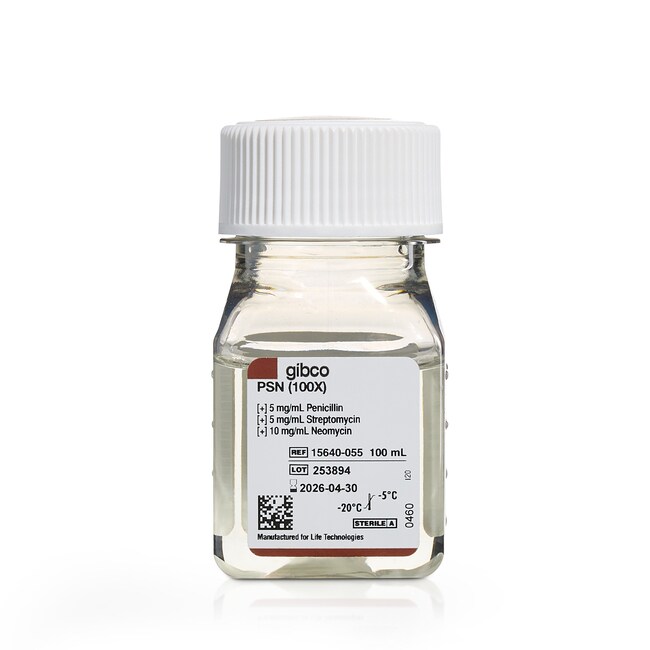
青霉素-链霉素-新霉素 (PSN) 抗生素混合物
抗生素 - 青霉素、链霉素和新霉素对革兰阳性细菌和革兰阴性细菌具有有效的联合抗菌作用,可用于防止细胞培养受到细菌污染。青霉素最初从真菌青霉菌中提纯制成,并通过直接干扰细菌细胞壁的合成、间接通过触发可进一步改变细胞壁的酶释放来发挥作用。链霉素最初从灰色链霉菌中提纯制成,新霉素从弗氏链霉菌中提纯制成。链霉素和新霉素的作用机制为与细菌核糖体的 30S 亚单位结合,进而抑制蛋白合成,导致敏感细菌死亡了解更多信息
| 货号 | 数量 |
|---|---|
| 15640055 | 100 mL |
货号 15640055
价格(CNY)
683.00
Each
数量:
100 mL
价格(CNY)
683.00
Each
抗生素 - 青霉素、链霉素和新霉素对革兰阳性细菌和革兰阴性细菌具有有效的联合抗菌作用,可用于防止细胞培养受到细菌污染。青霉素最初从真菌青霉菌中提纯制成,并通过直接干扰细菌细胞壁的合成、间接通过触发可进一步改变细胞壁的酶释放来发挥作用。链霉素最初从灰色链霉菌中提纯制成,新霉素从弗氏链霉菌中提纯制成。链霉素和新霉素的作用机制为与细菌核糖体的 30S 亚单位结合,进而抑制蛋白合成,导致敏感细菌死亡。我们为细胞培养应用提供各种抗生素和抗真菌剂。
该溶液每 ml 0.85% 生理盐水含 5 mg 青霉素、5 mg 链霉素、10 mg 新霉素。
产品用途
仅供研究使用:不适用于动物或人类诊断或治疗用途。
该溶液每 ml 0.85% 生理盐水含 5 mg 青霉素、5 mg 链霉素、10 mg 新霉素。
产品用途
仅供研究使用:不适用于动物或人类诊断或治疗用途。
仅供科研使用。不可用于诊断程序。
规格
最大浓度100 X
培养类型哺乳动物细胞培养
适用于(应用)防止细胞培养受到污染
数量100 mL
运输条件干冰
形式液体
产品类型Geneticin
无菌无菌过滤
Unit SizeEach
内容与储存
在冰箱(-5 至 -30°C)中储存。
常见问题解答 (FAQ)
我该如何对我的培养物去污染?
你们提供哪些抗生素来帮助用户控制或减少细胞培养中的污染情况?
How can I decontaminate my cultures?
What antibiotics do you offer to help control or eliminate cell culture contamination?
引用和文献 (9)
引用和文献
Abstract
Characterization of the 46-kDa intermediates of matrix metalloproteinase 3 (stromelysin 1) obtained by site-directed mutation of phenylalanine 83.
Journal:J Biol Chem
PubMed ID:8631880
The precursor of matrix metalloproteinase 3 (MMP-3/ stromelysin 1) is activated in vitro by proteinases or mercurial compounds by stepwise processes which include the initial formation of short-lived intermediates and the subsequent intermolecular cleavage of the His82-Phe83 bond to generate the fully activated mature MMP-3 (Nagase, H., Enghild, J. J.,
Pyridoxine induces glutathione synthesis via PKM2-mediated Nrf2 transactivation and confers neuroprotection.
Journal:Nat Commun
PubMed ID:32071304
'Oxidative stress is a major pathogenic mechanism in Parkinson''s disease (PD). As an important cellular antioxidant, glutathione (GSH) balances the production and incorporation of free radicals to protect neurons from oxidative damage. GSH level is decreased in the brains of PD patients. Hence, clarifying the molecular mechanism of GSH deficiency
Isorhynchophylline ameliorates cognitive impairment via modulating amyloid pathology, tau hyperphosphorylation and neuroinflammation: Studies in a transgenic mouse model of Alzheimer's disease.
Journal:Brain Behav Immun
PubMed ID:31476414
'Isorhynchophylline (IRN) has been demonstrated to have distinct anti-Alzheimer''s disease (AD) activity in several animal models of AD. In this study, we aimed at evaluating the preventive effect of IRN on the cognitive deficits and amyloid pathology in TgCRND8 mice. Male TgCRND8 mice were administered with IRN (20 or 40?mg/kg)
miR-210 promotes progression of endometrial carcinoma by regulating the expression of NFIX.
Journal:Int J Clin Exp Pathol
PubMed ID:31949601
'microRNA-210 (miR-210) plays an important role in human disease, but its function in endometrial cancer (EC) is still unclear. Similarly, the nuclear factor I/X (NFIX) plays an important role in various biological functions of cells, but its function in EC is not yet known. In this study, we detected the
Regulation of proapoptotic proteins Bak1 and p53 by miR-125b in an experimental model of Alzheimer's disease: Protective role of 17ß-estradiol.
Journal:Neurosci Lett
PubMed ID:27235580
Alzheimer's disease has become one of the most impacting disorders since world population is rapidly aging. MicroRNA-125b plays a crucial role in many cellular processes and pathologies, but, to date, its role in Alzheimer's disease is controversial. In this study, we demonstrated, for the first time, that the down regulation