Search


引用和文献 (6)
Gibco™
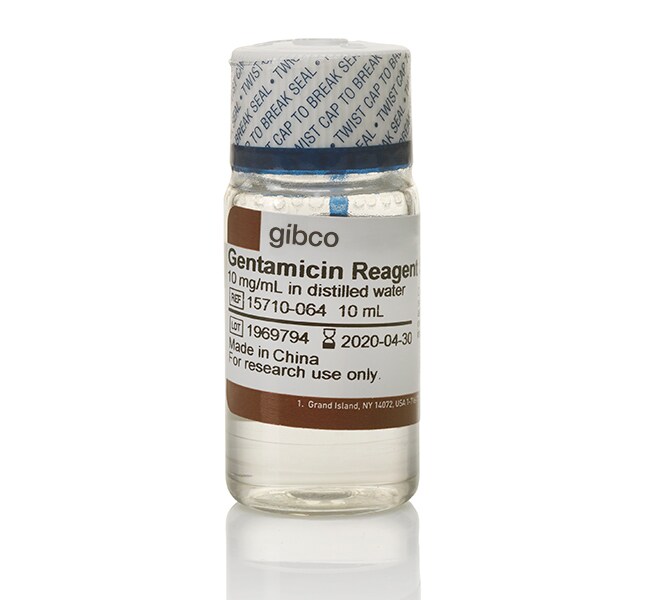
Gentamicin (10 mg/mL)
Gentamicin sulfate is a water-soluble antibiotic drug originally purified from the fungus Micromonospora purpurea. Gentamicin acts by binding to the了解更多信息
| 货号 | 数量 |
|---|---|
| 15710064 | 10 mL |
货号 15710064
价格(CNY)
-
数量:
10 mL
Gentamicin sulfate is a water-soluble antibiotic drug originally purified from the fungus Micromonospora purpurea. Gentamicin acts by binding to the 30S subunit of the bacterial ribosome leading to inhibition protein synthesis and death in susceptible bacteria. Gibco™ Gentamicin is effective against a wide variety of gram-positive and gram-negative bacteria, and is used for the prevention of bacterial contamination on cell cultures. The recommended working concentration ranges from 0.5 to 50 μg/ml. We offer a variety of antibiotics and antimycotics for cell culture applications.
Product Use
For Research Use Only: Not intended for animal or human diagnostic or therapeutic use.
Dual-Site cGMP Manufacturing
Gibco™ Gentamicin is manufactured at a cGMP compliant facility, located in Grand Island, New York. The facility is registered with the FDA as a medical device manufacturer and is certified to ISO 13485 standards. For supply chain continuity, we offer a comparable Gibco™ Gentamicin product made in our Scotland facility (15710-049). This facility is registered with the FDA as a medical device manufacturer and is certified to the ISO 13485 standard.
Product Use
For Research Use Only: Not intended for animal or human diagnostic or therapeutic use.
Dual-Site cGMP Manufacturing
Gibco™ Gentamicin is manufactured at a cGMP compliant facility, located in Grand Island, New York. The facility is registered with the FDA as a medical device manufacturer and is certified to ISO 13485 standards. For supply chain continuity, we offer a comparable Gibco™ Gentamicin product made in our Scotland facility (15710-049). This facility is registered with the FDA as a medical device manufacturer and is certified to the ISO 13485 standard.
仅供科研使用。不可用于诊断程序。
规格
最大浓度10 mg/mL
培养类型哺乳动物细胞培养
适用于(应用)防止细胞培养受到污染
数量10 mL
有效期24 个月
运输条件Room Temperature
形式Liquid
产品类型Geneticin
无菌无菌过滤
Unit SizeEach
内容与储存
Storage conditions: 15-30°C
Shipping conditions: Ambient
Shelf life: 24 months from date of manufacture
Shipping conditions: Ambient
Shelf life: 24 months from date of manufacture
常见问题解答 (FAQ)
我该如何对我的培养物去污染?
你们提供哪些抗生素来帮助用户控制或减少细胞培养中的污染情况?
If Gentamicin (10 mg/mL) is accidentally stored at 2-8 degrees C, would it affect the stability of the antibiotic?
How can I decontaminate my cultures?
What antibiotics do you offer to help control or eliminate cell culture contamination?
引用和文献 (6)
引用和文献
Abstract
Novel Cav2.1 splice variants isolated from Purkinje cells do not generate P-type Ca2+ current.
Journal:J Biol Chem
PubMed ID:11756409
'The alpha(1)2.1 (alpha(1A)) subunits of P-type and Q-type Ca(2+) channels are encoded by a single gene, Cacna1a. Although these channels differ in the inactivation kinetics and sensitivity to omega-agatoxin IVA, the mechanism underlying these differences remains to be clarified. Alternative splicings of the Cacna1a transcript have been postulated to contribute
Cell-autonomous impact of polysialic acid-producing enzyme ST8SIA2 on developmental migration and distribution of cortical interneurons.
Journal:J Neurochem
PubMed ID:31608978
'In humans, variations in the polysialic acid-producing enzyme ST8SIA2 and disturbances in the cortical inhibitory system are associated with neurodevelopmental psychiatric disorders such as schizophrenia and autism. In mice, the ST8SIA2-dependent formation of polysialic acid during embryonic development is crucial for the establishment of interneuron populations of the medial prefrontal
Identification of Novel Protein Targets of Dimethyl Fumarate Modification in Neurons and Astrocytes Reveals Actions Independent of Nrf2 Stabilization.
Journal:Mol Cell Proteomics
PubMed ID:30587509
'The fumarate ester dimethyl fumarate (DMF) has been introduced recently as a treatment for relapsing remitting multiple sclerosis (RRMS), a chronic inflammatory condition that results in neuronal demyelination and axonal loss. DMF is known to act by depleting intracellular glutathione and modifying thiols on Keap1 protein, resulting in the stabilization
Vesicular Stomatitis Virus Transcription Is Inhibited by TRIM69 in the Interferon-Induced Antiviral State.
Journal:J Virol
PubMed ID:31578292
'Interferons (IFNs) induce the expression of interferon-stimulated genes (ISGs), many of which are responsible for the cellular antiviral state in which the replication of numerous viruses is blocked. How the majority of individual ISGs inhibit the replication of particular viruses is unknown. We conducted a loss-of-function screen to identify genes
Use of Precision-Cut Lung Slices as an
Journal:Mol Ther Methods Clin Dev
PubMed ID:30112421
Organotypic slice cultures recapitulate many features of an intact organ, including cellular architecture, microenvironment, and polarity, making them an ideal tool for the