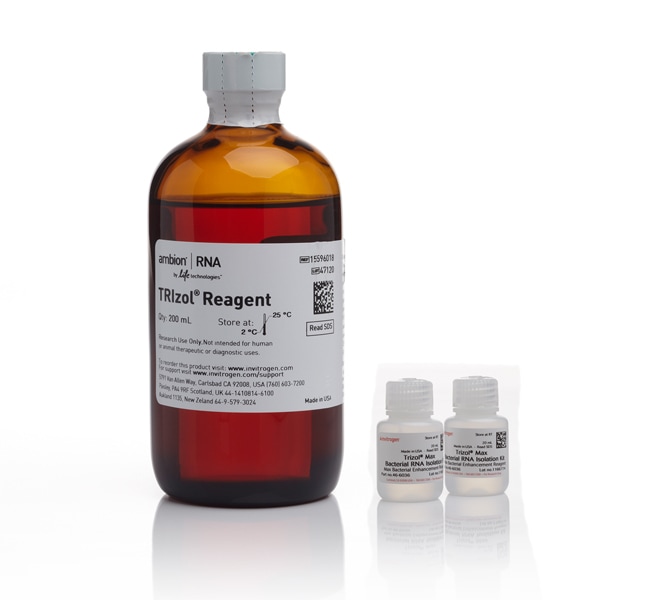
The TRIzol Reagent protocol specifies centrifugation speeds of 12,000 x g for 10 mins for RNA precipitation, but my centrifuge only goes up to 5,000 x g. Can I still perform my experiment?
Yes, centrifugation speeds as low as 5,000 to 6,000 x g have been used, but the centrifugation time should be doubled to get the expected yields.
Find additional tips, troubleshooting help, and resources within our RNA Sample Collection, Protection, and Isolation Support Center.
I accidentally added too much chloroform to my TRIzol Reagent reaction. What should I do?
If a large amount of chloroform was inadvertently added, you can add more TRIzol Reagent so that the ratio of 0.2 mL chloroform:1 mL TRIzol Reagent is maintained. If too much chloroform is added, this can drive the DNA, and eventually the protein, into the aqueous phase.
Find additional tips, troubleshooting help, and resources within our RNA Sample Collection, Protection, and Isolation Support Center.
I inadvertently added isopropanol instead of chloroform. What should I do?
If isopropanol is inadvertently added at this step instead of chloroform, add more isopropanol to precipitate everything, then resuspend the pellet in TRIzol Reagent and use the protocol as specified. RNA yields will be compromised, but it may be possible to obtain a product in RT-PCR. A detailed protocol follows:
(1) Add more isopropanol so that the total volume of isopropanol equals the volume of TRIzol Reagent used. Spin at 7500 x g for 10 min at 4 degrees C.
(2) Pour off supernatant; allow relatively compacted pellet to air dry (doesn't have to be completely dry, just reduce the volume of ispropanol).
(3) Estimate the size of the pellet in microliters; add at least 15–20 volumes of TRIzol Reagent (e.g., for a 100 µL pellet, add at least 1.5 mL TRIzol Reagent).
(4) Break the pellet up well (you may have to use a hand-held homogenizer). Store the solution for 10–15 min. at room temperature; every 5 min or so, shake it by hand to make certain it is well dispersed.
(5) Proceed with the TRIzol Reagent protocol as written (i.e., add chloroform). Results will not be optimal, but it may be possible to get a product in RT-PCR.
Find additional tips, troubleshooting help, and resources within our RNA Sample Collection, Protection, and Isolation Support Center.
What carrier do you recommend for isolation of RNA with TRIzol Reagent?
Glycogen can be included with your sample to improve yield, and remains with the RNA (glycogen is water soluble). Polyacrylamide can also be used as a carrier to precipitate small amounts of RNA.
Find additional tips, troubleshooting help, and resources within our RNA Sample Collection, Protection, and Isolation Support Center.
At what points can I stop in the protocol for TRIzol Reagent?
There are a couple of possible stopping points in the RNA extraction protocol as shown below:
•After homogenization (before addition of chloroform), samples can be stored at 4 degrees C overnight or at –70 degrees C for at least 1 year.
•Homogenized samples can sit at room temperature for several hours before chloroform is added.
•Homogenized samples can be thawed and refrozen prior to use (necessary when researcher intends to do experiment, but then cannot continue).
• After RNA precipitation, during RNA wash, the RNA can be stored in 75% ethanol for at least 1 year at –20 degreesC, or at least 1 week at 4 degrees C.
For DNA extraction, the phenol phase and interphase can be stored at 4 degrees C overnight before DNA precipitation. Some customers have tried storing at 4 degrees C for a week and –20 degrees C for a year and still got good recovery.
Find additional tips, troubleshooting help, and resources within our RNA Sample Collection, Protection, and Isolation Support Center.