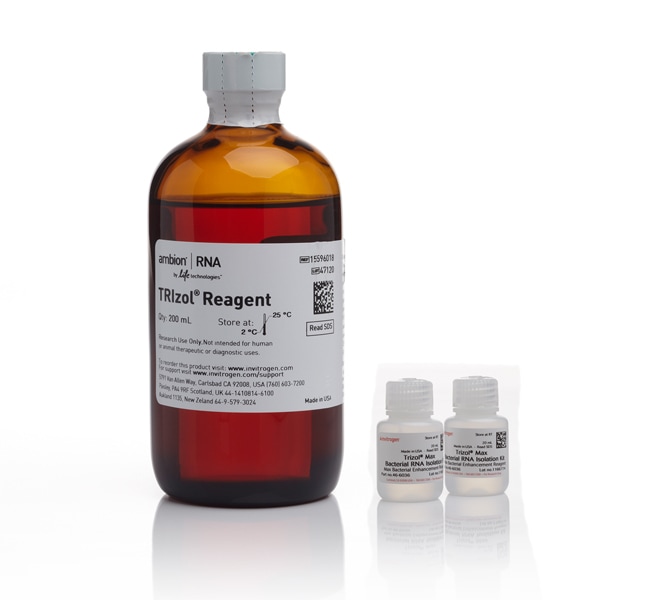
TRIzol™ Max™ 细菌 RNA 分离试剂盒
Invitrogen™

TRIzol™ Max™ 细菌 RNA 分离试剂盒

TRIzol™ Max™ 细菌 RNA 分离试剂盒提供了一种简单可靠的方法,可更好地从革兰氏阳性和革兰氏阴性细菌中分离完整的总 RNA。试剂盒利用 Max™ 细菌增强试剂和 TRIzol™了解更多信息
Have Questions?
更改视图buttonViewtableView
货号数量
16096040200 次制备
16096020100 Preps
货号 16096040
价格(CNY)
-
数量:
200 次制备
TRIzol™ Max™ 细菌 RNA 分离试剂盒提供了一种简单可靠的方法,可更好地从革兰氏阳性和革兰氏阴性细菌中分离完整的总 RNA。试剂盒利用 Max™ 细菌增强试剂TRIzol™ 试剂灭活内源性RNases ,促进蛋白变性,提高 RNA 质量和完整性。RNA 的分离大约需要一个小时。

TRIzol™ Max™ 细菌 RNA 分离试剂盒的主要特点:

•配制用于从革兰氏阳性和革兰氏阴性细菌中分离 RNA
•使用两种技术获得极高 RNA 得率和纯度
•通过消除酶促和机械裂解步骤,尽可能缩短 RNA 分离所需的时间

一个试剂盒中含有两种产品
TRIzol™ Max™ 细菌 RNA 分离试剂盒含有 Max™ 细菌增强试剂和 TRIzol™ 试剂。用含螯合剂、去污剂和缓冲液的 Max™ 细菌增强试剂对细菌进行 5 分钟预处理,使细菌蛋白变性并有效灭活内源性RNases 。随后通过 TRIzol™ 试剂进行细菌裂解,生成高质量、极轻微降解的 RNA 产物。

纯化 RNA 适用于与多种应用和产品配合使用
使用 TRIzol™ Max™ 细菌 RNA 分离试剂盒分离的细菌 RNA 适用下游应用,如实时荧光定量 PCR (qPCR)、RT-PCR、Northern 印迹、核酸酶保护试验、cDNA 合成、微阵列分析和斑点印迹杂交。

仅供科研使用。不适用于动物或人类诊断或治疗用途。
仅供科研使用。不可用于诊断程序。
规格
洗脱体积50 μL
最终产品类型总 RNA、转录组 RNA、micro RNA
适用于(应用)实时荧光定量 PCR (qPCR),逆转录酶 PCR (RT-PCR),cDNA 文库构建,核酸酶保护测定,Northern 印迹,克隆
高通量能力不兼容高通量应用(手动)
纯化时间1 个小时
数量200 次制备
运输条件室温
原始材料量多达 1 x 10^8 个细胞
产量70 µg
分离技术有机提取
样品类型细菌(革兰氏 +/-)
Unit SizeEach
内容与储存
包括 200 mL TRIzol™ 试剂和 2 x 20 mL Max 细菌增强试剂。

将 TRIzol™ 试剂存储在 2°C 至 25°C 下。Max 细菌增强试剂可在室温下储存。

常见问题解答 (FAQ)

我想从革兰氏阳性菌中分离RNA。你们推荐使用什么产品?是否需要改进裂解方案?

对于细菌样品,您可使用我们的TRIzol Max细菌RNA分离试剂盒(货号16096040),该试剂盒在匀浆时含有额外的试剂,有助于细菌细胞壁的裂解。您也可以使用我们的PureLinkRNA小量提取试剂盒(货号12183018A),使用该试剂盒时,需要准备溶菌酶溶液以溶解细胞壁。

I'd like to isolate RNA from gram-positive bacteria. What products can you recommend for me? Is a modified lysis protocol needed?

For bacterial samples, you could use our TRIzol Max Bacterial RNA Isolation Kit (Cat. No. 16096040), that contains an extra reagent during homogenization to help with lysis of the bacterial cell walls. You could also use our PureLink RNA Mini Kit (Cat. No. 12183018A), for which you would need to prepare a lyosyme solution to lyse the cell wall.

The TRIzol Reagent protocol specifies centrifugation speeds of 12,000 x g for 10 mins for RNA precipitation, but my centrifuge only goes up to 5,000 x g. Can I still perform my experiment?

Yes, centrifugation speeds as low as 5,000 to 6,000 x g have been used, but the centrifugation time should be doubled to get the expected yields.

Find additional tips, troubleshooting help, and resources within our RNA Sample Collection, Protection, and Isolation Support Center.

I accidentally added too much chloroform to my TRIzol Reagent reaction. What should I do?

If a large amount of chloroform was inadvertently added, you can add more TRIzol Reagent so that the ratio of 0.2 mL chloroform:1 mL TRIzol Reagent is maintained. If too much chloroform is added, this can drive the DNA, and eventually the protein, into the aqueous phase.

Find additional tips, troubleshooting help, and resources within our RNA Sample Collection, Protection, and Isolation Support Center.

I inadvertently added isopropanol instead of chloroform. What should I do?

If isopropanol is inadvertently added at this step instead of chloroform, add more isopropanol to precipitate everything, then resuspend the pellet in TRIzol Reagent and use the protocol as specified. RNA yields will be compromised, but it may be possible to obtain a product in RT-PCR. A detailed protocol follows:

(1) Add more isopropanol so that the total volume of isopropanol equals the volume of TRIzol Reagent used. Spin at 7500 x g for 10 min at 4 degrees C.
(2) Pour off supernatant; allow relatively compacted pellet to air dry (doesn't have to be completely dry, just reduce the volume of ispropanol).
(3) Estimate the size of the pellet in microliters; add at least 15–20 volumes of TRIzol Reagent (e.g., for a 100 µL pellet, add at least 1.5 mL TRIzol Reagent).
(4) Break the pellet up well (you may have to use a hand-held homogenizer). Store the solution for 10–15 min. at room temperature; every 5 min or so, shake it by hand to make certain it is well dispersed.
(5) Proceed with the TRIzol Reagent protocol as written (i.e., add chloroform). Results will not be optimal, but it may be possible to get a product in RT-PCR.

Find additional tips, troubleshooting help, and resources within our RNA Sample Collection, Protection, and Isolation Support Center.