Search

Thermo Scientific™
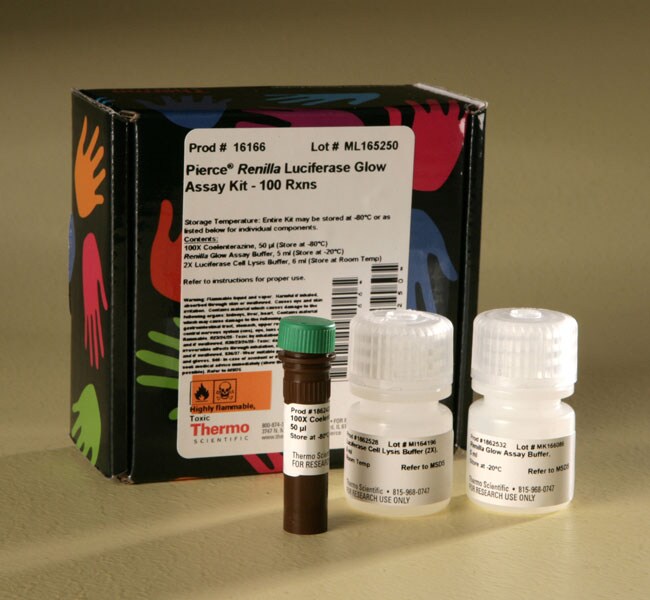
Pierce™ Renilla Luciferase Glow Assay Kit
Obtain bright and stable bioluminescence signal (half-life approx. 3 hour) in the presence of Renilla luciferase reporters.
Have Questions?
Change view

| Catalog Number | Quantity |
|---|---|
| 16166 | 100 Reaction Kit |
| 16167 | 1000 Reaction Kit |
Catalog number 16166
Price (CNY)
975.00
Online exclusive
Ends: 31-Dec-2026
1,335.00Save 360.00 (27%)
Each
Quantity:
100 Reaction Kit
Price (CNY)
975.00
Online exclusive
Ends: 31-Dec-2026
1,335.00Save 360.00 (27%)
Each
The Thermo Scientific Pierce Renilla Luciferase Glow Assay Kit provides an extremely bright and stable bioluminescence signal (half-life approx. 3 hours), especially in the presence of Green Renilla luciferase reporter.
Features of the Renilla Luciferase Glow Assay Kit:
- Sensitive—highly sensitive detection of Green Renilla luciferase activity
- Stable—increased signal stability compared to flash assays
- Simple—does not require a luminometer with injectors
- Compatible—assay reagents compatible with other Renilla luciferases
- Automation-friendly—amenable to high throughput assays
- Convenient—contains a universal cell lysis buffer and optimized glow assay reagent
- Safe—allows one to perform non-radioactive assays
This Pierce Luciferase Glow Assay Kit contains reagents for measuring the activity of Renilla luciferase in cell lysates. In the presence of luciferase, the glow reagent provides stable bioluminescent signal and is highly suited for luminometers without injectors or for batch processing of samples. The light output generated by the luciferase reaction can be correlated with the amount of luciferase protein produced which in turn is proportional to the promoter activity driving the luciferase expression. The glow assay reagents were optimized for best results with Thermo Scientific Green Renilla Luc Plasmids; however, this glow kit may be used to detect the activity of other Renilla luciferase derivatives that use coelenterazine as a substrate.
Includes:
Cell lysis buffer, reaction buffer and substrate
Requires:
Renilla luciferase and luminometer or other instrument capable of monitoring luminescence, such as the Varioskan ALF or the Varioskan LUX microplate readers.
Applications:
- Promoter studies for analyzing cis- regulatory elements and trans-acting factors
- Drug screening
- siRNA and miRNA screening
- Multiplexed assays to study off-target effects
- Protein localization reporter assays
- Signal transduction pathway analysis
- RNA splicing studies
The Green Renilla luciferase is a 36kDa protein produced by a derivative of the wild type Renilla luciferase gene from the sea pansy, Renilla reniformis. Compared to the wild type luciferase, Green Renilla is more stable in serum and has an the emission spectrum that is shifted toward the green region. The protein provides extremely bright flash signal that decays rapidly. The Pierce Renilla Glow Assay Kit reagent effectively stabilizes this bright bioluminescence to yield a signal half-life greater than 3 hours, thus eliminating the need for a luminometer with injectors. The assay kit was optimized for best results with Thermo Scientific Green Renilla Luc Plasmids; however, this glow kit may be used to detect the activity of other Renilla luciferase derivatives that use coelenterazine as a substrate.
Related Products
Pierce™ Renilla-Firefly Luciferase Dual Assay Kit (Cat. No. 16185)
For Research Use Only. Not for use in diagnostic procedures.
The Green Renilla luciferase is a 36kDa protein produced by a derivative of the wild type Renilla luciferase gene from the sea pansy, Renilla reniformis. Compared to the wild type luciferase, Green Renilla is more stable in serum and has an the emission spectrum that is shifted toward the green region. The protein provides extremely bright flash signal that decays rapidly. The Pierce Renilla Glow Assay Kit reagent effectively stabilizes this bright bioluminescence to yield a signal half-life greater than 3 hours, thus eliminating the need for a luminometer with injectors. The assay kit was optimized for best results with Thermo Scientific Green Renilla Luc Plasmids; however, this glow kit may be used to detect the activity of other Renilla luciferase derivatives that use coelenterazine as a substrate.
General References:
- Lorenz, W.W., et al. (1991). Proc. Natl. Acad. Sci. USA, 88:4438-4442.
Specifications
AssayReporter Enzyme, Luciferase Reporter Assay
Compatible CellsMammalian Cells
Detection MethodBioluminescence
For Use With (Equipment)Luminometer
Format96-well Plate, 384-well Plate
Label TypeEnzyme Labeled
Product LinePierce
Quantity100 Reaction Kit
SubstrateCoelenterazine
Substrate PropertiesChemical Substrate
Substrate TypeLuciferase Substrate
TargetLuciferase, Green Renilla Luciferase
TechniqueEnhanced Chemiluminescence
TypeAssay Kit
Unit SizeEach
Contents & Storage
Upon receipt store kit at -80°C or store individual components as indicated above.
• Renilla Glow Assay Buffer, 5 mL, store at 4°C
• Coelenterazine (100X), 50 μL, store at -80°C
• 2X Cell Lysis Buffer, 6 mL, store at room temperature
• Renilla Glow Assay Buffer, 5 mL, store at 4°C
• Coelenterazine (100X), 50 μL, store at -80°C
• 2X Cell Lysis Buffer, 6 mL, store at room temperature