Search

Gibco™
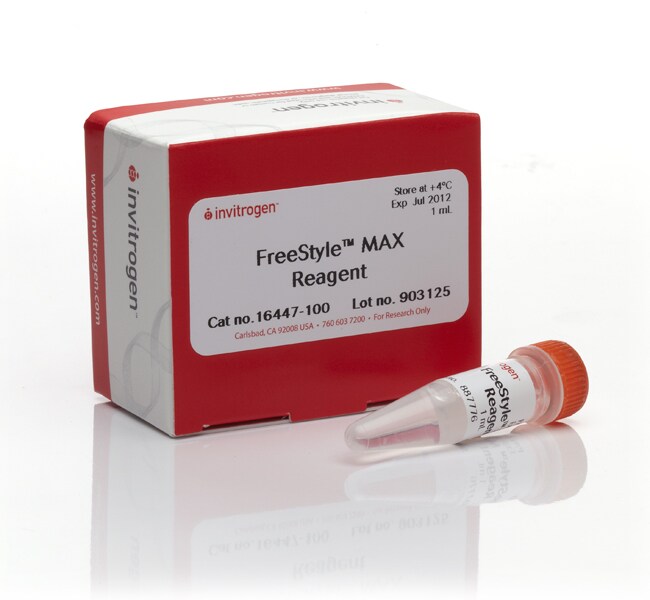
FreeStyle™ MAX 试剂
FreeStyle™ MAX 试剂是一种专有的非动物源性制剂,用于将质粒 DNA 转染到真核细胞中,其可轻松扩大以生产大量重组蛋白。FreeStyle™ MAX 试剂可在生物生产应用中获得极高表达水平和转染率,细胞毒性较低,并经过特殊配制可与以下产品配合使用:•无血清 FreeStyle™ 293了解更多信息
Have Questions?
更改视图

| 货号 | 数量 |
|---|---|
| 16447100 | 1 mL |
| 16447500 | 15 mL |
| 16447750 | 10 x 15 mL |
货号 16447100
价格(CNY)
12,808.00
Each
数量:
1 mL
价格(CNY)
12,808.00
Each
FreeStyle™ MAX 试剂是一种专有的非动物源性制剂,用于将质粒 DNA 转染到真核细胞中,其可轻松扩大以生产大量重组蛋白。FreeStyle™ MAX 试剂可在生物生产应用中获得极高表达水平和转染率,细胞毒性较低,并经过特殊配制可与以下产品配合使用:
•无血清 FreeStyle™ 293 表达培养基(货号 12338-018)中的 FreeStyle™ 293-F 细胞(悬浮人胚肾细胞,货号 R790-07)
•无血清 FreeStyle™ CHO 表达培养基(货号 12651-014)中的 FreeStyle™ CHO-S 细胞(悬浮中国仓鼠卵巢细胞,货号 R800-07)
•含 8 mM L-谷氨酰胺和 18 mL/L 10% Pluronic™ F-68 的 CD DG44 培养基(货号 A11000-01)中的 DG44 细胞(DHFR– 悬浮 CHO 细胞)
产品用途
FreeStyle™ MAX 试剂预期用于与 FreeStyle™ MAX 293 表达系统(货号 K9000-10)和 FreeStyle™ MAX CHO 表达系统(货号 K9000-20)配合使用。
•无血清 FreeStyle™ 293 表达培养基(货号 12338-018)中的 FreeStyle™ 293-F 细胞(悬浮人胚肾细胞,货号 R790-07)
•无血清 FreeStyle™ CHO 表达培养基(货号 12651-014)中的 FreeStyle™ CHO-S 细胞(悬浮中国仓鼠卵巢细胞,货号 R800-07)
•含 8 mM L-谷氨酰胺和 18 mL/L 10% Pluronic™ F-68 的 CD DG44 培养基(货号 A11000-01)中的 DG44 细胞(DHFR– 悬浮 CHO 细胞)
产品用途
FreeStyle™ MAX 试剂预期用于与 FreeStyle™ MAX 293 表达系统(货号 K9000-10)和 FreeStyle™ MAX CHO 表达系统(货号 K9000-20)配合使用。
仅供科研使用。不可用于诊断程序。
规格
分类无动物来源
适用于(应用)转染
高通量能力不兼容高通量应用(手动)
产品线Freestyle
产品类型转染试剂
数量1 mL
血清兼容性是
运输条件湿冰
细胞类型已建立的细胞系
样品类型质粒 DNA
转染技术脂质体介导转染
Unit SizeEach
内容与储存
每单位包含一小瓶试剂。储存在 +4°C 下。妥善储存时,保证 FreeStyle™ MAX 稳定储存 6 个月。