Search


引用和文献 (20)
Invitrogen™
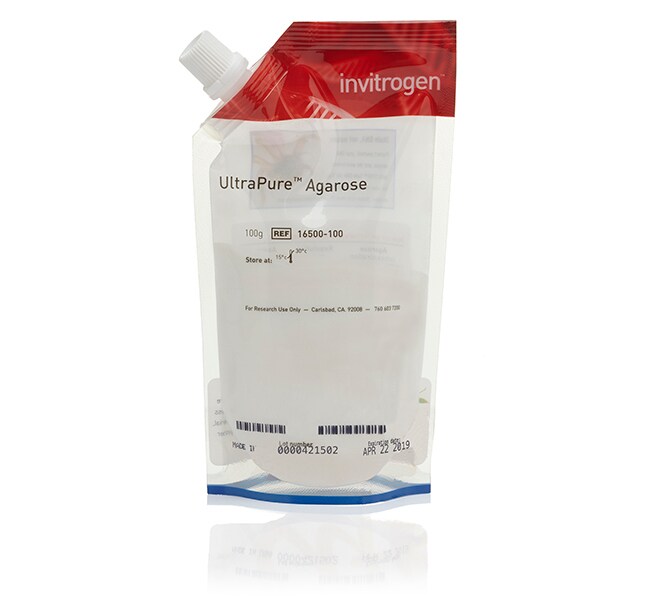
UltraPure™ 琼脂糖
UltraPure™ 琼脂糖是一种多糖,用于在琼脂糖凝胶电泳应用中筛分核酸。UltraPure™ 琼脂糖非常适合分离 100 bp 至 >30 kb 的了解更多信息
Have Questions?
更改视图

| 货号 | 数量 |
|---|---|
| 16500100 | 100 g |
| 16500500 | 500 g |
货号 16500100
价格(CNY)
1,402.00
飞享价
Ends: 31-Dec-2026
2,879.00共减 1,477.00 (51%)
Each
数量:
100 g
价格(CNY)
1,402.00
飞享价
Ends: 31-Dec-2026
2,879.00共减 1,477.00 (51%)
Each
UltraPure™ 琼脂糖是一种多糖,用于在琼脂糖凝胶电泳应用中筛分核酸。UltraPure™ 琼脂糖非常适合分离 100 bp 至 >30 kb 的 DNA 和 RNA 片段。UltraPure™ 琼脂糖的特性:
•非常适合在常规应用中分析和回收 DNA 和 RNA
•强凝胶结构可更好地进行处理并减少破损
•可用于蛋白电泳应用,如双向免疫扩散(抗原-抗体相互作用分析)和单向免疫扩散 (RID)(抗原定量分析)
改善包装
新型环保包装使用的塑料量比原始瓶少 75%。这意味着在制造过程中消耗更少的能源和原材料,垃圾填埋场的废弃物也更少。此外,简易倒口减少了溢出和污染的可能性。
性能和质量检测
UltraPure™ 琼脂糖的性能经评价可满足外观、水分、凝胶强度、凝胶温度、熔化温度、硫酸盐含量、电内渗和 DNase/RNase 活性的设定质量标准。
•非常适合在常规应用中分析和回收 DNA 和 RNA
•强凝胶结构可更好地进行处理并减少破损
•可用于蛋白电泳应用,如双向免疫扩散(抗原-抗体相互作用分析)和单向免疫扩散 (RID)(抗原定量分析)
改善包装
新型环保包装使用的塑料量比原始瓶少 75%。这意味着在制造过程中消耗更少的能源和原材料,垃圾填埋场的废弃物也更少。此外,简易倒口减少了溢出和污染的可能性。
性能和质量检测
UltraPure™ 琼脂糖的性能经评价可满足外观、水分、凝胶强度、凝胶温度、熔化温度、硫酸盐含量、电内渗和 DNase/RNase 活性的设定质量标准。
仅供科研使用。不可用于诊断程序。
规格
适用于(应用)凝胶电泳
形式粉末
凝胶兼容性琼脂糖凝胶
熔点标准熔点
数量100 g
运输条件室温
产品线UltraPure
产品类型琼脂糖
分离范围100 bp 至 >30 kb
Unit SizeEach
内容与储存
目录:1 袋,含 100 g UltraPure™ 琼脂糖
储存:15°C 至 30°C
储存:15°C 至 30°C
常见问题解答 (FAQ)
我想自己灌胶,你们推荐用什么琼脂糖?
I want to pour my own gels. Which agarose should I use?
引用和文献 (20)
引用和文献
Abstract
Proteomic analysis reveals presence of platelet microparticles in endothelial progenitor cell cultures.
Journal:Blood
PubMed ID:19369228
'The concept of endothelial progenitor cells (EPCs) has attracted considerable interest in cardiovascular research, but despite a decade of research there are still no specific markers for EPCs and results from clinical trials remain controversial. Using liquid chromatography-tandem mass spectrometry, we analyzed the protein composition of microparticles (MPs) originating from
A phantom for diffusion-weighted MRI (DW-MRI).
Journal:J Magn Reson Imaging
PubMed ID:23576443
'PURPOSE: To develop tissue-equivalent diffusivity materials and build a spherical diffusion phantom which mimics the conditions typically found in biological tissues. Also, to assess the reproducibility of ADC measurements from a whole-body diffusion protocol. MATERIALS AND METHODS: Nickel-doped agarose/sucrose gels were manufactured and used to build a spherical diffusion phantom
Determinants of nucleosome organization in primary human cells.
Journal:Nature
PubMed ID:21602827
'Nucleosomes are the basic packaging units of chromatin, modulating accessibility of regulatory proteins to DNA and thus influencing eukaryotic gene regulation. Elaborate chromatin remodelling mechanisms have evolved that govern nucleosome organization at promoters, regulatory elements, and other functional regions in the genome. Analyses of chromatin landscape have uncovered a variety
Controlling cell position in complex heterotypic 3D microtissues by tissue fusion.
Journal:Biotechnol Bioeng
PubMed ID:19012266
'Tissue fusion and cell sorting are processes fundamental to developmental biology with applications in tissue engineering. We have designed a fusion assay to investigate the factors governing the fusion of microtissues and the cell sorting that occurs after fusion. Normal human fibroblast (NHF) spheroids were self-assembled and cultured for 1,
Host alternation of chikungunya virus increases fitness while restricting population diversity and adaptability to novel selective pressures.
Journal:J Virol
PubMed ID:21047966
'The mechanisms by which RNA arboviruses, including chikungunya virus (CHIKV), evolve and maintain the ability to infect vertebrate and invertebrate hosts are poorly understood. To understand how host specificity shapes arbovirus populations, we studied CHIKV populations passaged alternately between invertebrate and vertebrate cells (invertebrate ? vertebrate) to simulate natural alternation