Search


引用和文献 (3)
Gibco™
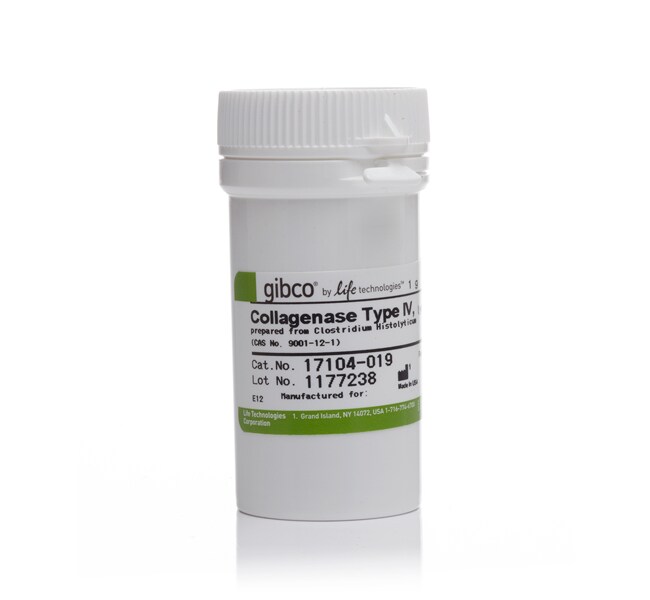
IV 型胶原酶,粉末
胶原酶是一种蛋白酶,其可以切割 Pro-X-Glyc-Pro 序列(常见于胶原蛋白)中的中性氨基酸 (X) 与甘氨酸之间的键。在蛋白酶中,只有胶原酶能够降解常见于皮肤、肌腱、血管和骨骼等结缔组织的三螺旋天然胶原纤维了解更多信息
| 货号 | 数量 |
|---|---|
| 17104019 | 1 g |
货号 17104019
价格(CNY)
2,365.00
飞享价
Ends: 26-Sep-2026
5,269.00共减 2,904.00 (55%)
Each
数量:
1 g
价格(CNY)
2,365.00
飞享价
Ends: 26-Sep-2026
5,269.00共减 2,904.00 (55%)
Each
胶原酶是一种蛋白酶,其可以切割 Pro-X-Glyc-Pro 序列(常见于胶原蛋白)中的中性氨基酸 (X) 与甘氨酸之间的键。在蛋白酶中,只有胶原酶能够降解常见于皮肤、肌腱、血管和骨骼等结缔组织的三螺旋天然胶原纤维。胶原酶解聚适用于人类肿瘤、小鼠肾脏、成人和胎儿大脑以及许多其他组织(包括上皮细胞)的培养。胶原酶相对温和,在生理温度和 pH 值条件下具有良好的解离能力,无需机械搅拌或特殊设备。
Gibco™ IV 型胶原酶分离自溶组织梭菌,包装形式为冻干非无菌粉末,供细胞或组织解离以及器官灌注等研究使用。我们保证 Gibco™ IV 型胶原酶的活性大于 160 单位/mg。与其他胶原酶制剂相比,Gibco™ IV 型胶原酶具有低胰蛋白酶活性,非常适合消化胰腺的胰岛细胞。
Gibco™ IV 型胶原酶分离自溶组织梭菌,包装形式为冻干非无菌粉末,供细胞或组织解离以及器官灌注等研究使用。我们保证 Gibco™ IV 型胶原酶的活性大于 160 单位/mg。与其他胶原酶制剂相比,Gibco™ IV 型胶原酶具有低胰蛋白酶活性,非常适合消化胰腺的胰岛细胞。
仅供科研使用。不可用于诊断程序。
规格
数量1 g
有效期24 个月
运输条件室温
形式冻干
产品类型胶原酶
无菌未灭菌
Unit SizeEach
内容与储存
储存条件:2°C 至 8°C。避光储存。
运输条件:室温
有效期:自生产之日起 24 个月
运输条件:室温
有效期:自生产之日起 24 个月
常见问题解答 (FAQ)
为何即使在胶原酶IV的分离时间(37°C条件下30-60分钟,实际效果视特定批次而定)比分散酶更长的情况下,也最好使用IV型胶原酶而不是分散酶?
你们提供哪些用于解离细胞的试剂?这些产品之间的主要区别是什么?
How do I make the 1000X stock (100 U/µL) solution from Collagenase powder?
Why is collagenase type IV favored over dispase even though the dissociation with collagenase IV seems to take longer (between 30 and 60 min, depending from the lot, at 37 degrees C) compared to dispase?
What reagents do you offer for cell dissociation, and what are the main differences between them?
引用和文献 (3)
引用和文献
Abstract
Isolation and in vitro culture of primary cardiomyocytes from adult zebrafish hearts.
Journal:Nat Protoc
PubMed ID:23538883
'This protocol describes how to isolate primary cardiomyocytes from adult zebrafish hearts and culture them for up to 4 weeks, thereby using them as an alternative to in vivo experiments. After collagenase digestion of the ventricle, cells are exposed to increasing calcium concentrations in order to obtain high-purity cardiomyocytes. The
Production of hepatocyte-like cells from human pluripotent stem cells.
Journal:Nat Protoc
PubMed ID:23424751
Large-scale production of hepatocytes from a variety of genetic backgrounds would be beneficial for drug screening and to provide a source of cells to be used as a substitute for liver transplantation. However, fully functional primary hepatocytes remain difficult to expand in vitro, and circumventing this problem by using an
Feeder layer- and serum-free culture of human embryonic stem cells.
Journal:Biol Reprod
PubMed ID:14627547
In addition to their contribution to the research on early human development, human embryonic stem (hES) cells may also be used for cell-based therapies. Traditionally, these cells have been cultured on mouse embryonic fibroblast feeder layers, which allow their continuous growth in an undifferentiated state. However, the use of hES