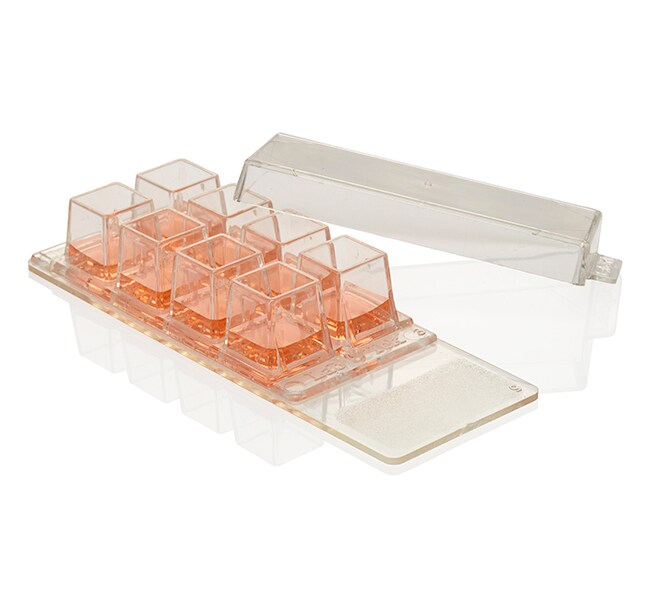
What cell density should I use for Lab-Tek Chambered Slides and Lab-Tek II Chambered Slides?
Unfortunately, we do not have a recommended cell density for our LabTek Chamber Slides. However, you can refer to the following link, which provides recommended cell densities for our other cell culture products:
https://www.thermofisher.com/us/en/home/references/gibco-cell-culture-basics/cell-culture-protocols/cell-culture-useful-numbers.html
What is the difference between your original Nunc Lab-Tek Chamber Slide System and your Nunc Lab-Tek II Chamber Slide System?
Please review the following key differences between the Nunc Lab-Tek Chamber Slide System and the Nunc Lab-Tek II Chamber Slide System:
- The Nunc Lab-Tek Chamber Slide System is available in Permanox plastic or glass and incorporates a silicone gasket.
- The Nunc Lab-Tek II Chamber Slide System is available in glass only and do not have a silicone gasket.
- The Nunc Lab-Tek II Chamber Slide System has a blue hydrophobic border and the upper structure is attached by an adhesive. Supplied with this product is a key and holder system which is used to remove the upper structure from the glass slide.
- The Nunc Lab-Tek Chamber Slide System is available in 1-, 2-, 4-, 8- or 16-well formats.
- The Nunc Lab-Tek II Chamber Slide System is available in 1-, 2-, 4- or 8-well formats.
Why do cells grow in lines when I am using glass Nunc Lab-Tek Chamber Slide products? How can I prevent this?
The following are possible causes and solutions:
- The cells could be stressed due to media substitution, especially from serum-free formulations, or other changes to the culture environment such as in temperature, humidity, and CO2 percentage. If possible, always plate cells in serum-containing medium. Switching cells to a serum-free media should be done gradually.
- The cells could be plated at very low densities. Most cell lines have a minimal platting density below which normal cell proliferation cannot occur, and therefore should be avoided.
- The cells could be poorly adherent. Treatment of cells that may reduce adhesion and therefore, should not be done immediately after plating, but after the cells have resumed exponential growth.
Can I fix and stain my Nunc Lab-Tek Chamber Slide products with the upper structure still attached?
The upper structure of our Nunc Lab-Tek Chamber Slide products are made of polystyrene so it is not compatible with many fixation reagents. These chamber slide products are designed for upper structure and gasket removal before fixing, staining, and coverslipping.
Can I use my Nunc Lab-Tek Chamber Slide products for fluorescence applications?
Our Nunc Lab-Tek Chamber Slide products are used for fluorescence analyses at the microscopic level.
The following are commonly used excitation and emittance wavelengths:
FITC
- Excitation: 420-490 nm
- Emittance: 520-550 nm
Rhodamine
- Excitation: 510-560 nm
- Emittance: 570-610 nm
Hoechst
- Excitation: 330-380 nm
- Emittance: 480-510 nm