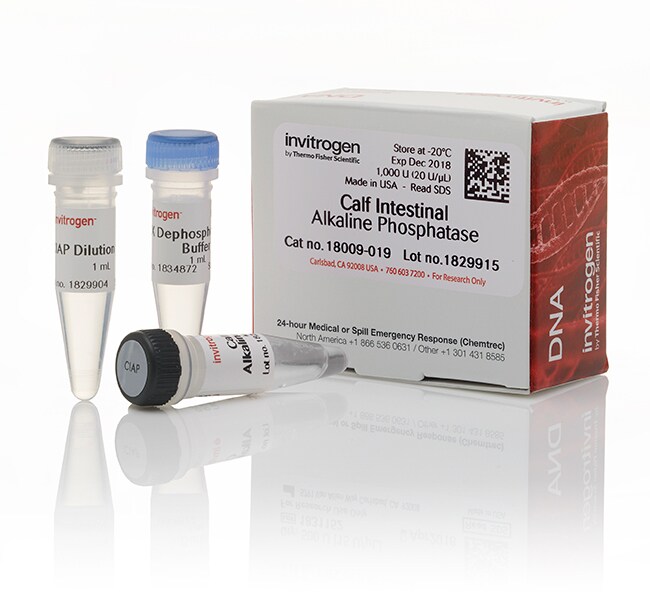
CIAP(小牛肠碱性磷酸酶),20 U/μL
Invitrogen17万+抗体限时买二赠一,靶点广,灵活用!
CIAP(小牛肠碱性磷酸酶),20 U/μL
Invitrogen™

CIAP(小牛肠碱性磷酸酶),20 U/μL

小牛肠碱性磷酸酶 (CIAP) 是一种磷酸单酯酶,可去除 DNA 和 RNA 中的3´ 和5´ 磷酸盐。浓度:20单位/μL应用:载体了解更多信息
Have Questions?
货号数量
180090191000 U
货号 18009019
价格(CNY)
694.00
Each
添加至购物车
数量:
1000 U
请求批量或定制报价
价格(CNY)
694.00
Each
添加至购物车
小牛肠碱性磷酸酶 (CIAP) 是一种磷酸单酯酶,可去除 DNA 和 RNA 中的3´ 和5´ 磷酸盐。

浓度:20单位/μL

应用:
载体 DNA 的5´-磷酸化末端的去磷酸化作用,防止自身连接 (1)。激酶正向反应前核酸5´末端的去磷酸化。

来源:从小牛肠粘膜纯化。

性能和质量测试:
脱氧核糖核酸内切酶、3´ 脱氧核糖核酸外切酶及核糖核酸酶分析;在转化试验中测定去磷酸化效率。

单位定义:
37°C 下,一个单位经1分钟水解1 μmol 的4-磷酸硝基苯酯。

单位反应条件:
1M 二乙醇胺缓冲液,10 mM 4-磷酸硝基苯酯,0.25 mM MgCl2 (pH 9.8),900μl,10分钟,37°C 下。
仅供科研使用。不可用于诊断程序。
规格
产品类型碱性磷酸酶
数量1000 U
运输条件经批准可置于湿冰或干冰上运输
最大浓度20 U/μL
CIP
Unit SizeEach
内容与储存
小牛肠碱性磷酸酶(20单位/μL)随附一瓶10X 去磷酸化缓冲液 [500 mM Tris-HCl (pH 8.5),1 mM EDTA],一瓶稀释缓冲液 [50% glycerol,25 mM Tris-HCl (pH 7.6),1 mM MgCl2 和0.1 mM ZnCl2 ]。小牛肠碱性磷酸酶储存在 -20°C 下。

常见问题解答 (FAQ)

进行限制性内切酶克隆除了连接酶以外还需要什么酶?

对载体进行去磷酸化以降低背景时可以使用:
热失活的碱性磷酸酶,或
牛小肠碱性磷酸酶(提供1 unit/μL或20 units/μL)规格)

如果需要获得磷酸化的DNA平末端(“补平”末端),您可以使用:
可以用DNA End Repair Mix或T4 DNA 聚合酶或E. coli DNA聚合酶Klenow片段(大片段)来产生平末端,因为它们有5’ →3’DNA聚合酶活性(补齐5’突出端)和3’→5’外切酶活性(切除3’突出端)。

去除5’磷酸基团,应使用什么酶?添加磷酸基团,应使用什么酶?

CIP/CIAP 或BAP可以对DNA/RNA的5’端去磷酸化;T4多核苷酸激酶可以添加磷酸基团。

What other enzymes besides ligase may I need to perform restriction cloning?

Dephosphorylating the vector to decrease background can be achieved with:
Heat Inactivated Alkaline Phosphatase, or Calf Intestinal Alkalline Phosphatase (available as 1 unit/µL or 20 units/µL)

If you need to create blunt phosphorylated DNA ends (“polishing” the ends), you can use:
DNA End Repair Mix or T4 DNA polymerase or Klenow Fragment (large fragment) of E. coli DNA polymerase to generate blunt ends due to their 5' to 3' DNA polymerase activity (filling-in of 5' overhangs) and 3' to 5' exonuclease activity (chewing back of 3' overhangs).

What enzymes can be used to remove 5' phosphate groups, and what enzyme can be used to add the phosphate groups back on?

CIP/CIAP or BAP can dephosphorylate the 5' ends of DNA/RNA. T4 Polynucleotide Kinase can add back phosphate groups.

Why are alkaline phosphatases used in cloning protocols? What is a typical protocol for dephosphorylation of nucleic acids?

Alkaline phosphatases are used to dephosphorylate the 5' ends of DNA. In cloning, it is used to prevent self-ligation of vector DNA. Standard ligation of DNA with ligase requires a 5' phosphate to be present on at least one of the ends being joined. When a DNA insert containing phosphates on both 5' termini is added to a dephosphorylated vector, the insert will be efficiently ligated into the vector, but the vector will not be able to self-ligate. Thus, dephosphorylation of vector lowers the number of background colonies containing vector without insert.