Search


引用和文献 (6)
Invitrogen™
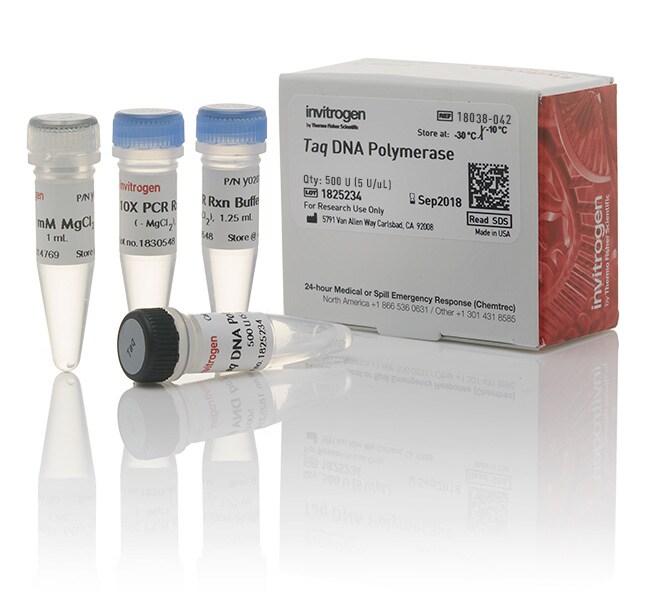
Taq DNA 聚合酶(野生型)
Taq DNA 聚合酶是一种耐热酶,在存在 dNTP 和引物的情况下,可从单链模板合成 DNA。该酶由94 kDa 分子量的单一多肽组成。其具有5´→3´了解更多信息
Have Questions?
更改视图

| 货号 | 数量 |
|---|---|
| 18038042 | 500 单位 |
| 18038018 | 100 单位 |
| 18038067 | 3 x 500 单位 |
| 18038240 | 5000 单位 |
货号 18038042
价格(CNY)
2,885.00
飞享价
Ends: 31-Dec-2026
4,122.00共减 1,237.00 (30%)
Each
数量:
500 单位
价格(CNY)
2,885.00
飞享价
Ends: 31-Dec-2026
4,122.00共减 1,237.00 (30%)
Each
Taq DNA 聚合酶是一种耐热酶,在存在 dNTP 和引物的情况下,可从单链模板合成 DNA。该酶由94 kDa 分子量的单一多肽组成。其具有5´→3´ DNA 聚合酶活性和5´→3´核酸外切酶活性(见图)。使用 Taq DNA 聚合酶,您可以获得:
重组酶或野生型酶的选择 PCR 产物扩增的大小高达5 kb 经许可和 PCR 质量认定的酶
应用
从复杂基因组、病毒和质粒模板扩增 DNA、RT-PCR、ssDNA 测序和循环测序
来源
野生型酶是从水生栖热菌 YT1中纯化而来的。
单位定义
一个单位的 Taq DNA 聚合酶是在74°C 下30分钟内将10nmol 脱氧核苷酸掺入 DNA 中所需的酶量
应用
从复杂基因组、病毒和质粒模板扩增 DNA、RT-PCR、ssDNA 测序和循环测序
来源
野生型酶是从水生栖热菌 YT1中纯化而来的。
单位定义
一个单位的 Taq DNA 聚合酶是在74°C 下30分钟内将10nmol 脱氧核苷酸掺入 DNA 中所需的酶量
仅供科研使用。不可用于诊断程序。
规格
外切核酸酶活性5' - 3'
保真度(相对于 Taq)1 X
产品规格单酶
热启动否
反应次数500 次反应
突出端3'-A
聚合酶Taq DNA 聚合酶
产品类型DNA 聚合酶
数量500 单位
反应形式分离组分
运输条件湿冰或干冰
尺寸(最终产品)5 kb或更小
原始材料DNA
最大浓度5 U/μL
适用于(应用)Standard PCR
高 GC PCR 扩增效果低
PCR 方法qPCR, 常规 PCR
反应速度标准
Unit SizeEach
内容与储存
包含:
• 100 μL Taq DNA 聚合酶 (5 U/μL)
• 2.5 mL 10X PCR 缓冲液(不含镁)
• 1 ml 氯化镁 (50 mM)
在 -20°C 的非无霜冷柜中储存。妥善储存的情况下,稳定6个月。
• 100 μL Taq DNA 聚合酶 (5 U/μL)
• 2.5 mL 10X PCR 缓冲液(不含镁)
• 1 ml 氯化镁 (50 mM)
在 -20°C 的非无霜冷柜中储存。妥善储存的情况下,稳定6个月。
常见问题解答 (FAQ)
当我用凝胶电泳检测时,我的寡核苷酸似乎没有显示出正确长度。这是为什么?
我所使用的引物刚开始时可以用来做PCR的,但是随着时间的推移它失效了。这是什么情况?
在我定制的寡核苷酸管中没有看到沉淀。我是否应该要求换货?
在我的寡核苷酸管子底部有球状的沉淀。这是什么?我的寡核苷酸还能再用吗?
我的冻干寡核苷酸是绿色的。还能再用吗?
引用和文献 (6)
引用和文献
Abstract
Biosensor detection systems: engineering stable, high-affinity bioreceptors by yeast surface display.
Journal:Methods Mol Biol
PubMed ID:19159105
'Over the past two decades, the field of biosensors has been developing fast, portable, and convenient detection tools for various molecules of interest, both biological and environmental. Although much attention is paid to the transduction portion of the sensor, the actual bioreceptor that binds the ligand is equally critical. Tight,
Role of de novo DNA methyltransferases and methyl CpG-binding proteins in gene silencing in a rat hepatoma.
Journal:J Biol Chem
PubMed ID:11844796
'The expression of metallothionein-I (MT-I), a known antioxidant, was suppressed in a transplanted rat hepatoma because of promoter methylation and was induced by heavy metals only after demethylation by 5-azacytidine (5-AzaC). Treatment of the tumor-bearing rats with 5-AzaC resulted in significant regression of the hepatoma. When the inhibitor-treated tumor was
Estrogen receptor alpha-mediated silencing of caveolin gene expression in neuronal cells.
Journal:J Biol Chem
PubMed ID:12138116
'Estrogen receptors (ER alpha/ER beta) are expressed in neuronal cells and exhibit a variety of activities in the central nervous system. ER activity is regulated in a ligand-dependent manner and by co-regulatory factors. Caveolin-1 is a recently identified co-activator of ER alpha mediating the ligand-independent activation of this steroid receptor.
Allurin, a 21-kDa sperm chemoattractant from Xenopus egg jelly, is related to mammalian sperm-binding proteins.
Journal:Proc Natl Acad Sci U S A
PubMed ID:11562501
Previously, we demonstrated that a protein from Xenopus egg jelly exhibits sperm chemoattractant activity when assayed by either video microscopy or by sperm passage across a porous filter. Here we describe the isolation and purification of allurin, the protein responsible for this activity. Freshly oviposited jellied eggs were soaked in
The polycystic kidney disease-1 promoter is a target of the beta-catenin/T-cell factor pathway.
Journal:J Biol Chem
PubMed ID:12048202
Polycystic kidney disease (PKD) results from loss-of-function mutations in the PKD1 gene. There are also reports showing abnormally high levels of PKD1 expression in cystic epithelial cells. At present, nothing is known about the molecular mechanisms regulating the normal expression of the PKD1 gene or whether transcriptional disregulation of the