Search


引用和文献 (12)
Invitrogen™
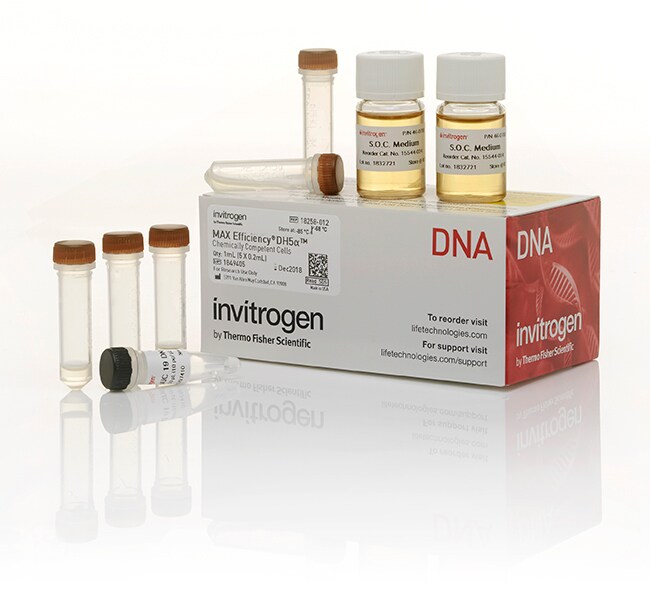
MAX Efficiency™ DH5α 感受态细胞
MAX Efficiency DH5α 感受态细胞是一种众所周知的通用细胞株,可用于许多日常克隆应用。除了支持蓝白斑筛选,DH5α 细胞中的 recA1 和 endA1 突变可增加插入片段稳定性并提高小提中制备的质粒了解更多信息
| 货号 | 数量 |
|---|---|
| 18258012 | 5 x 200μL |
货号 18258012
价格(CNY)
1,756.00
飞享价
Ends: 31-Dec-2026
2,195.00共减 439.00 (20%)
Each
数量:
5 x 200μL
价格(CNY)
1,756.00
飞享价
Ends: 31-Dec-2026
2,195.00共减 439.00 (20%)
Each
MAX Efficiency DH5α 感受态细胞是一种众所周知的通用细胞株,可用于许多日常克隆应用。除了支持蓝白斑筛选,DH5α 细胞中的 recA1 和 endA1 突变可增加插入片段稳定性并提高小提中制备的质粒 DNA 的质量。
MAX Efficiency DH5α 感受态细胞的特点包括:
•转化效率高达 1 × 10⁹ 转化体/μg 质粒 DNA
•可使用 DH5α (endA1) 大肠杆菌细胞株获得高质粒得率
•支持蓝白斑筛选 (lacZΔM15)
•插入片段稳定性更高 (recA1)
关于 MAX Efficiency DH5α 感受态细胞
MAX Efficiency DH5α 感受态细胞通过 Hanahan 程序的专利改良版进行制备 (1983)。这些细胞适用于构建基因库或使用质粒衍生载体生成 cDNA 文库。Φ80lacZΔM15 标志物提供了来自 pUC 或类似载体的 β-半乳糖苷酶基因的α-互补,因此可用于含有 Bluo-gal 或 X-gal 的细菌平板上菌落的蓝白斑筛选。使用较大质粒能够高效转化 DH5α 细胞,如果提供 DH5α-FT、DH5αF′、DH5αF′IQ、JM101 或 JM107 苔以便斑块形成,则还可将其用作 M13mp 克隆载体的宿主。
基因型:F- Φ80lacZΔM15 Δ(lacZYA-argF) U169 recA1 endA1 hsdR17 (rk-, mk+) phoA supE44 λ-thi-1 gyrA96 relA1
查找您需要的细胞株和规格
DH5α 细胞具有多种转化效率,有电转感受态和化学感受态两种规格,且为单次使用等份试液。
•Subcloning Efficiency DH5α 感受态细胞—我们极为经济的日常使用的感受态细胞
•Library Efficiency DH5α 感受态细胞—经济且可与难以转化的 DNA 配合使用
•MAX Efficiency DH5α-T1R 感受态细胞—耐受 T1 噬菌体,>109 转化体/μg 质粒 DNA
•One Shot MAX Efficiency DH5α-T1R 感受态细胞—单次使用规格,耐受 T1 噬菌体,>109 转化体/μg 质粒 DNA
•ElectroMAX DH5α 感受态细胞—电转感受态,>1010 转化体/μg 质粒 DNA,且适用于 cDNA 文库或较大插入片段
MAX Efficiency DH5α 感受态细胞的特点包括:
•转化效率高达 1 × 10⁹ 转化体/μg 质粒 DNA
•可使用 DH5α (endA1) 大肠杆菌细胞株获得高质粒得率
•支持蓝白斑筛选 (lacZΔM15)
•插入片段稳定性更高 (recA1)
关于 MAX Efficiency DH5α 感受态细胞
MAX Efficiency DH5α 感受态细胞通过 Hanahan 程序的专利改良版进行制备 (1983)。这些细胞适用于构建基因库或使用质粒衍生载体生成 cDNA 文库。Φ80lacZΔM15 标志物提供了来自 pUC 或类似载体的 β-半乳糖苷酶基因的α-互补,因此可用于含有 Bluo-gal 或 X-gal 的细菌平板上菌落的蓝白斑筛选。使用较大质粒能够高效转化 DH5α 细胞,如果提供 DH5α-FT、DH5αF′、DH5αF′IQ、JM101 或 JM107 苔以便斑块形成,则还可将其用作 M13mp 克隆载体的宿主。
基因型:F- Φ80lacZΔM15 Δ(lacZYA-argF) U169 recA1 endA1 hsdR17 (rk-, mk+) phoA supE44 λ-thi-1 gyrA96 relA1
查找您需要的细胞株和规格
DH5α 细胞具有多种转化效率,有电转感受态和化学感受态两种规格,且为单次使用等份试液。
•Subcloning Efficiency DH5α 感受态细胞—我们极为经济的日常使用的感受态细胞
•Library Efficiency DH5α 感受态细胞—经济且可与难以转化的 DNA 配合使用
•MAX Efficiency DH5α-T1R 感受态细胞—耐受 T1 噬菌体,>109 转化体/μg 质粒 DNA
•One Shot MAX Efficiency DH5α-T1R 感受态细胞—单次使用规格,耐受 T1 噬菌体,>109 转化体/μg 质粒 DNA
•ElectroMAX DH5α 感受态细胞—电转感受态,>1010 转化体/μg 质粒 DNA,且适用于 cDNA 文库或较大插入片段
仅供科研使用。不可用于诊断程序。
规格
耐抗生素细菌No
蓝色/白色筛查是
是否可克隆甲基化 DNA是
克隆不稳定 DNA不适合克隆不稳定DNA
是否含 F' 附加体缺乏 F’附加体
高通量能力不兼容高通量应用(手动)
提高质粒质量是
制备无甲基化 DNA不适合制备未甲基化DNA
产品线DH5a, MAX Efficiency
产品类型感受态细胞
数量5 x 200μL
减少克隆重组现象是
运输条件干冰
T1 噬菌体 - 抗性 (tonA)否
转化效率级别高效率 (> 10^9 cfu⁄μg)
产品规格One Shot
种属大肠杆菌
Unit SizeEach
内容与储存
包含:
• Max Efficiency DH5α 感受态细胞:5 个小瓶,各 200 μL(总计 1 mL)
•pUC19 DNA (0.01 μg/uL):1 个样品瓶,100μ L
• S.O.C.培养基:2 瓶,各 6 ml
感受态细胞在 -80°C 下储存。pUC19 DNA 在 -20°C 下储存。SOC 培养基在 4°C 或室温下储存。
• Max Efficiency DH5α 感受态细胞:5 个小瓶,各 200 μL(总计 1 mL)
•pUC19 DNA (0.01 μg/uL):1 个样品瓶,100μ L
• S.O.C.培养基:2 瓶,各 6 ml
感受态细胞在 -80°C 下储存。pUC19 DNA 在 -20°C 下储存。SOC 培养基在 4°C 或室温下储存。
常见问题解答 (FAQ)
我正在尝试克隆一个毒性可能非常大的插入片段。我使用过DH5α和TOP10细胞进行转化但是没有在平板上得到克隆。你们能为我提供一些建议吗?
你们提供Subcloning Efficiency、Library Efficiency和MAX Efficiency感受态细胞。它们的区别是什么?
I am trying to clone an insert that is supposedly pretty toxic. I used DH5? and TOP10 cells for the transformation and got no colonies on the plate. Do you have any suggestions for me?
How do you recommend that I prepare my DNA for successful electroporation of E. coli?
You offer competent cells in Subcloning Efficiency, Library Efficiency and MAX Efficiency. How do these differ?
引用和文献 (12)
引用和文献
Abstract
Studies on transformation of Escherichia coli with plasmids.
Journal:J Mol Biol
PubMed ID:6345791
Factors that affect the probability of genetic transformation of Escherichia coli by plasmids have been evaluated. A set of conditions is described under which about one in every 400 plasmid molecules produces a transformed cell. These conditions include cell growth in medium containing elevated levels of Mg2+, and incubation of
DNA sequence variation in the promoter region of the VEGF gene impacts VEGF gene expression and maximal oxygen consumption.
Journal:Am J Physiol Heart Circ Physiol
PubMed ID:16339827
'In its role as an endothelial cell proliferation and migration factor, vascular endothelial growth factor (VEGF) can affect peripheral circulation, and therefore impact maximal oxygen consumption (Vo2max). Because of the role of VEGF, and because variation in the VEGF gene has the ability to alter VEGF gene expression and VEGF
A role for mitochondrial Bak in apoptotic response to anticancer drugs.
Journal:J Biol Chem
PubMed ID:11447222
'In the present study a clonal Jurkat cell line deficient in expression of Bak was used to analyze the role of Bak in cytochrome c release from mitochondria. The Bak-deficient T leukemic cells were resistant to apoptosis induced by UV, staurosporin, VP-16, bleomycin, or cisplatin. In contrast to wild type
Comparison of kinetic properties between two mammalian ras p21 GDP/GTP exchange proteins, ras guanine nucleotide-releasing factor and smg GDP dissociation stimulation.
Journal:J Biol Chem
PubMed ID:8244990
'The mammalian counterpart of the yeast ras p21 GDP/GTP exchange protein CDC25, ras GRF, was expressed in Escherichia coli and purified, and its kinetic properties were compared with those of another mammalian ras p21 GDP/GTP exchange protein, smg GDS. ras GRF was active on Ki- and Ha- ras p21s but
Residues in the first extracellular loop of a G protein-coupled receptor play a role in signal transduction.
Journal:J Biol Chem
PubMed ID:12058045
'The Saccharomyces cerevisiae pheromone, alpha-factor (WHWLQLKPGQPMY), and Ste2p, its G protein-coupled receptor, were used as a model system to study ligand-receptor interaction. Cys-scanning mutagenesis on each residue of EL1, the first extracellular loop of Ste2p, was used to generate a library of 36 mutants with a single Cys residue substitution.