Search


引用和文献 (4)
Invitrogen™
MAX Efficiency™ DH10B 感受态细胞
MAX Efficiency DH10B 感受态细胞是高效大肠杆菌,为大多数应用的理想选择。DH10B 大肠杆菌有电转感受态和化学感受态两种规格。高转化效率使其适用于制备 cDNA 或基因组文库。使用规格为了解更多信息
| 货号 | 数量 |
|---|---|
| 18297010 | 5 x 200μL |
货号 18297010
价格(CNY)
1,270.00
飞享价
Ends: 31-Dec-2026
1,588.00共减 318.00 (20%)
Each
数量:
5 x 200μL
价格(CNY)
1,270.00
飞享价
Ends: 31-Dec-2026
1,588.00共减 318.00 (20%)
Each
MAX Efficiency DH10B 感受态细胞是高效大肠杆菌,为大多数应用的理想选择。DH10B 大肠杆菌有电转感受态和化学感受态两种规格。高转化效率使其适用于制备 cDNA 或基因组文库。使用规格为 150 kb 的质粒时观察到高效转化。通用 DH10B 基因型有以下特点:
•lacZ 可用于重组克隆的蓝白斑筛选
•消除 mcrA、mcrBC、mrr 和 hsdRMS 限制系统,以构建更具代表性的基因组文库
• A1 突变可增加质粒得率和数量
•lacZ 可用于重组克隆的蓝白斑筛选
•消除 mcrA、mcrBC、mrr 和 hsdRMS 限制系统,以构建更具代表性的基因组文库
• A1 突变可增加质粒得率和数量
仅供科研使用。不可用于诊断程序。
规格
耐抗生素细菌Yes (Streptomycin)
蓝色/白色筛查是
是否可克隆甲基化 DNA是
克隆不稳定 DNA不适合克隆不稳定DNA
是否含 F' 附加体缺乏 F’附加体
高通量能力不兼容高通量应用(手动)
提高质粒质量是
制备无甲基化 DNA不适合制备未甲基化DNA
产品线DH5a, MAX Efficiency
产品类型感受态细胞
数量5 x 200μL
减少克隆重组现象是
运输条件干冰
T1 噬菌体 - 抗性 (tonA)否
转化效率级别高效率 (> 10^9 cfu⁄μg)
产品规格One Shot
种属大肠杆菌
Unit SizeEach
内容与储存
包含:
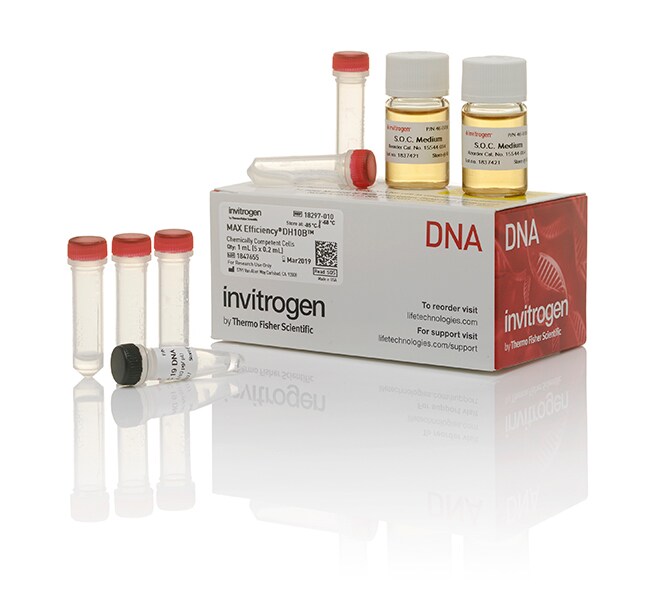
• MAX Efficiency DH10B 感受态细胞:5 个小瓶,各 200 μL(总计 1 mL)
•pUC19 DNA (0.01 μg/uL):1 个样品瓶,100μ L
• S.O.C.培养基:2 瓶,各 6 ml
感受态细胞在 -80°C 下储存。pUC19 DNA 在 -20°C 下储存。SOC 培养基在 4°C 或室温下储存。
• MAX Efficiency DH10B 感受态细胞:5 个小瓶,各 200 μL(总计 1 mL)
•pUC19 DNA (0.01 μg/uL):1 个样品瓶,100μ L
• S.O.C.培养基:2 瓶,各 6 ml
感受态细胞在 -80°C 下储存。pUC19 DNA 在 -20°C 下储存。SOC 培养基在 4°C 或室温下储存。
常见问题解答 (FAQ)
你们提供Subcloning Efficiency、Library Efficiency和MAX Efficiency感受态细胞。它们的区别是什么?
How do you recommend that I prepare my DNA for successful electroporation of E. coli?
You offer competent cells in Subcloning Efficiency, Library Efficiency and MAX Efficiency. How do these differ?
Does the methylation status of DNA affect its ability to be cloned?
When should DMSO, formamide, glycerol and other cosolvents be used in PCR?
引用和文献 (4)
引用和文献
Abstract
Calsarcin-3, a novel skeletal muscle-specific member of the calsarcin family, interacts with multiple Z-disc proteins.
Journal:J Biol Chem
PubMed ID:11842093
'The Z-disc is a highly specialized multiprotein complex of striated muscles that serves as the interface of the sarcomere and the cytoskeleton. In addition to its role in muscle contraction, its juxtaposition to the plasma membrane suggests additional functions of the Z-disc in sensing and transmitting external and internal signals.
Two distinct pseudomonas effector proteins interact with the pto kinase and activate plant immunity.
Journal:Cell
PubMed ID:12062102
The Pto serine/threonine kinase of tomato confers resistance to speck disease by recognizing strains of Pseudomonas syringae that express the protein AvrPto. Pto and AvrPto physically interact, and this interaction is required for activation of host resistance. We identified a second Pseudomonas protein, AvrPtoB, that interacts specifically with Pto and
MRK, a mixed lineage kinase-related molecule that plays a role in gamma-radiation-induced cell cycle arrest.
Journal:J Biol Chem
PubMed ID:11836244
Mitogen-activated protein (MAP) kinase pathways are three-kinase modules that mediate diverse cellular processes and have been highly conserved among eukaryotes. By using a functional complementation screen in yeast, we have identified a human MAP kinase kinase kinase (MAPKKK) that shares homology with members of the mixed lineage kinase (MLK) family
Haemophilus influenzae type b strain A2 has multiple sialyltransferases involved in lipooligosaccharide sialylation.
Journal:J Biol Chem
PubMed ID:11842084
The lipooligosaccharide (LOS) of Haemophilus influenzae contains sialylated glycoforms, and a sialyltransferase, Lic3A, has been previously identified. We report evidence for two additional sialyltransferases, SiaA, and LsgB, that affect N-acetyllactosamine containing glycoforms. Mutations in genes we have designated siaA and lsgB affected only the sialylated glycoforms containing N-acetylhexosamine. A mutation