Search


引用和文献 (12)
Thermo Scientific™
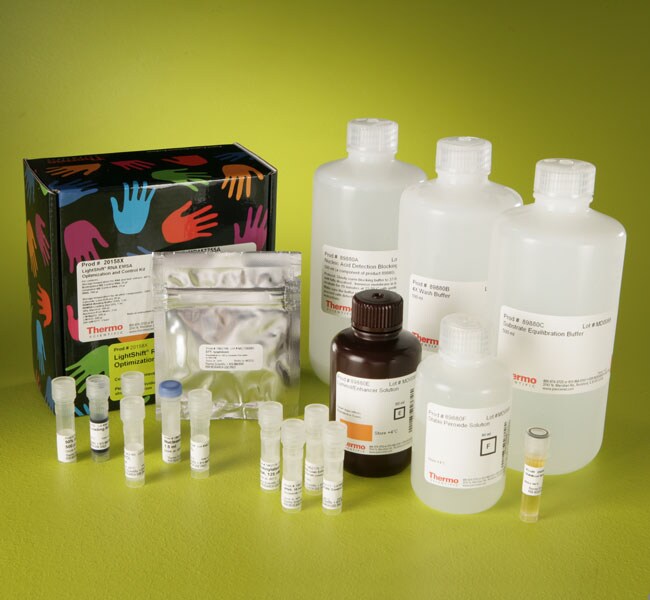
LightShift™ 化学发光 RNA EMSA 试剂盒
Thermo Scientific LightShift 化学发光 RNA EMSA 试剂盒为利用电泳迁移率变动实验 (EMSA) 研究 RNA了解更多信息
| 货号 | 数量 |
|---|---|
| 20158 | 100 reactions |
货号 20158
价格(CNY)
6,395.00
飞享价
Ends: 31-Dec-2026
8,114.00共减 1,719.00 (21%)
Each
数量:
100 reactions
价格(CNY)
6,395.00
飞享价
Ends: 31-Dec-2026
8,114.00共减 1,719.00 (21%)
Each
Thermo Scientific LightShift 化学发光 RNA EMSA 试剂盒为利用电泳迁移率变动实验 (EMSA) 研究 RNA 蛋白相互作用提供了一种无放射性解决方案。
LightShift 化学发光 RNA EMSA 试剂盒的特点:
•灵敏 — 化学发光检测与放射性检测相当
•节省时间 — 与放射性系统所需的 16 小时曝光相比,X 射线胶片在曝光 1 至 5 分钟后即可显影
•灵活 — 兼容通过不同方法生物素化的 RNA 探针
•易于使用 — 全套试剂盒包括用于结合反应和 RNA 探针检测的优化试剂
•无放射性 — 不存在放射性 RNA 探针所具有的废弃物问题
RNA EMSA 试剂盒使用生物素化 RNA 探针和化学发光底物系统,可快速且安全地检测 RNA-蛋白复合物,灵敏度与传统 32P-同位素方法相当。全套试剂盒包含构建和优化蛋白-RNA 结合条件所需的全部试剂、用于蛋白-RNA 相互作用的阳性对照及核酸相互作用化学发光检测的全部试剂。
关于 LightShift 化学发光 RNA EMSA 试剂盒
LightShift 化学发光 RNA EMSA 试剂盒是通过与常用 DNA 凝胶迁移实验相似的凝胶电泳迁移模式的变化检测蛋白-RNA 相互作用的体外技术。在 RNA EMSA 中,将标记的 RNA 探针与蛋白样品一起孵育,以开始结合。形成复合物后,通过非变性聚丙烯酰胺凝胶电泳分离样品。因为 RNA-蛋白复合物的迁移速度比游离 RNA 探针慢,所以使用 RNA 凝胶迁移实验可以观察到迁移距离。通过与过量未标记 RNA 结合竞争以减少特异性相互作用信号,验证了 RNA-蛋白相互作用的特异性。一般来说,突变或不相关 RNA 探针预计不会因特异性相互作用而竞争,在 EMSA 中检测时特定条带迁移的强度不应降低。完整的 LightShift 化学发光 RNA EMSA 试剂盒包含设置和优化 RNA 凝胶迁移分析所需的所有试剂,包括 RNA-蛋白质复合物形成的阳性对照。
LightShift 化学发光 RNA EMSA 试剂盒使用生物素化 RNA 探针、辣根过氧化物酶标记的链霉素亲和素和化学发光检测,以提供与使用放射性 RNA 探针时相似的灵敏度,但检测速度更快。标记的 RNA 探针可以在市场上购买或通过使用生物素化核苷酸进行失控体外转录反应生成或通过使用 Thermo Scientific Pierce RNA 3' 末端生物素化试剂盒将生物素标记酶促连接至 RNA 链的 3' 末端生成。LightShift 化学发光 RNA EMSA 试剂盒对于通过这三种方法中的任何一种进行生物素化的 RNA 探针都有效;然而,在失控体外转录 RNA 探针合成期间,RNA 二级结构可能会受到生物素化核苷酸的内部掺入的影响。因此,对于某些相互作用,可能需要定制的合成 RNA 探针或 3' 末端生物素化探针才能实现适当的蛋白-RNA 相互作用。
关于 LightShift 化学发光 RNA EMSA 试剂盒的阳性对照品
LightShift 化学发光 RNA EMSA 试剂盒中包括的阳性对照品是铁反应元件 (IRE) RNA 探针。IRE 结合反应与其他实验样品同时进行设置和检测。在缺铁条件下,铁反应蛋白 (IRP) 仍与细胞中存在的 IRE RNA 结合,有效抑制铁蛋白(铁存储蛋白)的翻译,然后抑制转铁蛋白受体。在富铁条件下,IRE 结合活性丧失,进行铁蛋白和转铁蛋白翻译。该系统普遍存在,并可产生稳健的条带迁移。用 200 倍摩尔过量未标记 IRE RNA 孵育阳性对照反应将使特异性 IRE 条带迁移信号减少约 70%,而相似倍数过量的无关 RNA 探针将不会使 IRE 条带迁移显著减少。这些对照品可用于各 RNA 凝胶迁移实验,以验证蛋白-RNA 复合物形成的正确设置、电泳、转移和检测。
相关产品
用于 LightShift™ 化学发光 RNA EMSA 试剂盒的 tRNA
LightShift 化学发光 RNA EMSA 试剂盒的特点:
•灵敏 — 化学发光检测与放射性检测相当
•节省时间 — 与放射性系统所需的 16 小时曝光相比,X 射线胶片在曝光 1 至 5 分钟后即可显影
•灵活 — 兼容通过不同方法生物素化的 RNA 探针
•易于使用 — 全套试剂盒包括用于结合反应和 RNA 探针检测的优化试剂
•无放射性 — 不存在放射性 RNA 探针所具有的废弃物问题
RNA EMSA 试剂盒使用生物素化 RNA 探针和化学发光底物系统,可快速且安全地检测 RNA-蛋白复合物,灵敏度与传统 32P-同位素方法相当。全套试剂盒包含构建和优化蛋白-RNA 结合条件所需的全部试剂、用于蛋白-RNA 相互作用的阳性对照及核酸相互作用化学发光检测的全部试剂。
关于 LightShift 化学发光 RNA EMSA 试剂盒
LightShift 化学发光 RNA EMSA 试剂盒是通过与常用 DNA 凝胶迁移实验相似的凝胶电泳迁移模式的变化检测蛋白-RNA 相互作用的体外技术。在 RNA EMSA 中,将标记的 RNA 探针与蛋白样品一起孵育,以开始结合。形成复合物后,通过非变性聚丙烯酰胺凝胶电泳分离样品。因为 RNA-蛋白复合物的迁移速度比游离 RNA 探针慢,所以使用 RNA 凝胶迁移实验可以观察到迁移距离。通过与过量未标记 RNA 结合竞争以减少特异性相互作用信号,验证了 RNA-蛋白相互作用的特异性。一般来说,突变或不相关 RNA 探针预计不会因特异性相互作用而竞争,在 EMSA 中检测时特定条带迁移的强度不应降低。完整的 LightShift 化学发光 RNA EMSA 试剂盒包含设置和优化 RNA 凝胶迁移分析所需的所有试剂,包括 RNA-蛋白质复合物形成的阳性对照。
LightShift 化学发光 RNA EMSA 试剂盒使用生物素化 RNA 探针、辣根过氧化物酶标记的链霉素亲和素和化学发光检测,以提供与使用放射性 RNA 探针时相似的灵敏度,但检测速度更快。标记的 RNA 探针可以在市场上购买或通过使用生物素化核苷酸进行失控体外转录反应生成或通过使用 Thermo Scientific Pierce RNA 3' 末端生物素化试剂盒将生物素标记酶促连接至 RNA 链的 3' 末端生成。LightShift 化学发光 RNA EMSA 试剂盒对于通过这三种方法中的任何一种进行生物素化的 RNA 探针都有效;然而,在失控体外转录 RNA 探针合成期间,RNA 二级结构可能会受到生物素化核苷酸的内部掺入的影响。因此,对于某些相互作用,可能需要定制的合成 RNA 探针或 3' 末端生物素化探针才能实现适当的蛋白-RNA 相互作用。
关于 LightShift 化学发光 RNA EMSA 试剂盒的阳性对照品
LightShift 化学发光 RNA EMSA 试剂盒中包括的阳性对照品是铁反应元件 (IRE) RNA 探针。IRE 结合反应与其他实验样品同时进行设置和检测。在缺铁条件下,铁反应蛋白 (IRP) 仍与细胞中存在的 IRE RNA 结合,有效抑制铁蛋白(铁存储蛋白)的翻译,然后抑制转铁蛋白受体。在富铁条件下,IRE 结合活性丧失,进行铁蛋白和转铁蛋白翻译。该系统普遍存在,并可产生稳健的条带迁移。用 200 倍摩尔过量未标记 IRE RNA 孵育阳性对照反应将使特异性 IRE 条带迁移信号减少约 70%,而相似倍数过量的无关 RNA 探针将不会使 IRE 条带迁移显著减少。这些对照品可用于各 RNA 凝胶迁移实验,以验证蛋白-RNA 复合物形成的正确设置、电泳、转移和检测。
相关产品
用于 LightShift™ 化学发光 RNA EMSA 试剂盒的 tRNA
仅供科研使用。不可用于诊断程序。
规格
检测EMSA Assay
适用于(设备)myECL™ 成像仪、X 射线胶片
反应次数100 reactions
产品线LightShift
产品类型LightShift化学发光RNA EMSA试剂盒
数量100 reactions
靶标特异性无靶标特异性
技术增强的化学发光、膜印迹、凝胶迁移
检测方法化学发光
产品规格试剂盒
样品类型蛋白质
Unit SizeEach
内容与储存
足够用于:100 结合反应和检测:1000 cm2 膜(10 微型凝胶印迹)• 125 nM 生物素化 IRE RNA 对照35 μL(在 -20°C 下储存)
• 10 μM 未标记 IRE RNA 对照,25 μL(在 -20°C 下储存)
• 2 mg/mL 细胞溶质肝脏提取物,50 μL(在 -20°C 下储存)
• 10 mg/mL tRNA,100 μL(在 -20°C 下储存)
• 10X REMSA 结合缓冲液,1 mL(在 -20°C 下储存)
• 50% 甘油,500 μL(在 -20°C 下储存)
• 2M KCl,500 μL(在 -20°C 下储存)
• 1M MgCl2,500 μL(在 -20°C 下储存)
• DTT,冻干(在 -20°C 下储存)
• 无核酸酶水,1.5 mL(在 -20°C 下储存)
• 5X REMSA 上样缓冲液,1 mL(在 -20°C 下储存)
• 稳定链霉素亲和素-HRP,1.5 mL(在 4°C 下储存)
• 鲁米诺/增强剂溶液,80 mL(在 4°C 下储存)
• 稳定的过氧化物溶液,80 mL(在 4°C 下储存)
• 核酸检测封闭缓冲液,500 mL(在 4°C 下储存)
• 4X 洗涤缓冲液、500 mL(在 4°C 下储存)
• 底物平衡缓冲液,500 mL(在 4°C 下储存)
• 10 μM 未标记 IRE RNA 对照,25 μL(在 -20°C 下储存)
• 2 mg/mL 细胞溶质肝脏提取物,50 μL(在 -20°C 下储存)
• 10 mg/mL tRNA,100 μL(在 -20°C 下储存)
• 10X REMSA 结合缓冲液,1 mL(在 -20°C 下储存)
• 50% 甘油,500 μL(在 -20°C 下储存)
• 2M KCl,500 μL(在 -20°C 下储存)
• 1M MgCl2,500 μL(在 -20°C 下储存)
• DTT,冻干(在 -20°C 下储存)
• 无核酸酶水,1.5 mL(在 -20°C 下储存)
• 5X REMSA 上样缓冲液,1 mL(在 -20°C 下储存)
• 稳定链霉素亲和素-HRP,1.5 mL(在 4°C 下储存)
• 鲁米诺/增强剂溶液,80 mL(在 4°C 下储存)
• 稳定的过氧化物溶液,80 mL(在 4°C 下储存)
• 核酸检测封闭缓冲液,500 mL(在 4°C 下储存)
• 4X 洗涤缓冲液、500 mL(在 4°C 下储存)
• 底物平衡缓冲液,500 mL(在 4°C 下储存)
常见问题解答 (FAQ)
能否使用NativePAGE凝胶进行EMSA(电泳迁移率变动分析)?
What is an electrophoretic mobility shift assay (EMSA)?
How do I identify if my protein has bound to my EMSA probe?
I do not see a shifted band on my EMSA gel. What should I do?
Which substrate do you recommend using with the LightShift Chemiluminiscent EMSA Kit and LightShift Chemiluminiscent RNA EMSA Kit?
引用和文献 (12)
引用和文献
Abstract
Association between polymorphism in the promoter region of lncRNA GAS5 and the risk of colorectal cancer.
Journal:Biosci Rep
PubMed ID:30902880
'The growth arrest special 5 (GAS5), as a research hotspot of long noncoding RNAs (lncRNAs), has been reported to be associated with colorectal cancer (CRC). However, the association between polymorphisms in GAS5 and the risk of CRC was not clear. In the present study, a case-control study in 1078 CRC
Ribosome Provisioning Activates a Bistable Switch Coupled to Fast Exit from Stationary Phase.
Journal:Mol Biol Evol
PubMed ID:30835283
'Observations of bacteria at the single-cell level have revealed many instances of phenotypic heterogeneity within otherwise clonal populations, but the selective causes, molecular bases, and broader ecological relevance remain poorly understood. In an earlier experiment in which the bacterium Pseudomonas fluorescens SBW25 was propagated under a selective regime that mimicked
Disordered Regions of Mixed Lineage Leukemia 4 (MLL4) Protein Are Capable of RNA Binding.
Journal:Int J Mol Sci
PubMed ID:30400675
'Long non-coding RNAs (lncRNAs) are emerging as important regulators of cellular processes and are extensively involved in the development of different cancers; including leukemias. As one of the accepted methods of lncRNA function is affecting chromatin structure; lncRNA binding has been shown for different chromatin modifiers. Histone lysine methyltransferases (HKMTs)
CircRNA circRNA_102171 promotes papillary thyroid cancer progression through modulating CTNNBIP1-dependent activation of ß-catenin pathway.
Journal:J Exp Clin Cancer Res
PubMed ID:30424816
'As a type of recently discovered noncoding RNA, circular RNAs (circRNAs) exert pivot biological functions in diverse cancers. However, the role of circRNA_102171 in papillary thyroid cancer (PTC) has not been investigated. Our study was focused on the functional investigation toward circRNA_102171 in PTC progression. And we also aimed to
LncHOXA10 drives liver TICs self-renewal and tumorigenesis via HOXA10 transcription activation.
Journal:Mol Cancer
PubMed ID:30545354
Liver cancer is one of the most deadly cancers in the world. There are various cells in liver tumor bulk, including liver tumor initiating cells (TICs), which account for liver tumorigenesis, drug resistance, relapse and metastasis. The homeobox (HOX) transcription factors play critical roles in many physiological and pathological processes,