Search

Thermo Scientific™
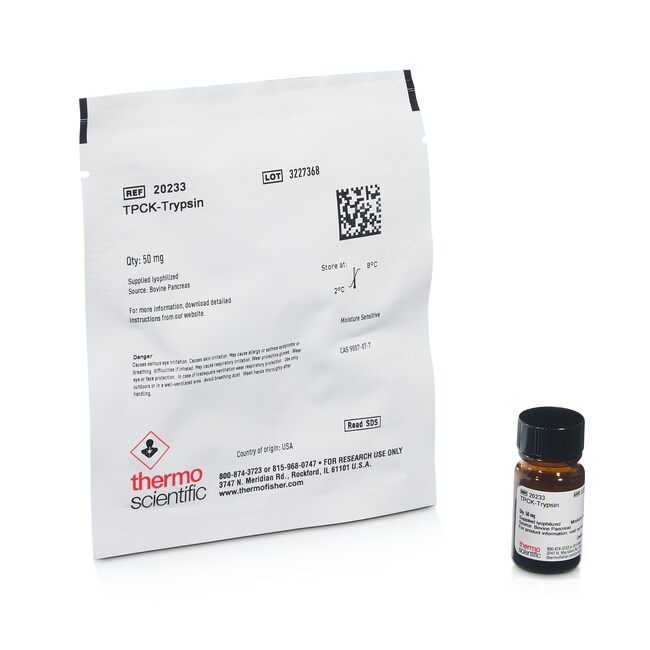
Trypsin, TPCK Treated
Thermo Scientific Pierce TPCK Trypsin is a serine endoprotease that is applicable to amino acid analysis and protein sequencing, mapping了解更多信息
| 货号 | 数量 |
|---|---|
| 20233 | 50 mg |
货号 20233
价格(CNY)
1,316.00
Each
数量:
50 mg
价格(CNY)
1,316.00
Each
Thermo Scientific Pierce TPCK Trypsin is a serine endoprotease that is applicable to amino acid analysis and protein sequencing, mapping and structural studies; the immobilized form allows sample separation after treatment.
Features of Thermo Scientific Pierce TPCK Trypsin
• Cleaves at carboxyl side of arginine and lysine residues
• Digestion conditions: pH 7.5–9.0, 37°C
Trypsin has a wide range of applications including amino acid analysis and protein sequencing, mapping and structural studies. Enzymes such as trypsin and chymotrypsin have become important tools in sequencing studies since they are highly selective in their cleavage of peptide bonds. Trypsin cleaves only those peptide bonds in which the carboxyl group is contributed by a lysine or an arginine residue, regardless of the length or amino acid sequence of the chain. Our Immobilized TPCK Trypsin can be substituted for free trypsin in many application and is advantageous because it minimizes autolysis, eliminates contamination of a sample with the protease and allows control of the digestion by removing the trypsin. Immobilized trypsin is also more stable against heat-induced denaturation, resulting in longer maintenance of activity.
Applications:
• Removal of adherent cells from tissue culture flasks
• Preparing tryptic fragments for Edman degradation sequencing
• Immobilized trypsin can be used to purify soybean trypsin inhibitor
• Use our Pierce Trypsin, MS Grade (Cat No. 90057) for mass spectrometry workflows
Trypsin is a 23.8kDa pancreatic serine endoprotease derived from trypsinogen, an inactive precursor zymogen, after enzymatic removal of an n-terminal leader sequence by enterokinase. Once some trypsin has been formed it can catalyze the conversion of more trypsinogen into its catalytically-active form. Trypsin is treated with L-1-tosylamido-2-phenylethyl chloromethyl ketone (TPCK) to inhibit contaminating chymotrypsin activity without affecting trypsin activity.
Dissolving 0.25 g of trypsin in 100 mL of chilled HBSS for a 0.25% w/v solution is recommended. Mix solution until homogenous and pH is 7.4 to 7.8. Filter the solution through a low protein-binding filter such as the Nalgene™ Rapid-Flow™ Sterile Disposable Filter Units with PES Membranes (Cat No. 567-0010) and store -5°C to -20°C.
Related Products
Immobilized Trypsin, TPCK Treated (Agarose Resin)
仅供科研使用。不可用于诊断程序。
规格
描述Pierce TPCK Trypsin
形式粉末
数量50 mg
产品类型Trypsin
Unit SizeEach
内容与储存
Store in original container protected from direct sunlight in a dry, cool, and well-ventilated area from 2–8°C.