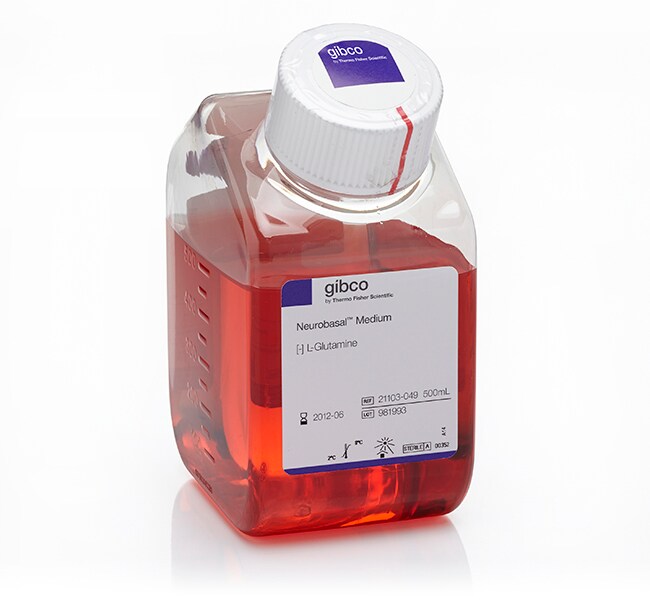
Neurobasal™ Medium
Invitrogen17万+抗体限时买二赠一,靶点广,灵活用!
Neurobasal™ Medium
Gibco™

Neurobasal™ Medium

Neurobasal Medium is a basal medium designed for long-term maintenance and maturation of pure pre-natal and embryonic neuronal cell populationsRead more
Have Questions?
Catalog NumberQuantity
21103049500 mL
Catalog number 21103049
Price (CNY)
773.00
Online Exclusive
Ends: 27-Dec-2025
1,263.00
Save 490.00 (39%)
Each
Add to cart
Quantity:
500 mL
Customize this product
Price (CNY)
773.00
Online Exclusive
Ends: 27-Dec-2025
1,263.00
Save 490.00 (39%)
Each
Add to cart
Neurobasal Medium is a basal medium designed for long-term maintenance and maturation of pure pre-natal and embryonic neuronal cell populations without the need for an astrocyte feeder layer when used with Gibco B-27 supplements.

Neurobasal Medium is suitable for use in most neuronal cell applications. For other applications, we provide alternative formulations of Neurobasal media and B-27 supplements.

For established protocols using Neurobasal media, access our Gibco Neurobiology Protocol Handbook.

View publications using Gibco neurobiology products at our Gibco CellCite.

For Research Use Only. Not for use in diagnostic procedures.
Specifications
Cell TypeNeural Cells
Product LineNeurobasal
Product TypeNeurobasal Medium
Quantity500 mL
Shelf Life12 Months From Date of Manufacture
Shipping ConditionAmbient
Tested ForEndotoxin, Performance, Sterility, Osmolality, pH
ClassificationSerum-free
Culture TypeNeuronal Cell Culture
FormLiquid
With AdditivesPhenol Red
Unit SizeEach
Contents & Storage
Store in refrigerator (2–8°C) and protect from light.

Frequently asked questions (FAQs)

Can B-27 supplement be filtered?

Yes, the protein content in this product is high enough so filtering through a low protein binding filter as a 50X or 1X in solution should not be a problem.

Find additional tips, troubleshooting help, and resources within our Cell Culture Support Center.

Can Neurobasal Medium alone or Neurobasal Medium supplemented with B-27 supplement be frozen to extend product shelf life?

No, it is not recommended to freeze media due to the potential of precipitates forming upon thaw. Inorganic salts and amino acids in the formulation may come out of solution when exposed to temperature fluctuations. These precipitates will not go back into solution easily once formed.

Find additional tips, troubleshooting help, and resources within our Cell Culture Support Center.

What supplements should I use with Neurobasal or Neurobasal-A medium?

Neurobasal and Neurobasal-A media (for postnatal and adult neurons) allow for long-term maintenance of neuronal cells without the need for an astrocyte feeder layer. These media should be supplemented with either serum or a serum-free supplement, plus 0.5mM L-glutamine. B-27 supplement is a serum-free supplement that comes as a 50X concentrate in a 10ml volume. This is enough supplement for 500ml of media. Fetal, postnatal, and adult neural cultures can be grown in the appropriate Neurobasal medium supplemented with B-27 supplement .

We also have two other supplements. One is called G-5 and is for growth and expression of glial cells (normal and tumor) of astrocytic phenotype. This comes in a 1ml size, at a 100X concentration. The other supplement is called N-2 and is for growth and expression of post-mitotic neurons and tumor cells of neuronal phenotype. This comes in a 5ml size, at a 100X concentration.

For more information on Neurobasal media, search "Neurobasal" from our website home page.

Find additional tips, troubleshooting help, and resources within our Cell Culture Support Center.

Why does the Neurobasal Medium contain a higher concentration of L-cysteine, which is reported to activate NMDA receptors, according to the paper "Excitotoxicity Triggered by Neurobasal Culture Medium", http://dx.plos.org/10.1371/journal.pone.0025633?

The original published formulation of Neurobasal culture medium contained 10 µM L-cysteine. However, our Neurobasal media formulation contains 260 µM L-cysteine because it was shown to improve cell survival.

Find additional tips, troubleshooting help, and resources within our Cell Culture Support Center.

Can I maintain differentiated neurospheres in Neurobasal+B27+N2+bFGF+EGF?

Neurospheres can be plated on laminin coated culture plates for neuron differentiation. The issue is that it is difficult to control the plating density of neurospheres. Alternatively, neurospheres can be dissociated into single cells and plate single cell suspension at a certain density such as 1-5 x 10^4 cells/cm2 onto laminin coated plates for neuron differentiation. For general neuron differentiation, Neurobasal+B27+N2 can be used. Growth factors such as BDNF and/or GDNF can be added into medium for improving survival of differentiating NSCs.

Find additional tips, troubleshooting help, and resources within our Cell Culture Support Center.

Citations & References (5)

Citations & References
Abstract
A comprehensive protocol for efficient differentiation of human NPCs into electrically competent neurons.
Authors:Romito E,Battistella I,Plakhova V,Paplekaj A,Forastieri C,Toffolo E,Musio C,Conti L,Battaglioli E,Rusconi F
Journal:Journal of neuroscience methods
PubMed ID:39053772
Activation of Trk neurotrophin receptor signaling by pituitary adenylate cyclase-activating polypeptides.
Authors: Lee Francis S; Rajagopal Rithwick; Kim Albert H; Chang Paul C; Chao Moses V;
Journal:J Biol Chem
PubMed ID:11784714
'Pituitary adenylate cyclase-activating polypeptide (PACAP), a neuropeptide that acts through G protein-coupled receptors, exerts neuroprotective effects upon many neuronal populations. However, the intracellular signaling mechanisms that account for PACAP''s trophic effects are not well characterized. Here we have tested the possibility that PACAP uses neurotrophin signaling pathways. We have found ... More
Long-term culture of mouse cortical neurons as a model for neuronal development, aging, and death.
Authors: Lesuisse Christian; Martin Lee J;
Journal:J Neurobiol
PubMed ID:11920724
A long-term cell culture system was used to study maturation, aging, and death of cortical neurons. Mouse cortical neurons were maintained in culture in serum-free medium (Neurobasal supplemented with B27) for 60 days in vitro (DIV). The levels of several proteins were evaluated by immunoblotting to demonstrate that these neurons ... More
Axonal Transport Enables Neuron-to-Neuron Propagation of Human Coronavirus OC43.
Authors:Dubé M, Le Coupanec A, Wong AHM, Rini JM, Desforges M, Talbot PJ
Journal:J Virol
PubMed ID:29925652
Human coronaviruses (HCoVs) are recognized respiratory pathogens for which accumulating evidence indicates that in vulnerable patients the infection can cause more severe pathologies. HCoVs are not always confined to the upper respiratory tract and can invade the central nervous system (CNS) under still unclear circumstances. HCoV-induced neuropathologies in humans are ... More
A Human Pluripotent Stem Cell-based Platform to Study SARS-CoV-2 Tropism and Model Virus Infection in Human Cells and Organoids.
Authors:Yang L, Han Y, Nilsson-Payant BE, Gupta V, Wang P, Duan X, Tang X, Zhu J, Zhao Z, Jaffré F, Zhang T, Kim TW, Harschnitz O, Redmond D, Houghton S, Liu C, Naji A, Ciceri G, Guttikonda S, Bram Y, Nguyen DT, Cioffi M, Chandar V, Hoagland DA, Huang Y, Xiang J, Wang H, Lyden D, Borczuk A, Chen HJ, Studer L, Pan FC, Ho DD, tenOever BR, Evans T, Schwartz RE, Chen S
Journal:Cell Stem Cell
PubMed ID:32579880
SARS-CoV-2 has caused the COVID-19 pandemic. There is an urgent need for physiological models to study SARS-CoV-2 infection using human disease-relevant cells. COVID-19 pathophysiology includes respiratory failure but involves other organ systems including gut, liver, heart, and pancreas. We present an experimental platform comprised of cell and organoid derivatives from ... More