Search


引用和文献 (5)
Gibco™
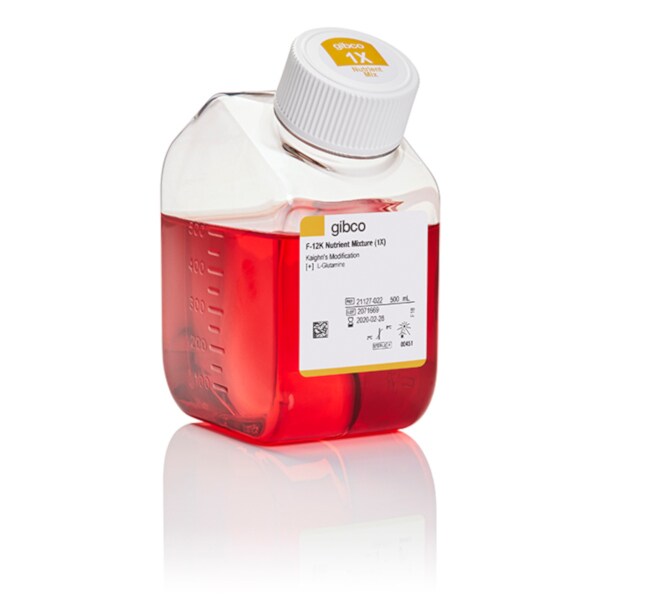
Ham's F-12K (Kaighn's) 培养基
Ham's F-12K (Kaighn's) 培养基是 Ham's F-12 Nutrient Mixture 的改良产品。Ham's了解更多信息
Have Questions?
更改视图

| 货号 | 数量 |
|---|---|
| 21127022 | 500 mL |
| 21127030 | 10 x 500 mL |
货号 21127022
价格(CNY)
443.00
飞享价
Ends: 31-Dec-2026
554.00共减 111.00 (20%)
Each
数量:
500 mL
价格(CNY)
443.00
飞享价
Ends: 31-Dec-2026
554.00共减 111.00 (20%)
Each
Ham's F-12K (Kaighn's) 培养基是 Ham's F-12 Nutrient Mixture 的改良产品。Ham's F-12K (Kaighn's) 培养基专门为原代人类肝细胞以及减血清环境中的部分大鼠和鸡肝细胞而开发。
这种 Ham's F-12K (Kaighn's) 培养基的生产方式如下:
可提供完整配方。
Ham's F-12K 的使用
Ham's F-12K (Kaighn's) 培养基含有传统基础培养基中不具备的多种成分,比如腐胺、胸苷、次黄嘌呤、锌以及较高水平的全部氨基酸和丙酮酸钠。添加这些成分后,对于某些细胞类型只需在培养基中补充极少量的血清或成分明确的组分。Ham's F-12K (Kaighn's) 培养基不含蛋白质或生长因子,因此通常会补充生长因子和胎牛血清 (FBS)。必须针对每种细胞系优化 FBS 浓度。Ham's F-12K (Kaighn's) 培养基使用碳酸氢钠缓冲体系 (2.5 g/L),因此需要 5–10% CO2 的环境来维持生理 pH 值。
两地 cGMP 生产
为确保供应链的稳定,同时在位于纽约格兰德岛和英国苏格兰的两家独立工厂生产 Ham's F-12K (Kaighn's) 培养基。两个地点都符合 cGMP 生产要求,并通过 ISO 13485 认证,是在 FDA 登记的医疗器械生产商。
这种 Ham's F-12K (Kaighn's) 培养基的生产方式如下:
| 包含 | 不含 |
| •L-谷氨酰胺 | •HEPES: |
| • 酚红 |
可提供完整配方。
Ham's F-12K 的使用
Ham's F-12K (Kaighn's) 培养基含有传统基础培养基中不具备的多种成分,比如腐胺、胸苷、次黄嘌呤、锌以及较高水平的全部氨基酸和丙酮酸钠。添加这些成分后,对于某些细胞类型只需在培养基中补充极少量的血清或成分明确的组分。Ham's F-12K (Kaighn's) 培养基不含蛋白质或生长因子,因此通常会补充生长因子和胎牛血清 (FBS)。必须针对每种细胞系优化 FBS 浓度。Ham's F-12K (Kaighn's) 培养基使用碳酸氢钠缓冲体系 (2.5 g/L),因此需要 5–10% CO2 的环境来维持生理 pH 值。
两地 cGMP 生产
为确保供应链的稳定,同时在位于纽约格兰德岛和英国苏格兰的两家独立工厂生产 Ham's F-12K (Kaighn's) 培养基。两个地点都符合 cGMP 生产要求,并通过 ISO 13485 认证,是在 FDA 登记的医疗器械生产商。
仅供科研使用。不可用于诊断程序。
规格
细胞类型人肝细胞
最大浓度1 X
生产质量cGMP-compliant under the ISO 13485 standard
产品线Gibco
产品类型Ham's F-12K (Kaighn's) 培养基
数量500 mL
有效期自生产之日起 12 个月
运输条件室温
分类非动物源性
形式液体
无菌无菌过滤
灭菌方法无菌过滤
加有添加剂低糖, 谷氨酰胺, 酚红, 丙酮酸钠
不加添加剂不含 HEPES
Unit SizeEach
内容与储存
储存条件:2-8°C。避光储存
运输条件:环境
运输条件:环境
常见问题解答 (FAQ)
加入血清后的培养基可以使用多久?
我的培养基是室温条件下运送来的,但注明应保存于冷藏条件下。这会有影响么?
我该如何去除细胞培养基中的支原体污染?
我发现培养物的生长速率变缓。我该如何处理?
我的细胞不能贴附于培养容器。我该如何处理?
引用和文献 (5)
引用和文献
Abstract
Human MutY homolog, a DNA glycosylase involved in base excision repair, physically and functionally interacts with mismatch repair proteins human MutS homolog 2/human MutS homolog 6.
Journal:J Biol Chem
PubMed ID:11801590
Adenines mismatched with guanines or 7,8-dihydro-8-oxo-deoxyguanines that arise through DNA replication errors can be repaired by either base excision repair or mismatch repair. The human MutY homolog (hMYH), a DNA glycosylase, removes adenines from these mismatches. Human MutS homologs, hMSH2/hMSH6 (hMutSalpha), bind to the mismatches and initiate the repair on
Stimulation of neuronal neurite outgrowth using functionalized carbon nanotubes.
Journal:Nanotechnology
PubMed ID:20173239
Low concentrations (0.11-1.7 microg ml(-1)) of functionalized carbon nanotubes (CNTs), which are multi-walled CNTs modified by amino groups, when added with nerve growth factor (NGF), promoted outgrowth of neuronal neurites in dorsal root ganglion (DRG) neurons and rat pheochromocytoma cell line PC12h cells in culture media. The quantity of active
Dystrophin deficiency markedly increases enterovirus-induced cardiomyopathy: a genetic predisposition to viral heart disease.
Journal:Nat Med
PubMed ID:12118246
Both enteroviral infection of the heart and mutations in the dystrophin gene can cause cardiomyopathy. Little is known, however, about the interaction between genetic and acquired forms of cardiomyopathy. We previously demonstrated that the enteroviral protease 2A cleaves dystrophin; therefore, we hypothesized that dystrophin deficiency would predispose to enterovirus-induced cardiomyopathy.
The Slp homology domain of synaptotagmin-like proteins 1-4 and Slac2 functions as a novel Rab27A binding domain.
Journal:J Biol Chem
PubMed ID:11773082
rab27A, which encodes a small GTP-binding protein, was recently identified as a gene in which mutations caused human hemophagocytic syndrome (Griscelli syndrome) and ashen mice, which exhibit defects in melanosome transport as well as in regulated granule exocytosis in cytotoxic T lymphocytes. However, little is known about the molecular mechanism
Role for 18:1 lysophosphatidic acid as an autocrine mediator in prostate cancer cells.
Journal:J Biol Chem
PubMed ID:12084719
Lysophosphatidic acid (LPA) is a lipid mediator that may play an important role in growth and survival of carcinomas. In this study, LPA production and response were characterized in two human prostate cancer (CaP) cell lines: PC-3 and Du145. Bombesin, a neuroendocrine peptide that is mitogenic for CaP cells, stimulated