Search


引用和文献 (5)
Thermo Scientific™
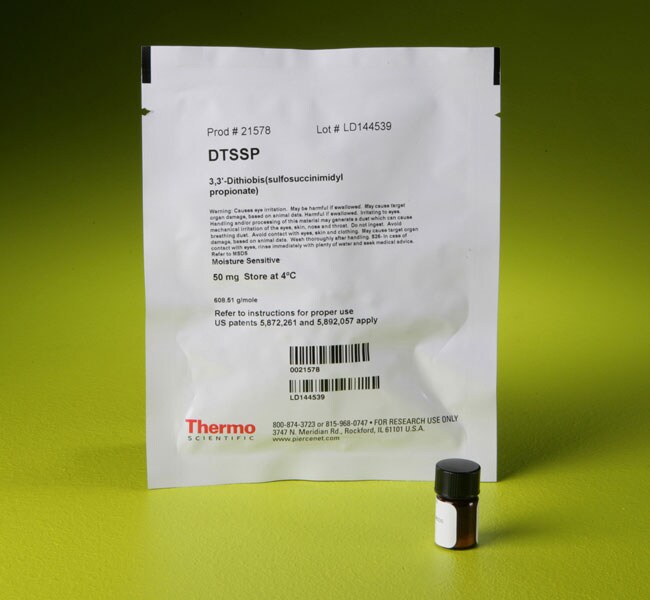
DTSSP(3,3’-二硫双(磺基琥珀酰亚胺丙酸酯))
Thermo Scientific Pierce DTSSP 是一种广泛采用的水溶性交联剂,含有位于8原子间隔臂周围的胺反应性 NHS 酯末端,其中心二硫键可以被还原剂切割。DTSSP 是 3,3'-二硫双(磺基琥珀酰亚胺丙酸酯),其含有胺反应性了解更多信息
| 货号 | 数量 |
|---|---|
| 21578 | 50 mg |
货号 21578
价格(CNY)
2,569.00
Each
数量:
50 mg
价格(CNY)
2,569.00
Each
Thermo Scientific Pierce DTSSP 是一种广泛采用的水溶性交联剂,含有位于8原子间隔臂周围的胺反应性 NHS 酯末端,其中心二硫键可以被还原剂切割。
DTSSP 是 3,3'-二硫双(磺基琥珀酰亚胺丙酸酯),其含有胺反应性 N-羟基磺基琥珀酰亚胺(磺基-NHS)酯,位于8碳间隔臂的各端。磺基-NHS 酯在 pH 7-9 条件下与伯胺反应可形成稳定的酰胺键,同时释放 N-羟基磺基琥珀酰亚胺离去基团。蛋白(包括抗体)通常在赖氨酸 (K) 残基的侧链中有若干伯胺和每个多肽的 N 端,这些多肽可用作 sulfo-NHS 酯交联试剂的靶标。DSS(DTSSP 的非磺化类似物)也可用于需要膜可透过性交联剂的应用。
DTSSP 的特点:
•反应基团:磺基-NHS 酯(两端)
•可与以下基团发生反应:氨基(伯胺)
•磺基-NHS 酯与任何含伯胺分子快速反应
•pH 值8.5时,间隔臂中的二硫键易被 10-50 mM DTT 或 TCEP 切割
•间隔臂也易于被还原 SDS-PAGE 样品上样切割
•可切割交联剂可分离交联产物
•水溶性;与 DSP 具有可比性
•膜不渗透性,可进行细胞表面标记
应用:
•细胞裂解和免疫沉淀之前,细胞表面蛋白的化学交联
•“固定”蛋白相互作用,以便识别较弱或瞬时蛋白相互作用
•蛋白交联,以通过一步反应形成生物偶联
•将蛋白固定至胺包被的表面
DTSSP 的特性
•别名:磺基-DSP
• 分子量:608.51
•间隔臂长度:12.0Å(8原子)
•反应基团:Sulfo-NHS 酯,在 pH 值 7.0–9.0 时与伯胺反应
DTSSP 规格
我们按照较高规格生产 DTSSP,以生产高特异性生物偶联物,确保您数据的完整性,并为您提供较高程度的一致性。每批 DTSSP 都经过检测以满足以下最低规格:
•溶解性> 6 mg/mL(溶于 DI 水)
•鉴别:IR 扫描仅显示具有 DTSSP 的结构和官能团特征的峰
•纯度:> 80%(通过定量 NMR 法测定;交联剂纯度的较高标准)
产品参考文献:
交联剂应用指南 -- 检索本产品的较新参考文献
相关产品
DTSSP(3,3’-二硫双(磺基琥珀酰亚胺丙酸酯))
DSP(二硫双(琥珀酰亚胺丙酸酯)),Lomant 试剂
DSS(双琥珀酰亚胺辛二酸酯)
DTSSP 是 3,3'-二硫双(磺基琥珀酰亚胺丙酸酯),其含有胺反应性 N-羟基磺基琥珀酰亚胺(磺基-NHS)酯,位于8碳间隔臂的各端。磺基-NHS 酯在 pH 7-9 条件下与伯胺反应可形成稳定的酰胺键,同时释放 N-羟基磺基琥珀酰亚胺离去基团。蛋白(包括抗体)通常在赖氨酸 (K) 残基的侧链中有若干伯胺和每个多肽的 N 端,这些多肽可用作 sulfo-NHS 酯交联试剂的靶标。DSS(DTSSP 的非磺化类似物)也可用于需要膜可透过性交联剂的应用。
DTSSP 的特点:
•反应基团:磺基-NHS 酯(两端)
•可与以下基团发生反应:氨基(伯胺)
•磺基-NHS 酯与任何含伯胺分子快速反应
•pH 值8.5时,间隔臂中的二硫键易被 10-50 mM DTT 或 TCEP 切割
•间隔臂也易于被还原 SDS-PAGE 样品上样切割
•可切割交联剂可分离交联产物
•水溶性;与 DSP 具有可比性
•膜不渗透性,可进行细胞表面标记
应用:
•细胞裂解和免疫沉淀之前,细胞表面蛋白的化学交联
•“固定”蛋白相互作用,以便识别较弱或瞬时蛋白相互作用
•蛋白交联,以通过一步反应形成生物偶联
•将蛋白固定至胺包被的表面
DTSSP 的特性
•别名:磺基-DSP
• 分子量:608.51
•间隔臂长度:12.0Å(8原子)
•反应基团:Sulfo-NHS 酯,在 pH 值 7.0–9.0 时与伯胺反应
DTSSP 规格
我们按照较高规格生产 DTSSP,以生产高特异性生物偶联物,确保您数据的完整性,并为您提供较高程度的一致性。每批 DTSSP 都经过检测以满足以下最低规格:
•溶解性> 6 mg/mL(溶于 DI 水)
•鉴别:IR 扫描仅显示具有 DTSSP 的结构和官能团特征的峰
•纯度:> 80%(通过定量 NMR 法测定;交联剂纯度的较高标准)
产品参考文献:
交联剂应用指南 -- 检索本产品的较新参考文献
相关产品
DTSSP(3,3’-二硫双(磺基琥珀酰亚胺丙酸酯))
DSP(二硫双(琥珀酰亚胺丙酸酯)),Lomant 试剂
DSS(双琥珀酰亚胺辛二酸酯)
仅供科研使用。不可用于诊断程序。
规格
细胞渗透性否
描述DTSSP
形式粉末
标记方法化学标记
分子量608.51
聚乙二醇化否
产品线Pierce
数量50 mg
反应一部分Sulfo-NHS 酯
运输条件环境
溶解度水
间隔臂长12.0 Å
水溶性是
化学反应性胺-胺
可裂解用硫醇
交联剂类型同型双功能团试剂
产品规格标准
产品类型交联剂
间隔子中等(10 至 30 Å)
Unit SizeEach
内容与储存
接收后,请在 4°C 下干燥储存。
常见问题解答 (FAQ)
Can you provide the shelf-life for DTSSP (3,3'-dithiobis(sulfosuccinimidyl propionate))?
What is the difference between a homo- and a hetero- bifunctional cross-linker?
引用和文献 (5)
引用和文献
Abstract
HIV envelope-mediated, CCR5/a4ß7-dependent killing of CD4-negative ?d T cells which are lost during progression to AIDS.
Journal:Blood
PubMed ID:21926353
'HIV infects and replicates in CD4+ T cells but effects on host immunity and disease also involve depletion, hyper-activation, and modification of CD4-negative cell populations. In particular, the depletion of CD4-negative ?d T cells is common to all HIV+ individuals. We found that soluble or cell-associated envelope glycoproteins from CCR5-tropic
Adaptor autoregulation promotes coordinated binding within clathrin coats.
Journal:J Biol Chem
PubMed ID:22457357
Membrane traffic is an essential process that allows protein and lipid exchange between the endocytic, lysosomal, and secretory compartments. Clathrin-mediated traffic between the trans-Golgi network and endosomes mediates responses to the environment through the sorting of biosynthetic and endocytic protein cargo. Traffic through this pathway is initiated by the controlled
A nucleotide phosphatase activity in the nucleotide binding domain of an orphan resistance protein from rice.
Journal:J Biol Chem
PubMed ID:22157756
Plant resistance proteins (R-proteins) are key components of the plant immune system activated in response to a plethora of different pathogens. R-proteins are P-loop NTPase superfamily members, and current models describe their main function as ATPases in defense signaling pathways. Here we show that a subset of R-proteins have evolved
Surface-affinity profiling to identify host-pathogen interactions.
Journal:Infect Immun
PubMed ID:21947776
Proteolytic treatment of intact bacterial cells has proven to be a convenient approach for the identification of surface-exposed proteins. This class of proteins directly interacts with the outside world, for instance, during adherence to human epithelial cells. Here, we aimed to identify host receptor proteins by introducing a preincubation step
Psb27, a transiently associated protein, binds to the chlorophyll binding protein CP43 in photosystem II assembly intermediates.
Journal:Proc Natl Acad Sci U S A
PubMed ID:22031695
Photosystem II (PSII), a large multisubunit pigment-protein complex localized in the thylakoid membrane of cyanobacteria and chloroplasts, mediates light-driven evolution of oxygen from water. Recently, a high-resolution X-ray structure of the mature PSII complex has become available. Two PSII polypeptides, D1 and CP43, provide many of the ligands to an