Search


引用和文献 (5)
Thermo Scientific™
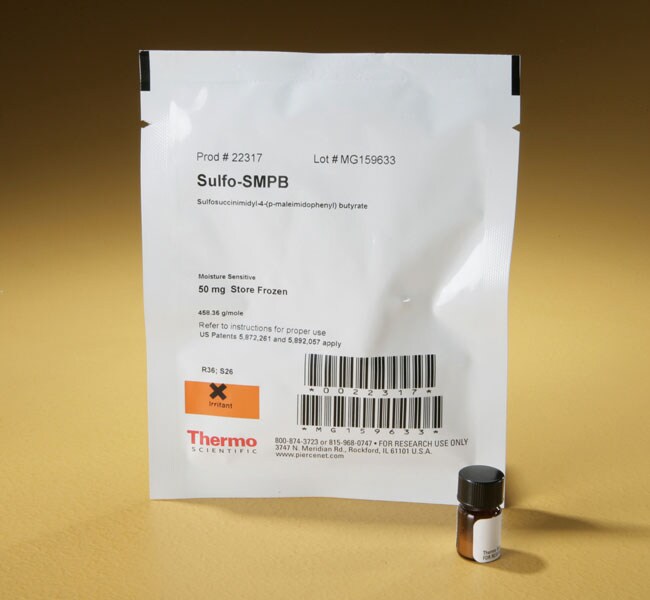
Sulfo-SMPB(磺基琥珀酰亚胺 4-(N-马来酰亚胺基苯基)丁酸酯)
Thermo Scientific Pierce Sulfo-SMPB 是一种水溶性胺-巯基交联剂,含有 NHS 酯和马来酰亚胺反应性基团,位于中等长度芳香族间隔臂(11.6 埃)的相对两端了解更多信息
| 货号 | 数量 |
|---|---|
| 22317 | 50 mg |
货号 22317
价格(CNY)
3,663.00
Each
数量:
50 mg
价格(CNY)
3,663.00
Each
Thermo Scientific Pierce Sulfo-SMPB 是一种水溶性胺-巯基交联剂,含有 NHS 酯和马来酰亚胺反应性基团,位于中等长度芳香族间隔臂(11.6 埃)的相对两端。
Sulfo-SMPB 的特点:
•反应性基团:sulfo-NHS 酯和马来酰亚胺
•可与以下基团发生反应:氨基和巯基
•延伸的链长度限制空间位阻
•不可切割
•水溶性(与 SMPB 具有可比性)
•膜不可透过性,能够进行细胞表面标记
产品参考:
交联剂应用指南 -- 检索本产品的最新参考文献
相关产品
SMPB(琥珀酰亚胺 4-(p-马来酰亚胺基苯基)丁酸酯)
Sulfo-SMPB 的特点:
•反应性基团:sulfo-NHS 酯和马来酰亚胺
•可与以下基团发生反应:氨基和巯基
•延伸的链长度限制空间位阻
•不可切割
•水溶性(与 SMPB 具有可比性)
•膜不可透过性,能够进行细胞表面标记
产品参考:
交联剂应用指南 -- 检索本产品的最新参考文献
相关产品
SMPB(琥珀酰亚胺 4-(p-马来酰亚胺基苯基)丁酸酯)
仅供科研使用。不可用于诊断程序。
规格
细胞渗透性否
描述Sulfo-SMPB
形式粉末
标记方法化学标记
分子量458.37
聚乙二醇化否
产品线Pierce
数量50 mg
反应一部分马来酰亚胺、Sulfo-NHS 酯
运输条件环境
溶解度水
间隔臂长11.6 Å
水溶性是
化学反应性胺-巯基
可裂解否
交联剂类型异型双功能团试剂
产品规格标准
产品类型交联剂
间隔子中等(10 至 30 Å)
Unit SizeEach
内容与储存
接收后在 -20°C 下干燥储存。
常见问题解答 (FAQ)
Can you provide the shelf-life for Sulfo-SMPB (sulfosuccinimidyl 4-(N-maleimidophenyl)butyrate)?
引用和文献 (5)
引用和文献
Abstract
pICln inhibits snRNP biogenesis by binding core spliceosomal proteins.
Journal:Mol Cell Biol
PubMed ID:10330151
'The U1, U2, U4, U5, and U6 small nuclear ribonucleoproteins (snRNPs) form essential components of spliceosomes, the machinery that removes introns from pre-mRNAs in eukaryotic cells. A critical initial step in the complex process of snRNP biogenesis is the assembly of a group of common core proteins (Sm proteins) on
Substrate-induced conformational change in bacterial complex I.
Journal:J Biol Chem
PubMed ID:15037611
'The mechanism coupling electron transfer and proton pumping in respiratory complex I (NADH-ubiquinone oxidoreductase) has not been established, but it has been suggested that it involves conformational changes. Here, the influence of substrates on the conformation of purified complex I from Escherichia coli was studied by cross-linking and electron microscopy.
Decorin evokes protracted internalization and degradation of the epidermal growth factor receptor via caveolar endocytosis.
Journal:J Biol Chem
PubMed ID:15994311
Decorin inhibits the epidermal growth factor receptor (EGFR) by down-regulating its tyrosine kinase activity, thereby blocking the growth of a variety of transformed cells and tumor xenografts. In this study we provide evidence that decorin directly binds to the EGFR causing its dimerization, internalization, and ultimately its degradation. Using various
Combination of DNA-directed immobilization and immuno-PCR: very sensitive antigen detection by means of self-assembled DNA-protein conjugates.
Journal:Nucleic Acids Res
PubMed ID:12907742
An assay for very sensitive antigen detection is described which takes advantage of the self- assembly capabilities of semi-synthetic conjugates of DNA and proteins. The general scheme of this assay is similar to a two-sided (sandwich) enzyme-linked immunoassay (ELISA); however, covalent single-stranded DNA-streptavidin (STV) conjugates, capable of hybridizing to complementary
Biologically active decorin is a monomer in solution.
Journal:J Biol Chem
PubMed ID:14660661
It has been reported that decorin and its protein core can have molecular masses nearly double the size of those previously published, suggesting a dimeric structure. In this study we tested whether biologically active decorin and its glycoprotein core would form dimers in solution. We used homo- and hetero-bifunctional chemical