Search


引用和文献 (7)
Gibco™
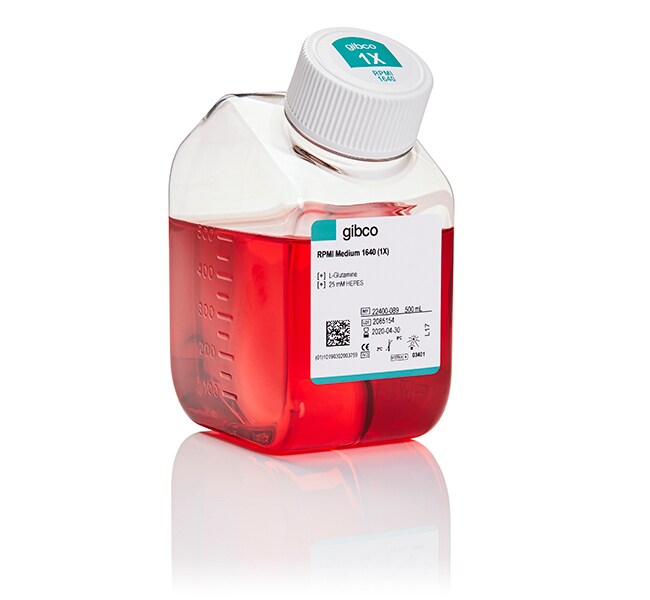
RPMI 1640 培养基,HEPES
RPMI 1640 培养基最初是为了悬浮培养人白血病单层细胞而开发的。Roswell Park Memorial Institute (RPMI) 1640 培养基被发现适用于多种哺乳动物细胞,包括了解更多信息
Have Questions?
更改视图

| 货号 | 数量 |
|---|---|
| 22400089 | 500 mL |
| 22400097 | 100 mL |
| 22400105 | 10 x 500 mL |
| 22400071 | 1000 mL |
| 22400121 | 6 x 1000 mL |
货号 22400089
价格(CNY)
508.00
飞享价
Ends: 31-Dec-2026
635.00共减 127.00 (20%)
Each
数量:
500 mL
价格(CNY)
508.00
飞享价
Ends: 31-Dec-2026
635.00共减 127.00 (20%)
Each
RPMI 1640 培养基最初是为了悬浮培养人白血病单层细胞而开发的。Roswell Park Memorial Institute (RPMI) 1640 培养基被发现适用于多种哺乳动物细胞,包括 HeLa 细胞、Jurkat 细胞、 MCF-7 细胞、PC12 细胞、PBMC 细胞、星形胶质细胞和癌细胞。针对广泛的细胞培养应用,我们提供多种组分的 RPMI 1640 改良培养基。使用培养基选择工具查找适合的配方。
可提供完整配方。
RPMI 的使用
RPMI 1640 培养基相比其他培养基之所以具有独特的效果,是因为其中含有还原剂谷胱甘肽和高浓度的维生素。RPMI 1640 培养基含有生物素、 维生素 B12 以及 PABA,这些成分是 Eagle’s MEM 和DMEM所不具备的。此外,该培养基之中还含有高浓度的维生素肌醇和胆碱。RPMI 1640 培养基不含蛋白质、脂质或生长因子。因此,RPMI 1640 培养基需要添加剂,通常采用 10% 胎牛血清 (FBS)。RPMI 1640 培养基使用碳酸氢钠缓冲系统 (2.0 g/L),因此需要 5–10% CO2 环境来维持生理 pH 值。
cGMP 生产和质量体系
RPMI 1640 培养基在位于纽约格兰德岛的符合 cGMP 要求的工厂内生产。该工厂是在FDA登记的医疗器械生产商,且通过ISO 13485标准认证。为确保供应链连续性,我们同时提供由我们的苏格兰工厂生产的等同 RPMI 1640 产品 (52400-025)。后者亦是在FDA登记的医疗仪器生产商,且符合ISO 13485标准。
这种 RPMI 的改良方式如下:
| 包含 | 不含 | ||
| •L-谷氨酰胺 • HEPES | |||
| • 酚红 |
可提供完整配方。
RPMI 的使用
RPMI 1640 培养基相比其他培养基之所以具有独特的效果,是因为其中含有还原剂谷胱甘肽和高浓度的维生素。RPMI 1640 培养基含有生物素、 维生素 B12 以及 PABA,这些成分是 Eagle’s MEM 和DMEM所不具备的。此外,该培养基之中还含有高浓度的维生素肌醇和胆碱。RPMI 1640 培养基不含蛋白质、脂质或生长因子。因此,RPMI 1640 培养基需要添加剂,通常采用 10% 胎牛血清 (FBS)。RPMI 1640 培养基使用碳酸氢钠缓冲系统 (2.0 g/L),因此需要 5–10% CO2 环境来维持生理 pH 值。
cGMP 生产和质量体系
RPMI 1640 培养基在位于纽约格兰德岛的符合 cGMP 要求的工厂内生产。该工厂是在FDA登记的医疗器械生产商,且通过ISO 13485标准认证。为确保供应链连续性,我们同时提供由我们的苏格兰工厂生产的等同 RPMI 1640 产品 (52400-025)。后者亦是在FDA登记的医疗仪器生产商,且符合ISO 13485标准。
仅用于研究和生产用途。不可用于临床诊断或直接用于人类或动物。
规格
细胞系HeLa、Jurkat、MCF-7、PC-12、PBMC、星形胶质细胞和癌细胞
细胞类型白血病细胞
最大浓度1 X
生产质量cGMP-compliant under the ISO 13485 standard
产品线Gibco
产品类型RPMI 1640 培养基(Roswell Park Memorial Institute 1640 培养基)
数量500 mL
有效期自生产之日起 12 个月
运输条件室温
分类非动物源性
形式液体
血清水平标准血清
无菌无菌过滤
灭菌方法无菌过滤
加有添加剂谷氨酰胺, HEPES:, 酚红
不加添加剂不含丙酮酸钠
Unit SizeEach
内容与储存
储存条件:2-8°C。避光储存
运输条件:环境
有效期:自生产之日起 12 个月
运输条件:环境
有效期:自生产之日起 12 个月
常见问题解答 (FAQ)
加入血清后的培养基可以使用多久?
我的培养基是室温条件下运送来的,但注明应保存于冷藏条件下。这会有影响么?
我该如何去除细胞培养基中的支原体污染?
我发现培养物的生长速率变缓。我该如何处理?
我的细胞不能贴附于培养容器。我该如何处理?
引用和文献 (7)
引用和文献
Abstract
A functional role for the B56 alpha-subunit of protein phosphatase 2A in ceramide-mediated regulation of Bcl2 phosphorylation status and function.
Journal:J Biol Chem
PubMed ID:11929874
'Recently it has been shown that the potent apoptotic agent ceramide activates a mitochondrial protein phosphatase 2A (PP2A) and promotes dephosphorylation of the anti-apoptotic molecule Bcl2 (Ruvolo, P. P., Deng, X., Ito, T., Carr, B. K., and May, W. S. (1999) J. Biol. Chem. 274, 20296-20300). In cells expressing Bcl2,
Cell-penetrating Peptide enhanced intracellular Raman imaging and photodynamic therapy.
Journal:
PubMed ID:23659475
'We present the application of a theranostic system combining Raman imaging and the photodynamic therapy (PDT) effect. The theranostic nanoplatform was created by loading the photosensitizer, protoporphyrin IX, onto a Raman-labeled gold nanostar. A cell-penetrating peptide, TAT, enhanced intracellular accumulation of the nanoparticles in order to improve their delivery and
Slow-cycling therapy-resistant cancer cells.
Journal:Stem Cells Dev
PubMed ID:21973238
Tumor recurrence after chemotherapy is a major cause of patient morbidity and mortality. Recurrences are thought to be secondary to small subsets of cancer cells that are better able to survive traditional forms of chemotherapy and thus drive tumor regrowth. The ability to isolate and better characterize these therapy-resistant cells
Krüppel-like zinc fingers bind to nuclear import proteins and are required for efficient nuclear localization of erythroid Krüppel-like factor.
Journal:J Biol Chem
PubMed ID:12072445
Erythroid Krüppel-like Factor (EKLF/KLF-1) is an erythroid-specific transcription factor that contains three C(2)H(2) zinc fingers and is required for correct chromatin structure and expression of the beta-globin locus. However, regions within the EKLF protein that serve as signals for its nuclear localization and the proteins that may enable it to
Natural truncation of the chemokine MIP-1 beta /CCL4 affects receptor specificity but not anti-HIV-1 activity.
Journal:J Biol Chem
PubMed ID:12070155
Activated lymphocytes synthesize and secrete substantial amounts of the beta-chemokines macrophage inflammatory protein (MIP)-1 alpha/CCL3 and MIP-1 beta/CCL4, both of which inhibit infection of cells with human immunodeficiency virus type 1 (HIV-1). The native form of MIP-1 beta secreted by activated human peripheral blood lymphocytes (MIP-1 beta(3-69)) lacks the two