Search


引用和文献 (5)
Thermo Scientific™
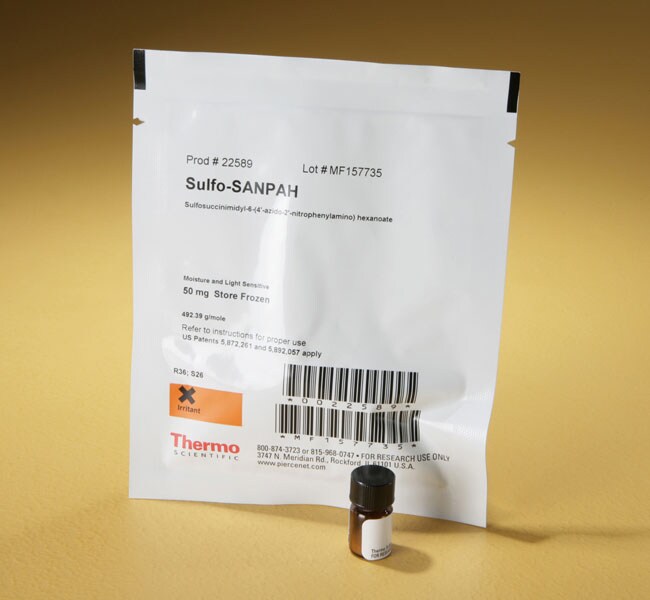
Pierce™ Sulfo-SANPAH,No-Weigh™ 规格
Thermo Scientific Pierce Sulfo-SANPAH 是具有胺反应性 N-羟基琥珀酰亚胺 (NHS) 酯和光活化硝基苯基叠氮化物的异型双功能交联剂。NHS 酯在了解更多信息
Have Questions?
更改视图

| 货号 | 数量 |
|---|---|
| 22589 | 50 mg |
| A35395 | 10 x 1 mg |
货号 22589
价格(CNY)
5,548.00
Each
数量:
50 mg
价格(CNY)
5,548.00
Each
Thermo Scientific Pierce Sulfo-SANPAH 是具有胺反应性 N-羟基琥珀酰亚胺 (NHS) 酯和光活化硝基苯基叠氮化物的异型双功能交联剂。NHS 酯在 pH 值 7–9 缓冲液中与伯胺基 (-NH2) 有效反应,形成稳定的酰胺键。该反应会释放 sulfo-N-羟基-琥珀酰亚胺。当暴露于紫外光,硝基苯基叠氮化物形成一个氮烯基团,通过双键开始加成反应,插入 C-H 和 N-H 位点,或随后进行环扩张以与亲核试剂(例如伯胺)反应。Sulfo-SANPAH 以钠盐形式提供,用于细胞表面蛋白交联,带有电荷具备水溶性,溶解浓度达到 10 mM。
Thermo Scientific No-Weigh 产品是以小包装预分装形式提供的交联试剂。预分装形式为打开即用型,防止随时间推移试剂反应活性降低和受到污染。对于这种包装规格,可每次使用一小瓶新鲜试剂,消除了进行少量试剂称重的操作困扰,并减少了对试剂稳定性的担忧。
Sulfo-SANPAH 的特点:
•反应性基团:sulfo-NHS 酯和硝基苯基叠氮化物
• 可与以下基团发生反应:氨基和任何亲核试剂
• 不可切割
• N-磺基琥珀酰亚胺-6-(4'-叠氮基-2'-苯基硝基氨基) 己酸
• 在 320-350 nm 处发生最佳光解,尽可能减少辐照对生物分子的损害
• 水溶性;不可切割
产品参考文献:
交联剂应用指南 -- 检索本产品的最新参考文献
Thermo Scientific No-Weigh 产品是以小包装预分装形式提供的交联试剂。预分装形式为打开即用型,防止随时间推移试剂反应活性降低和受到污染。对于这种包装规格,可每次使用一小瓶新鲜试剂,消除了进行少量试剂称重的操作困扰,并减少了对试剂稳定性的担忧。
Sulfo-SANPAH 的特点:
•反应性基团:sulfo-NHS 酯和硝基苯基叠氮化物
• 可与以下基团发生反应:氨基和任何亲核试剂
• 不可切割
• N-磺基琥珀酰亚胺-6-(4'-叠氮基-2'-苯基硝基氨基) 己酸
• 在 320-350 nm 处发生最佳光解,尽可能减少辐照对生物分子的损害
• 水溶性;不可切割
产品参考文献:
交联剂应用指南 -- 检索本产品的最新参考文献
仅供科研使用。不可用于诊断程序。
规格
细胞渗透性否
形式粉末
标记方法化学标记
分子量492.4
聚乙二醇化否
产品线Pierce
数量50 mg
反应一部分Sulfo-NHS 酯,芳香叠氮化物
运输条件环境
溶解度水
间隔臂长18.2 Å
水溶性是
化学反应性胺-非选择性
可裂解用硫醇
交联剂类型异型双功能团试剂
产品规格标准、一次性使用
产品类型交联剂
间隔子中等(10 至 30 Å)
Unit SizeEach
内容与储存
收到后,在 -20°C 下避光防潮储存。
常见问题解答 (FAQ)
Can you provide the shelf-life for Sulfo-SANPAH?
What are the reactive groups on Sulfo-SANPAH and which groups do they react with?
引用和文献 (5)
引用和文献
Abstract
Growth cones as soft and weak force generators.
Journal:Proc Natl Acad Sci U S A
PubMed ID:21813757
'Many biochemical processes in the growth cone finally target its biomechanical properties, such as stiffness and force generation, and thus permit and control growth cone movement. Despite the immense progress in our understanding of biochemical processes regulating neuronal growth, growth cone biomechanics remains poorly understood. Here, we combine different experimental
Tension is required but not sufficient for focal adhesion maturation without a stress fiber template.
Journal:J Cell Biol
PubMed ID:22291038
Focal adhesion composition and size are modulated in a myosin II-dependent maturation process that controls adhesion, migration, and matrix remodeling. As myosin II activity drives stress fiber assembly and enhanced tension at adhesions simultaneously, the extent to which adhesion maturation is driven by tension or altered actin architecture is unknown.
Periostin modulates myofibroblast differentiation during full-thickness cutaneous wound repair.
Journal:J Cell Sci
PubMed ID:22266908
The matricellular protein periostin is expressed in the skin. Although periostin has been hypothesized to contribute to dermal homeostasis and repair, this has not been directly tested. To assess the contribution of periostin to dermal healing, 6 mm full-thickness excisional wounds were created in the skin of periostin-knockout and wild-type,
Alpha-actinin-4 and CLP36 protein deficiencies contribute to podocyte defects in multiple human glomerulopathies.
Journal:J Biol Chem
PubMed ID:21680739
Genetic alterations of a-actinin-4 can cause podocyte injury through multiple mechanisms. Although a mechanism involving gain-of-a-actinin-4 function was well described and is responsible for a dominantly inherited form of human focal segmental glomerulosclerosis (FSGS), evidence supporting mechanisms involving loss-of-a-actinin-4 function in human glomerular diseases remains elusive. Here we show that
Contractile forces contribute to increased glycosylphosphatidylinositol-anchored receptor CD24-facilitated cancer cell invasion.
Journal:J Biol Chem
PubMed ID:21828044
The malignancy of a tumor depends on the capability of cancer cells to metastasize. The process of metastasis involves cell invasion through connective tissue and transmigration through endothelial monolayers. The expression of the glycosylphosphatidylinositol-anchored receptor CD24 is increased in several tumor types and is consistently associated with increased metastasis formation