Which Thermo Scientific protein assay is the best or the most reliable?
The choice of protein assay is dependent on preferences related to assay speed, accuracy and sensitivity, as well as interfering substances in the sample to be assayed. BCA has less protein-to-protein variation, is compatible with most detergents, and has larger working range. Pierce Bradford Plus Protein Assay Kit (Cat. Nos. 23236, A55866) is compatible with reducing sugars, is more sensitive and is faster and easier to use. For a comparison of different protein assays and compatible reagents, see our Tech Tip: Protein Quantitation Assay Compatibility Table (https://assets.thermofisher.com/TFS-Assets/LSG/Application-Notes/TR0068-Protein-assay-compatibility.pdf).
Find additional tips, troubleshooting help, and resources within our Protein Assays and Quantitation Support Center.
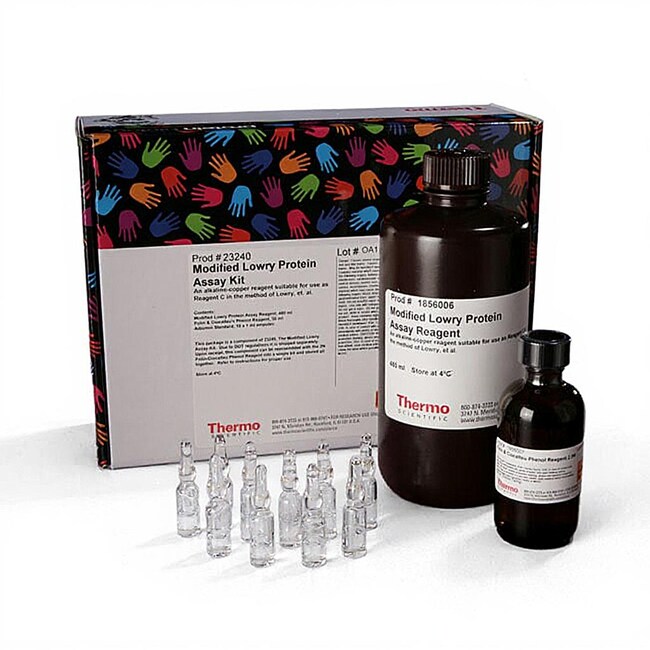
I purchased the Pierce Modified Lowry Protein Assay Kit (Cat. No. 23240). The label on the bottle states that it should be stored at 4 degrees C, whereas the box that the kit arrives in states to store at 2-8 degrees C. Which is correct?
The entire kit (3 components) can be stored at 4°C. The storage of individual components is listed below:
- The Lowry Protein Assay Reagent should be stored at 4°C.
- The 2N Folin-Ciocalteu Reagent has been tested for one year at both 4°C and room temperature, and shows no difference in performance with both storage conditions.
The Albumin Standard Ampules can be stored at 4°C or room temperature. Stability testing for one year at 4°C and at room temperature has also been performed for the Albumin Standards.
Find additional tips, troubleshooting help, and resources within our Protein Assays and Analysis Support Center
Can you provide the shelf-life for the Pierce Modified Lowry Protein Assay Kit?
The Pierce Modified Lowry Protein Assay Kit is covered under our general 1-year warranty and is guaranteed to be fully functional for 12 months from the date of shipment, if stored as recommended. Please see section 8.1 of our Terms & Conditions of Sale (https://www.thermofisher.com/content/dam/LifeTech/Documents/PDFs/Terms-and-Conditions-of-Sale.pdf) for more details.
Find additional tips, troubleshooting help, and resources within our Protein Assays and Analysis Support Center.
I assayed two protein samples, each containing a different mixture of proteins of same concentration and observed very different color responses in the assay. What is the cause?
Each of the commonly used total protein assay methods exhibits some degree of varying response toward different proteins. These differences relate to amino acid sequence, pI, structure and the presence of certain side chains or prosthetic groups that can dramatically alter the protein’s color response. Most protein assay methods use BSA or immunoglobulin (IgG) as the standard against which the concentration of protein in the sample is determined. However, if great accuracy is required, prepare the standard curve from a pure sample of the target protein.
Find additional tips, troubleshooting help, and resources within our Protein Assays and Analysis Support Center.
My buffer or components of my buffer are not listed in the compatibility table for my protein assay. What should I do?
You can test the tolerance of the assay for your specific buffer formulation. For in-house generated compatibility information, substances were considered compatible at the indicated concentration in the Standard Test Tube Protocol (found in the manual for each protein assay) if the error in protein concentration estimation caused by the presence of the substance was less than or equal to 10%. The substances were tested using WR prepared immediately before each experiment. Blank-corrected 562nm absorbance measurements (for a 1000µg/mL BSA standard + substance) were compared to the net 562nm measurements of the same standard prepared in 0.9% saline.
Find additional tips, troubleshooting help, and resources within our Protein Assays and Analysis Support Center.