Search


引用和文献 (9)
Thermo Scientific™
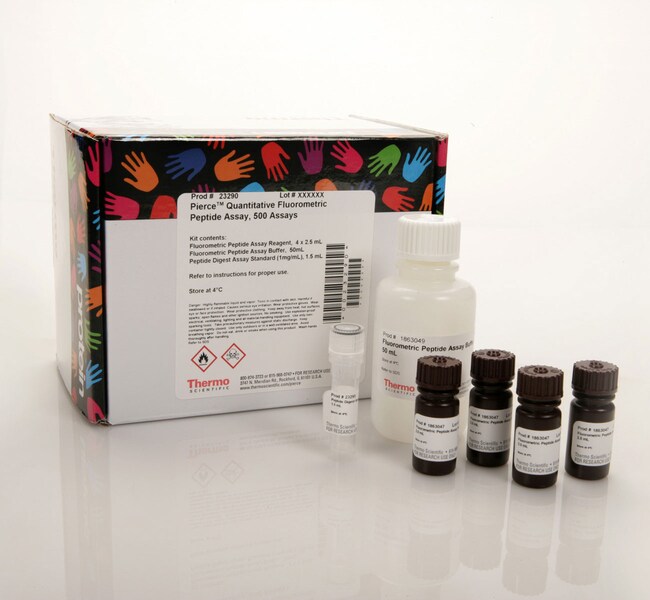
Pierce™ 定量肽检测试剂与标准品
Pierce 比色或荧光定量肽检测试剂和标准品是易于使用的微孔板检测试剂,专为提高与质谱分析配合使用的肽定量的灵敏度和可重现性而设计。
Have Questions?
更改视图

| 货号 | 产品类型 | 检测方法 |
|---|---|---|
| 23290 | 肽检测 | 荧光 |
| 23275 | 肽检测 | 比色法 |
| 23295 | 肽酶切检测标准品 | 比色, 荧光 |
货号 23290
价格(CNY)
4,430.00
飞享价
Ends: 31-Dec-2026
5,735.00共减 1,305.00 (23%)
Each
产品类型:
肽检测
检测方法:
荧光
价格(CNY)
4,430.00
飞享价
Ends: 31-Dec-2026
5,735.00共减 1,305.00 (23%)
Each
Pierce 比色或荧光定量肽检测试剂是一种简单的混合读取微孔板检测试剂,具有稳定的信号,可准确、可靠地测定肽消化样品。优质的肽消化参考标准品单独提供或包含在试剂盒内,用于生成线性标准曲线,以提高准确性和可重现性。这款灵敏度更高、测定样品量较低且随附的参考标准品至关重要,它可准确、可靠地测定肽消化样品,进而对进样量进行归一化,以便用于 MS 分析。
• 灵敏 — 准确检测低至 5 µg/mL(荧光法)或 25 µg/mL(比色法)的肽混合物
• 可重现 — 检测试剂盒的性能已使用肽消化混合物进行严格检测
• 可靠的肽消化标准品 — 试剂盒包括一种经验证的肽消化标准品,可提高定量的可重现性
• 兼容 — 可与多种试剂配合使用,包括 MS 样品制备试剂和 TMT 标记肽(荧光测定)
• 方便 — 简单的混合读取形式,在短短5分钟(荧光法)或15分钟(比色法)内便可读到稳定信号
Pierce 定量比色肽检测试剂盒提供了改良的 BCA 试剂(用于将 Cu+2 还原为 Cu+1)、经优化的专有螯合剂(用于定量肽混合物)以及肽消化参考标准品(用于生成对照线性标准曲线)。这款比色肽检测试剂盒只需少量样品 (20 µL),且工作肽浓度范围为 25–1000 μg/mL。在反应中,先在碱性条件下通过肽的酰胺主链还原铜(双缩脲反应),随后,还原的铜与螯合物结合形成明亮的红色复合物(吸收波长为 480 nm),在短短15分钟内便可读取到该复合物。该反应产生的信号比用于肽分析的 Micro-BCA 蛋白检测试剂盒灵敏 3–4 倍。比色肽检测试剂盒与 TMT 标记肽兼容,但不建议用于合成肽,因为该检测试剂盒会受到肽氨基酸含量的影响。
Pierce 定量荧光肽检测试剂盒的试剂包括肽测定缓冲液、荧光肽标记试剂以及用于肽浓度定量测定的肽消化测定标准品。这款灵敏的检测试剂盒仅需 10 µL 样品,会随着肽浓度增加 (5–1000 μg/mL) 而产生线性响应,并且可生成在短短5分钟内便能检测到的稳定最终荧光。在此检测试剂盒中,使用胺反应性荧光试剂(直到与胰蛋白酶肽反应才会发出荧光)在肽的氨基末端添加了特异性标记。在微孔板读数仪 (ex390/em475) 上检测荧光标记的肽。该检测试剂盒适用于定量测定肽消化混合物和氨基末端未封闭的合成肽。荧光检测试剂盒与 TMT 标记肽不兼容。
Thermo Scientific 肽消化测定标准品旨在用作与 Pierce 定量荧光和比色肽检测试剂配合使用的参考标准品,以提高肽定量的可重现性和准确性。肽消化测定标准品以浓度为 1 mg/mL 的即用型液体规格提供。已使用 MS 级胰蛋白酶消化参考蛋白,以尽量减少缺失的切割。为确保性能一致,监测蛋白的酶切效率以确保批间一致性,并通过与参比标准品进行比较来评估质量。
应用
• 对样品浓度进行归一化,以便用于下游定量应用
• 对上样量进行归一化,以便用于 LC、MS 和 LC/MS 应用
• 在肽纯化步骤后测量回收率
• 可重现 — 检测试剂盒的性能已使用肽消化混合物进行严格检测
• 可靠的肽消化标准品 — 试剂盒包括一种经验证的肽消化标准品,可提高定量的可重现性
• 兼容 — 可与多种试剂配合使用,包括 MS 样品制备试剂和 TMT 标记肽(荧光测定)
• 方便 — 简单的混合读取形式,在短短5分钟(荧光法)或15分钟(比色法)内便可读到稳定信号
Pierce 定量比色肽检测试剂盒提供了改良的 BCA 试剂(用于将 Cu+2 还原为 Cu+1)、经优化的专有螯合剂(用于定量肽混合物)以及肽消化参考标准品(用于生成对照线性标准曲线)。这款比色肽检测试剂盒只需少量样品 (20 µL),且工作肽浓度范围为 25–1000 μg/mL。在反应中,先在碱性条件下通过肽的酰胺主链还原铜(双缩脲反应),随后,还原的铜与螯合物结合形成明亮的红色复合物(吸收波长为 480 nm),在短短15分钟内便可读取到该复合物。该反应产生的信号比用于肽分析的 Micro-BCA 蛋白检测试剂盒灵敏 3–4 倍。比色肽检测试剂盒与 TMT 标记肽兼容,但不建议用于合成肽,因为该检测试剂盒会受到肽氨基酸含量的影响。
Pierce 定量荧光肽检测试剂盒的试剂包括肽测定缓冲液、荧光肽标记试剂以及用于肽浓度定量测定的肽消化测定标准品。这款灵敏的检测试剂盒仅需 10 µL 样品,会随着肽浓度增加 (5–1000 μg/mL) 而产生线性响应,并且可生成在短短5分钟内便能检测到的稳定最终荧光。在此检测试剂盒中,使用胺反应性荧光试剂(直到与胰蛋白酶肽反应才会发出荧光)在肽的氨基末端添加了特异性标记。在微孔板读数仪 (ex390/em475) 上检测荧光标记的肽。该检测试剂盒适用于定量测定肽消化混合物和氨基末端未封闭的合成肽。荧光检测试剂盒与 TMT 标记肽不兼容。
Thermo Scientific 肽消化测定标准品旨在用作与 Pierce 定量荧光和比色肽检测试剂配合使用的参考标准品,以提高肽定量的可重现性和准确性。肽消化测定标准品以浓度为 1 mg/mL 的即用型液体规格提供。已使用 MS 级胰蛋白酶消化参考蛋白,以尽量减少缺失的切割。为确保性能一致,监测蛋白的酶切效率以确保批间一致性,并通过与参比标准品进行比较来评估质量。
应用
• 对样品浓度进行归一化,以便用于下游定量应用
• 对上样量进行归一化,以便用于 LC、MS 和 LC/MS 应用
• 在肽纯化步骤后测量回收率
For Research Use Only. Not for use in diagnostic procedures.
规格
化学反应性胺
最终产品类型肽
适用于(设备)微孔板读数仪
数量500 次检测
工作流程步骤过程中检测
检测方法荧光
产品规格试剂盒
产品线Pierce
产品类型肽检测
原始材料肽, 蛋白酶酶切的蛋白
Unit SizeEach
内容与储存
荧光肽测定试剂,4 x 2.5 mL
荧光肽测定缓冲液,50 mL
肽消化测定标准品,1.5 mL
在冷藏冰箱 (2–8°C) 中储存。
荧光肽测定缓冲液,50 mL
肽消化测定标准品,1.5 mL
在冷藏冰箱 (2–8°C) 中储存。
常见问题解答 (FAQ)
When I quantitate my mass spec peptide sample with the Pierce Quantitative Colorimetric Peptide Assay, I get different results than when I use the Pierce Quantitative Fluorometric Peptide Assay. Which is best to use for the most accurate quantitation?
How can I determine peptide yield in my mass spectrometry samples after sample clean-up?
I have good peptide identification numbers but the variation between sample replicates is high. What do you recommend to improve sample reproducibility?
I have varying amounts of peptide in my samples. Is there a way to determine peptide yield after sample clean-up?
I have varying amounts of peptide in my mass spectrometry analysis samples. Is there a way I can determine peptide yield after sample clean-up?
引用和文献 (9)
引用和文献
Abstract
The effect of altered pH growth conditions on the production, composition, and proteomes of Helicobacter pylori outer membrane vesicles.
Journal:Proteomics
PubMed ID:37991474
Gram-negative bacteria release outer membrane vesicles (OMVs) that contain cargo derived from their parent bacteria. Helicobacter pylori is a Gram-negative human pathogen that produces urease to increase the pH of the surrounding environment to facilitate colonization of the gastric mucosa. However, the effect of acidic growth conditions on the production
Detectability of Biotin Tags by LC-MS/MS.
Journal:Journal of proteome research
PubMed ID:33780260
The high affinity of biotin to streptavidin has made it one of the most widely used affinity tags in proteomics. Early methods used biotin for enrichment alone and mostly ignored the biotin-labeled peptide. Recent advances in labeling have led to an increase in biotinylation efficiency and shifted the interest to
Quantitative proteomic analysis of human peripheral nerves from subjects with type 2 diabetes.
Journal:Diabetic medicine : a journal of the British Diabetic Association
PubMed ID:34309080
AIMS: Diabetic peripheral neuropathy (DPN) is a common and severe complication to type 2 diabetes. The pathogenesis of DPN is not fully known, but several pathways and gene polymorphisms contributing to DPN are described. DPN can be studied using nerve biopsies, but studies on the proteome of the nerve itself,
Proteomics analysis reveals the differential impact of the p97 inhibitor CB-5083 on protein levels in various cellular compartments of the HL-60 cell line.
Journal:microPublication biology
PubMed ID:39677520
Human p97/VCP is a vital AAA ATPase (ATPase associated with diverse cellular activity) that plays critical roles in protein homeostasis by regulating autophagy, endosomal trafficking, and the ubiquitin-proteasome system. Global proteomics analysis of p97/VCP inhibition with CB-5083 has been performed in HCT116 colon cells. Here, we examined the impact of
Response of Lactiplantibacillus plantarum NMGL2 to Combinational Cold and Acid Stresses during Storage of Fermented Milk as Analyzed by Data-Independent Acquisition Proteomics.
Journal:Foods (Basel, Switzerland)
PubMed ID:34209263
To understand the mechanism of tolerance of lactic acid bacteria (LAB) during cold storage of fermented milk, 31 LAB strains were isolated from traditional fermented products, and Lactiplantibacillus plantarum NMGL2 was identified with good tolerance to both cold and acid stresses. Data-independent acquisition proteomics method was employed to analyze the