Search

Thermo Scientific™
适用于生物素化蛋白的 Pierce™ Far-Western 蛋白免疫印迹试剂盒
The Thermo Scientific Pierce Far-Western Blot Kit for Biotinylated Proteins enables in-gel or on-membrane Western blot detection of target proteins了解更多信息
| 货号 | 数量 |
|---|---|
| 23500 | 220 mL |
货号 23500
价格(CNY)
9,205.00
Each
数量:
220 mL
价格(CNY)
9,205.00
Each
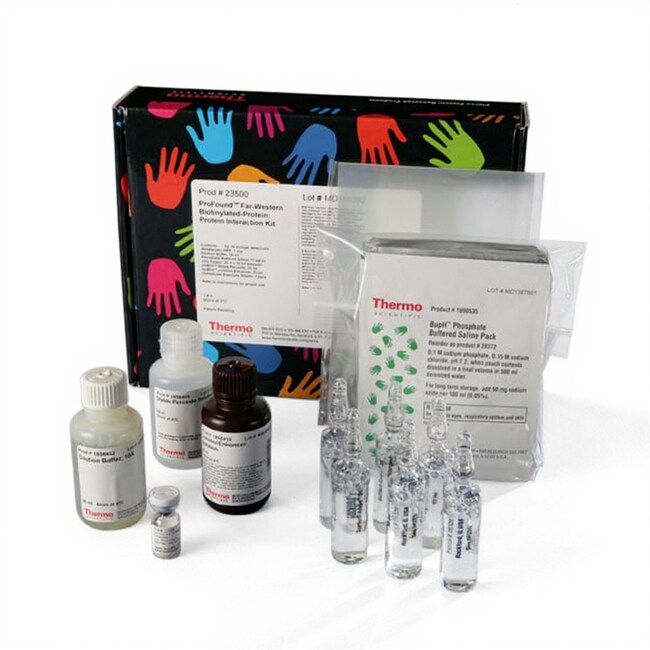
The Thermo Scientific Pierce Far-Western Blot Kit for Biotinylated Proteins enables in-gel or on-membrane Western blot detection of target proteins via interaction with any biotin-labeled test protein used as the primary probe.
Features of the Far-Western Blot Kit for Biotinylated Proteins:
• On-membrane or in-gel detection options—on-membrane detection offers greater sensitivity; in-gel detection is faster and prevents problems associated with incomplete or inefficient transfer
• Nonradioactive alternative for far-Western analysis—reliable and sensitive biotin/streptavidin-HRP chemistry combined with chemiluminescent detection offers a practical and safe alternative to radiolabeling the bait protein
• Useful interaction range—effective for interaction pairs that have moderate to strong binding associations between the prey and the biotinylated bait protein
• Primary antibody-free detection—uses a biotinylated protein as the probe, eliminating the need for primary antibodies or even to have prior knowledge of target-protein identities
• Compatible with both SDS-PAGE and native gels—provides option to probe for prey proteins in a more native environment because reduced or denaturing systems may not always allow for the intended interaction
• Reduced nonspecific binding—biotin/streptavidin-HRP systems demonstrate less nonspecific binding compared to antibodies directed against the bait protein
• Compatible with protein staining—gels can be used for total protein staining after the in-gel chemiluminescent detection step, eliminating the need to run two gels
This far-Western blotting kit provides the reagents and protocol necessary to probe for target proteins by virtue of their interaction with a specific binding partner, which the researcher supplies in purified, biotinylated form. The kit is successful for analysis of protein-protein interactions in which the target (prey) proteins can be bound after they have been separated by gel electrophoresis. The kit includes reagents and procedures for probing and chemiluminescent detection with blots or directly from mini gels.
Includes:
• Streptavidin-HRP conjugate, dilution and wash buffers, chemiluminescent substrate solutions, and cellophane sheets for mini gels
Applications:
• Protein interaction discovery—search and screen for proteins in cell lysates that have binding affinity to the purified biotinylated protein
• Protein interaction confirmation—characterize and identify the presence of native or off-target binding interactions involving a given biotinylated protein and particular samples
Far-Western blotting involves probing for targets first with a putative interaction-protein rather than a primary antibody. The method is called far-Western blotting because primary antibodies are used secondarily to detect the primary interaction probe rather than the target protein. The Pierce Far-Western Blot Kit for Biotinylated Proteins eliminates the use of antibodies altogether. The primary probe (i.e., the biotinylated bait protein supplied by the researcher) is secondarily detected with streptavidin-HRP conjugate, whose activity is visualized by reaction with a very sensitive chemiluminescent substrate.
Features of the Far-Western Blot Kit for Biotinylated Proteins:
• On-membrane or in-gel detection options—on-membrane detection offers greater sensitivity; in-gel detection is faster and prevents problems associated with incomplete or inefficient transfer
• Nonradioactive alternative for far-Western analysis—reliable and sensitive biotin/streptavidin-HRP chemistry combined with chemiluminescent detection offers a practical and safe alternative to radiolabeling the bait protein
• Useful interaction range—effective for interaction pairs that have moderate to strong binding associations between the prey and the biotinylated bait protein
• Primary antibody-free detection—uses a biotinylated protein as the probe, eliminating the need for primary antibodies or even to have prior knowledge of target-protein identities
• Compatible with both SDS-PAGE and native gels—provides option to probe for prey proteins in a more native environment because reduced or denaturing systems may not always allow for the intended interaction
• Reduced nonspecific binding—biotin/streptavidin-HRP systems demonstrate less nonspecific binding compared to antibodies directed against the bait protein
• Compatible with protein staining—gels can be used for total protein staining after the in-gel chemiluminescent detection step, eliminating the need to run two gels
This far-Western blotting kit provides the reagents and protocol necessary to probe for target proteins by virtue of their interaction with a specific binding partner, which the researcher supplies in purified, biotinylated form. The kit is successful for analysis of protein-protein interactions in which the target (prey) proteins can be bound after they have been separated by gel electrophoresis. The kit includes reagents and procedures for probing and chemiluminescent detection with blots or directly from mini gels.
Includes:
• Streptavidin-HRP conjugate, dilution and wash buffers, chemiluminescent substrate solutions, and cellophane sheets for mini gels
Applications:
• Protein interaction discovery—search and screen for proteins in cell lysates that have binding affinity to the purified biotinylated protein
• Protein interaction confirmation—characterize and identify the presence of native or off-target binding interactions involving a given biotinylated protein and particular samples
Far-Western blotting involves probing for targets first with a putative interaction-protein rather than a primary antibody. The method is called far-Western blotting because primary antibodies are used secondarily to detect the primary interaction probe rather than the target protein. The Pierce Far-Western Blot Kit for Biotinylated Proteins eliminates the use of antibodies altogether. The primary probe (i.e., the biotinylated bait protein supplied by the researcher) is secondarily detected with streptavidin-HRP conjugate, whose activity is visualized by reaction with a very sensitive chemiluminescent substrate.
仅供科研使用。不可用于诊断程序。
规格
反应性所有物种
足够用于10次小型凝胶
检测方法化学发光
产品线Pierce
产品类型Western 印迹试剂盒
数量220 mL
基质链霉亲和素-HRP
Unit SizeEach
内容与储存
足够用于:使用生物素化蛋白探针进行 10 次小型凝胶或印迹实验
• 链霉素亲和素-HRP 偶联物,0.1 mg
• 稀释缓冲液 (10X),50 mL
• PBS 包(每包可制备 500 mL),17 包
• 鲁米诺增强剂,55 mL
• 稳定的过氧化物缓冲液,55 mL
• Surfact-Amps 20 去垢剂溶液,6 x 10 mL
• 预切割玻璃纸,10 张
将试剂盒储存于 4°C。
• 链霉素亲和素-HRP 偶联物,0.1 mg
• 稀释缓冲液 (10X),50 mL
• PBS 包(每包可制备 500 mL),17 包
• 鲁米诺增强剂,55 mL
• 稳定的过氧化物缓冲液,55 mL
• Surfact-Amps 20 去垢剂溶液,6 x 10 mL
• 预切割玻璃纸,10 张
将试剂盒储存于 4°C。