Search

Thermo Scientific™
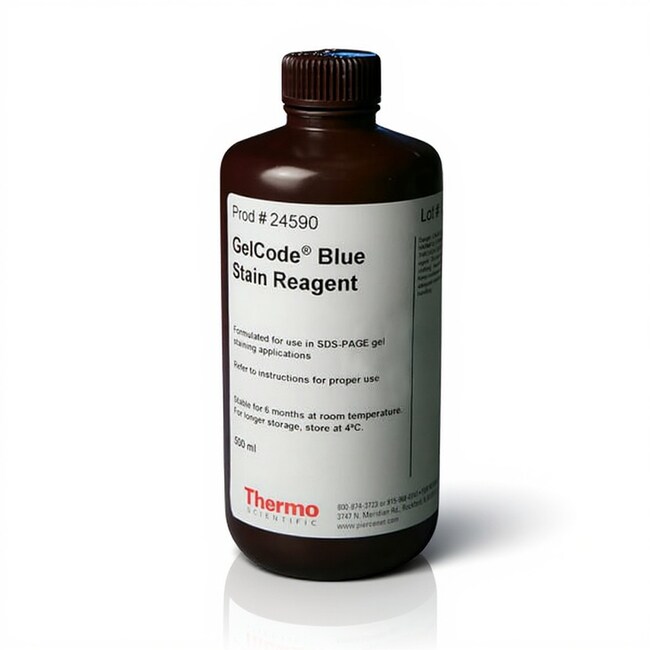
GelCode™ 蓝色染色试剂
GelCode Blue 染色试剂是一种基于胶体考马斯染料 G-250 的即用型蛋白染色剂,可提供聚丙烯酰胺凝胶中的纳克级检测以及印迹中检测。特点:•无需进行甲醇-乙酸脱色• 快速一步法一小时染色—即用型染色试剂;可直接在染色托盘中观察到条带形成;无过夜染色产生的背景;灵活的固定和清洗方案;无凝胶收缩;可以对染色凝胶进行干燥处理• 水洗提高了染色灵敏度—可选步骤提供了水晶般透明凝胶背景,使弱染色的条带变得更易见比较所有考马斯染料 ›这一独特的 GelCode了解更多信息
| 货号 | 数量 |
|---|---|
| 24590 | 500 mL |
货号 24590
价格(CNY)
321.00
飞享价
Ends: 31-Dec-2026
1,274.00共减 953.00 (75%)
Each
数量:
500 mL
价格(CNY)
321.00
飞享价
Ends: 31-Dec-2026
1,274.00共减 953.00 (75%)
Each
GelCode Blue 染色试剂是一种基于胶体考马斯染料 G-250 的即用型蛋白染色剂,可提供聚丙烯酰胺凝胶中的纳克级检测以及印迹中检测。
特点:
•无需进行甲醇-乙酸脱色
• 快速一步法一小时染色—即用型染色试剂;可直接在染色托盘中观察到条带形成;无过夜染色产生的背景;灵活的固定和清洗方案;无凝胶收缩;可以对染色凝胶进行干燥处理
• 水洗提高了染色灵敏度—可选步骤提供了水晶般透明凝胶背景,使弱染色的条带变得更易见
比较所有考马斯染料 ›
这一独特的 GelCode 蓝色染色试剂仅对蛋白染色,支持在一小时凝胶染色过程中直接在凝胶中观察条带。由于脱色步骤不能固定蛋白,GelCode 蓝色染色剂与质谱分析和 N 端序列分析兼容。
特点:
•无需进行甲醇-乙酸脱色
• 快速一步法一小时染色—即用型染色试剂;可直接在染色托盘中观察到条带形成;无过夜染色产生的背景;灵活的固定和清洗方案;无凝胶收缩;可以对染色凝胶进行干燥处理
• 水洗提高了染色灵敏度—可选步骤提供了水晶般透明凝胶背景,使弱染色的条带变得更易见
比较所有考马斯染料 ›
这一独特的 GelCode 蓝色染色试剂仅对蛋白染色,支持在一小时凝胶染色过程中直接在凝胶中观察条带。由于脱色步骤不能固定蛋白,GelCode 蓝色染色剂与质谱分析和 N 端序列分析兼容。
仅供科研使用。不可用于诊断程序。
GelCode 蓝色染色试剂包含添加剂,有助于减慢染料-染料和染料-蛋白聚合物的形成,该聚合物形成于所有基于考马斯染料的蛋白染色试剂中。然而,如果不进行干扰,该试剂将形成可见染料-染料聚合物并在瓶底沉淀。幸运的是,将瓶子轻轻翻转或斜晃几次可使这些聚合物完全分散。因此,在倾倒或分配之前最好将染色试剂混合,以确保使用均匀的试剂样品。
产品参考资料:
- Mateer, S.C.,et al.(2002).J.Biol.Chem.227,12324-12333.
- Aulak, K.S.,et al.(2001).Proc.Natl.Acad.Sci.USA98,12056-12061.
- Lim, J.,et al.(2002).J.Biol.Chem.277,20774-20782.
- Hilton, J.M.,et al.(2001).J.Biol.Chem.276,16341-16347.
- Tani, M.,et al.(2002).J.Biol.Chem.275,3462-3468.
规格
检测定位印迹内检测,凝胶内检测
检测方法比色法
数量500 mL
有效期每 6 个月
靶标分子蛋白质
颜色Blue
标签或染料Coomassie
产品线GelCode
产品类型蛋白凝胶染色试剂
Unit SizeEach
内容与储存
储存于 4°C。