Search


引用和文献 (4)
Gibco™
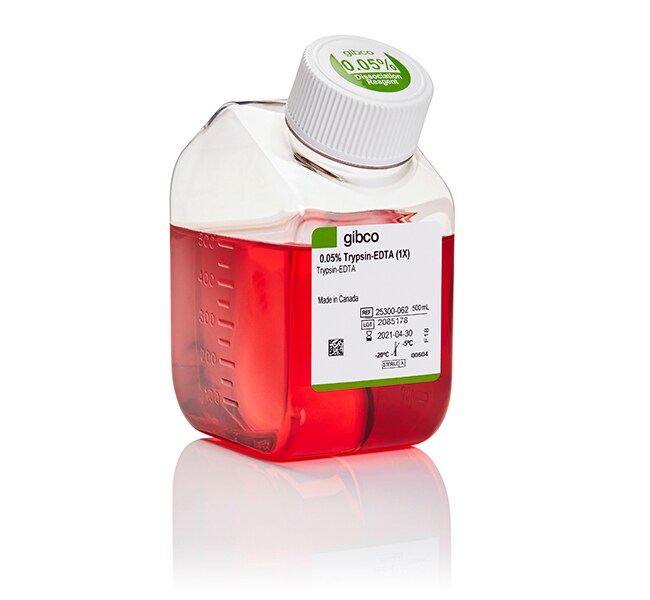
胰蛋白酶-EDTA (0.05%),含酚红
Gibco Trypsin-EDTA is made from trypsin powder, an irradiated mixture of proteases derived from porcine pancreas. Due to its digestive了解更多信息
Have Questions?
更改视图

| 货号 | 数量 |
|---|---|
| 25300062 | 500 mL |
| 25300054 | 100 mL |
| 25300120 | 20 x 100 mL |
货号 25300062
价格(CNY)
620.00
飞享价
Ends: 31-Dec-2026
821.00共减 201.00 (24%)
Each
数量:
500 mL
价格(CNY)
620.00
飞享价
Ends: 31-Dec-2026
821.00共减 201.00 (24%)
Each
Gibco Trypsin-EDTA is made from trypsin powder, an irradiated mixture of proteases derived from porcine pancreas. Due to its digestive strength, trypsin is widely used for cell dissociation, routine cell culture passaging, and primary tissue dissociation. The trypsin concentration required for dissociation varies with cell type and experimental requirements. See the complete range of Gibco trypsin solutions and recommended dissociation conditions.
We offer a variety of trypsin formulations and animal origin-free TrypLE reagent that feature:
• Quality Testing
• Documented Traceability
• Dual-site cGMP Manufacturing
This trypsin solution is modified as follows:
With
• EDTA
• Phenol Red
The complete formulation is available.
Quality Testing
Gibco Trypsin solutions are tested for pH, osmolality, sterility, and performance. In addition, the raw materials are verified for e-beam irradiation and precursor lots are tested for endotoxin, PPV, PCV 1/2, mycoplasma, bacterial, fungal, and viral contamination, as well as multiple activity assays, ash analysis, and moisture analysis.
Documented Traceability
We can provide detailed documentation to meet your regulatory needs. Gibco Trypsin information available includes lot traceability, animal origin certificates, lot analyses, irradiation certificates, a viral inactivation summary, and supply chain transparency.
cGMP Manufacturing and Quality System
For supply chain continuity, we manufacture Gibco Trypsin-EDTA (0.05%), phenol red at two separate facilities located in Grand Island, NY and Scotland, UK. Both sites are compliant with cGMP manufacturing requirements and are certified to the ISO 13485 standard.
We offer a variety of trypsin formulations and animal origin-free TrypLE reagent that feature:
• Quality Testing
• Documented Traceability
• Dual-site cGMP Manufacturing
This trypsin solution is modified as follows:
With
• EDTA
• Phenol Red
The complete formulation is available.
Quality Testing
Gibco Trypsin solutions are tested for pH, osmolality, sterility, and performance. In addition, the raw materials are verified for e-beam irradiation and precursor lots are tested for endotoxin, PPV, PCV 1/2, mycoplasma, bacterial, fungal, and viral contamination, as well as multiple activity assays, ash analysis, and moisture analysis.
Documented Traceability
We can provide detailed documentation to meet your regulatory needs. Gibco Trypsin information available includes lot traceability, animal origin certificates, lot analyses, irradiation certificates, a viral inactivation summary, and supply chain transparency.
cGMP Manufacturing and Quality System
For supply chain continuity, we manufacture Gibco Trypsin-EDTA (0.05%), phenol red at two separate facilities located in Grand Island, NY and Scotland, UK. Both sites are compliant with cGMP manufacturing requirements and are certified to the ISO 13485 standard.
规格
细胞类型哺乳动物细胞
螯合剂EDTA
最大浓度1X
渗透压270 - 310 mOsm/kg
产品线Gibco
数量500 mL
有效期24 个月
运输条件湿冰
来源动物来源
经过测试体外生物测定
分类动物来源
形式液体
产品类型细胞培养解离试剂
无菌无菌过滤
灭菌方法Sterile-filtered
加有添加剂酚红, EDTA
pH7.1 - 8
Unit SizeEach
内容与储存
储存条件:-5°C 至 -20°C
有效期:自生产之日起 24 个月
有效期:自生产之日起 24 个月
常见问题解答 (FAQ)
解冻后的胰酶可在冰箱中放置多长时间?
Gibco TrypLE试剂与胰酶相比优势在于?
你们提供哪些用于解离细胞的试剂?这些产品之间的主要区别是什么?
你们是否提供不含酚红的培养基(无酚红培养基)?
How do you isolate cells from tissue?
引用和文献 (4)
引用和文献
Abstract
Combined effects of the bisphosphonate, zoledronic acid and the aromatase inhibitor letrozole on breast cancer cells in vitro: evidence of synergistic interaction.
Journal:Br J Cancer
PubMed ID:20160726
'Aromatase inhibitors are widely used in the treatment of oestrogen receptor-positive post-menopausal breast cancer. These patients may also be receiving the bisphosphonate, zoledronic acid (ZA) to prevent bone loss or reduce skeletal morbidity in the setting of advanced disease. The potential biological interaction of these two drugs in breast cancer
Isolation, cultivation and characterization of adult murine prostate stem cells.
Journal:Nat Protoc
PubMed ID:20360765
'The successful isolation and cultivation of prostate stem cells will allow us to study their unique biological properties and their application in therapeutic approaches. Here we describe step-by-step procedures on the basis of previous work in our laboratory for the harvesting of primary prostate cells from adolescent male mice by
Binding of low affinity N-formyl peptide receptors to G protein. Characterization of a novel inactive receptor intermediate.
Journal:J Biol Chem
PubMed ID:7738006
G protein-coupled seven-transmembrane-containing receptors, such as the N-formyl peptide receptor (FPR) of neutrophils, likely undergo a conformational change upon binding of ligand, which enables the receptor to transmit a signal to G proteins. We have examined the functional significance of numerous conserved charged amino acid residues proposed to be located
Characterization of the 46-kDa intermediates of matrix metalloproteinase 3 (stromelysin 1) obtained by site-directed mutation of phenylalanine 83.
Journal:J Biol Chem
PubMed ID:8631880
The precursor of matrix metalloproteinase 3 (MMP-3/ stromelysin 1) is activated in vitro by proteinases or mercurial compounds by stepwise processes which include the initial formation of short-lived intermediates and the subsequent intermolecular cleavage of the His82-Phe83 bond to generate the fully activated mature MMP-3 (Nagase, H., Enghild, J. J.,