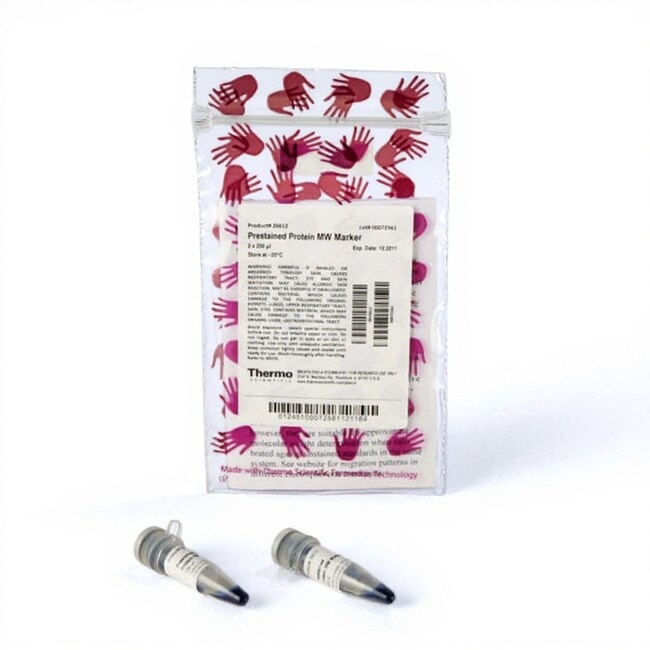
Pierce™ Prestained Protein MW Marker
Invitrogen17万+抗体限时买二赠一,靶点广,灵活用!
Femto超敏底物钜惠大包装上市!100mL到手价不到500元!
Pierce™ Prestained Protein MW Marker
Thermo Scientific™

Pierce™ Prestained Protein MW Marker

Thermo Scientific Prestained Protein Molecular Weight Marker is a mixture of six blue-stained natural proteins (20 to 120 kDa) forRead more
Have Questions?
Catalog NumberQuantity
266122 x 250 μL
Catalog number 26612
Price (CNY)
393.00
Each
Add to cart
Quantity:
2 x 250 μL
Request bulk or custom format
Price (CNY)
393.00
Each
Add to cart

Thermo Scientific Prestained Protein Molecular Weight Marker is a mixture of six blue-stained natural proteins (20 to 120 kDa) for use as size standards in protein electrophoresis (SDS-PAGE). The protein standards are supplied in a ready-to-use format for direct loading onto gels; no need to heat, reduce, or add sample buffer prior to use.

Component proteins

  • Beta-galactosidase (120 kDa)
  • Bovine serum albumin (85 kDa)
  • Ovalbumin (50 kDa)
  • Cardonic anhydrase (35 kDa)
  • Beta-lactoglobulin (25 kDa)
  • Lysozyme (20 kDa)

Applications

  • Monitoring protein migration during SDS-polyacrylamide gel electrophoresis.
  • Monitoring protein transfer onto membranes after western blotting
  • Sizing of proteins on SDS-polyacrylamide gels and western blots
For Research Use Only. Not for use in diagnostic procedures.
Specifications
Detection MethodColorimetric
Gel CompatibilityBolt™ Bis-Tris Plus Gels, Novex™ Tricine Gels, Novex™ Tris-Glycine Gels, NuPAGE™ Bis-Tris Gels, NuPAGE™ Tris-Acetate Gels, SDS-PAGE Gels
Molecular Weight (g/mol)120, 85, 50, 35, 25, 20 kDa
Product LinePierce™
Product TypeProtein Molecular Weight (MW) Marker
Quantity2 x 250 μL
Ready to LoadYes
Shipping ConditionApproved for shipment on Wet or Dry Ice
Stain Type1 color: Blue
System TypeWestern Blotting, SDS-PAGE
Number of Markers6
Size Range20 to 120 kDa
Unit SizeEach
Contents & Storage
Storage Buffer: 62.5 mM Tris · H3PO4 (pH 7.5 at 25°C), 1 mM EDTA, 2% (w/v) SDS, 1 mM DTT, 1.5 mM NaN3 and 33% (v/v) glycerol.

Upon receipt store at -20°C. Product is shipped with an ice pack.

Frequently asked questions (FAQs)

Why do Thermo Scientific prestained protein ladders not show the real protein sizes?

Coupling of chromophores to proteins affects the apparent molecular weight of proteins in SDS-PAGE relative to unstained standards. The apparent molecular weight of prestained protein standards is calibrated in the classical TRIS glycine-SDS Laemmli system, however prestained proteins may have different mobility in other electrophoresis buffer and gel systems. It should also be noted that the sizing of proteins by gel electrophoresis does not give an exact value and depends on the protein sequence and post-modification.

Find additional tips, troubleshooting help, and resources within our Protein Assays and Analysis Support Center.

The upper bands of the ladder are missing. What could be the reason?

The upper bands of the ladder may be degraded by proteases. Ladder, gel, buffer, pipettes, pipette tips, or equipment can be contaminated by proteases during usage. A general recommendation would be to avoid working with proteases in the same room. We would recommend preparing fresh solutions, cleaning the equipment, and using clean pipettes and tips. If the ladder itself is contaminated, please use a new tube of the ladder.

Find additional tips, troubleshooting help, and resources within our Protein Assays and Analysis Support Center.

Do the proteins in Thermo Scientific protein ladders have a His-Tag or would otherwise react with an anti-His-Tag antibody?

No, proteins in Thermo Scientific protein ladders are not His tagged. However, non-specific interaction between the ladder proteins and primary or secondary antibodies is possible and some His-Tag detection systems, such as Thermo Scientific 6xHis Protein Tag Stain Reagent Kit, show non-specific interaction. The protein ladder bands are more readily detected when using high antibody concentrations. The non-specific cross-reactivity is difficult to predict, it often has a different pattern dependent on the antibodies used in each individual experiment. The most general way to handle this problem would be to use lower concentrations of antibodies and to use lower amount of protein ladders. It may also be useful to leave one empty well between the ladder and the sample to overcome a possible leakage of the signal to the nearby sample lane.

Find additional tips, troubleshooting help, and resources within our Protein Assays and Analysis Support Center.

Can Thermo Scientific protein ladders be detected by Strep-Tactin conjugates?

PageRuler Unstained protein ladders can be detected directly on Western blots by using Strep-Tactin conjugates or an antibody against the Strep-tag II sequence. All PageRuler and Spectra ladder proteins contain an integral Strep-tag II sequence, however the prestained ladders cannot be detected by Strep-Tactin conjugates.

Find additional tips, troubleshooting help, and resources within our Protein Assays and Analysis Support Center.

Why is non-specific binding detected after Western blot?

Protein ladder bands can sometimes be detected with chemiluminescent techniques due to non-specific interactions of ladder proteins with either primary or secondary antibodies (or with both). The ladder bands are only rarely detected by chromogenic substrates. The extremely high sensitivity of the chemiluminescent assays is needed to see the bands, so the actual degree of cross-reactivity is low. The non-specific cross-reactivity is difficult to predict, it often has a different pattern depending on the antibodies used. If antibodies recognize a linear epitope, the cross-reactivity may be due to sequence homology. If antibodies react with a denaturation-resistant conformational epitope it could be impossible to identify the exact reason for detected cross-reactivity. The most general way to handle this problem would be to use lower concentrations of antibodies.

Find additional tips, troubleshooting help, and resources within our Protein Assays and Analysis Support Center.