Search


引用和文献 (10)
Thermo Scientific™
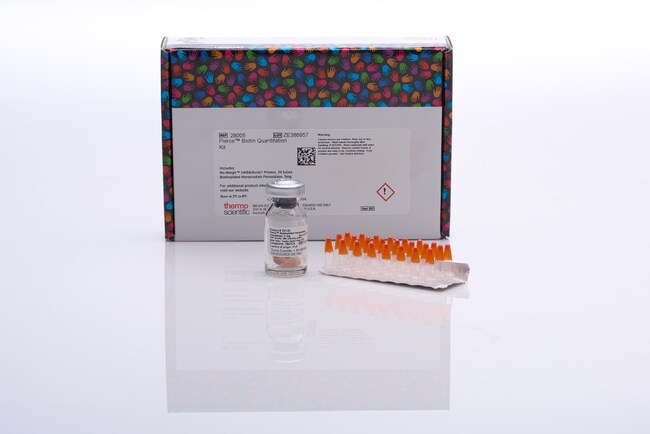
Pierce™ 生物素定量试剂盒
Thermo Scientific Pierce 生物素定量试剂盒包括 HABA 试剂和生物素化蛋白标准品的等份试液,用于标记抗体和其他蛋白中生物素化水平的便利比色测定。生物素定量试剂盒的特点:•比色–需要酶标仪或分光光度计套件以便在 500nm 处进行测量•可靠–用于生物素化水平测定的经证实的良好表征方法•便利–试剂盒可提供轻松进行检测所需的试剂和标准品•灵活–适用于分光光度计比色皿或带 96了解更多信息
| 货号 | 数量 |
|---|---|
| 28005 | 12 Tests |
货号 28005
价格(CNY)
3,871.00
Each
数量:
12 Tests
价格(CNY)
3,871.00
Each
Thermo Scientific Pierce 生物素定量试剂盒包括 HABA 试剂和生物素化蛋白标准品的等份试液,用于标记抗体和其他蛋白中生物素化水平的便利比色测定。
生物素定量试剂盒的特点:
•比色–需要酶标仪或分光光度计套件以便在 500nm 处进行测量
•可靠–用于生物素化水平测定的经证实的良好表征方法
•便利–试剂盒可提供轻松进行检测所需的试剂和标准品
•灵活–适用于分光光度计比色皿或带 96 孔微孔板的标准酶标仪
• 选项 –使用说明中概述的程序,基于消光系数,直接通过吸光度值计算结果
• 稳健 –提供的 HABA-亲和素复合物可在广泛的 pH 值和盐浓度范围内使用
HABA 染料(4'-羟基偶氮苯-2-羧酸)是一种能够快速估算溶液中生物素与蛋白质摩尔比的试剂。Pierce 生物素定量试剂盒包含 HABA 和亲和素及生物素化辣根过氧化物酶 (HRP) 阳性对照的预混液。HABA-亲和素预混液以便利的 Thermo Scientific No-Weigh 微管包装(消除称量少量试剂带来的困难)提供。
为了定量生物素化,将含有生物素化蛋白的溶液加入 HABA 和亲和素混合物中。由于对亲和素的亲和力较高,生物素取代 HABA 且 500 nm 处的吸光度成比例降低。通过这种方法,可在单个比色皿中,通过测量添加含生物素的样品前后 HABA-亲和素溶液的吸光度,对溶液中存在的未知量生物素进行定量。吸光度的变化通过 HABA-亲和素复合物的消光系数与样品中的生物素量相关联。查看在线 HABA 计算器。
生物素定量试剂盒的特点:
•比色–需要酶标仪或分光光度计套件以便在 500nm 处进行测量
•可靠–用于生物素化水平测定的经证实的良好表征方法
•便利–试剂盒可提供轻松进行检测所需的试剂和标准品
•灵活–适用于分光光度计比色皿或带 96 孔微孔板的标准酶标仪
• 选项 –使用说明中概述的程序,基于消光系数,直接通过吸光度值计算结果
• 稳健 –提供的 HABA-亲和素复合物可在广泛的 pH 值和盐浓度范围内使用
HABA 染料(4'-羟基偶氮苯-2-羧酸)是一种能够快速估算溶液中生物素与蛋白质摩尔比的试剂。Pierce 生物素定量试剂盒包含 HABA 和亲和素及生物素化辣根过氧化物酶 (HRP) 阳性对照的预混液。HABA-亲和素预混液以便利的 Thermo Scientific No-Weigh 微管包装(消除称量少量试剂带来的困难)提供。
为了定量生物素化,将含有生物素化蛋白的溶液加入 HABA 和亲和素混合物中。由于对亲和素的亲和力较高,生物素取代 HABA 且 500 nm 处的吸光度成比例降低。通过这种方法,可在单个比色皿中,通过测量添加含生物素的样品前后 HABA-亲和素溶液的吸光度,对溶液中存在的未知量生物素进行定量。吸光度的变化通过 HABA-亲和素复合物的消光系数与样品中的生物素量相关联。查看在线 HABA 计算器。
仅供科研使用。不可用于诊断程序。
规格
产品线Pierce
产品类型生物素定量试剂盒
数量12 Tests
标记目标抗体, 蛋白
标签或染料生物素
Unit SizeEach
内容与储存
足够用于:检测 12 份蛋白样品的生物素化
• HABA-亲和素预混液,24 管
• 生物素化辣根过氧化物酶,5 mg
在 4°C 下储存。
• HABA-亲和素预混液,24 管
• 生物素化辣根过氧化物酶,5 mg
在 4°C 下储存。
常见问题解答 (FAQ)
How can I determine the amount of biotinylation on my ligand?
Can you provide the shelf life for Pierce Biotin Quantitation Kit (28005)?
How can I determine the degree of protein labeling?
引用和文献 (10)
引用和文献
Abstract
Buoyancy-activated cell sorting using targeted biotinylated albumin microbubbles.
Journal:
PubMed ID:25993512
'Cell analysis often requires the isolation of certain cell types. Various isolation methods have been applied to cell sorting, including fluorescence-activated cell sorting and magnetic-activated cell sorting. However, these conventional approaches involve exerting mechanical forces on the cells, thus risking cell damage. In this study we applied a novel isolation
A general protocol for the generation of Nanobodies for structural biology.
Journal:
PubMed ID:24577359
There is growing interest in using antibodies as auxiliary tools to crystallize proteins. Here we describe a general protocol for the generation of Nanobodies to be used as crystallization chaperones for the structural investigation of diverse conformational states of flexible (membrane) proteins and complexes thereof. Our technology has a competitive
Development of a novel, guinea pig-specific IFN-? ELISPOT assay and characterization of guinea pig cytomegalovirus GP83-specific cellular immune responses following immunization with a modified vaccinia virus Ankara (MVA)-vectored GP83 vaccine.
Journal:
PubMed ID:24856783
The guinea pig (Cavia porcellus) provides a useful animal model for studying the pathogenesis of many infectious diseases, and for preclinical evaluation of vaccines. However, guinea pig models are limited by the lack of immunological reagents required for characterization and quantification of antigen-specific T cell responses. To address this deficiency,
Engineering selective competitors for the discrimination of highly conserved protein-protein interaction modules.
Journal:Nat Commun
PubMed ID:31586061
'Designing highly specific modulators of protein-protein interactions (PPIs) is especially challenging in the context of multiple paralogs and conserved interaction surfaces. In this case, direct generation of selective and competitive inhibitors is hindered by high similarity within the evolutionary-related protein interfaces. We report here a strategy that uses a semi-rational
A Monoclonal-Monoclonal Antibody Based Capture ELISA for Abrin.
Journal:Toxins (Basel)
PubMed ID:29057799
Abrin, one of the most highly potent toxins in the world, is derived from the plant,