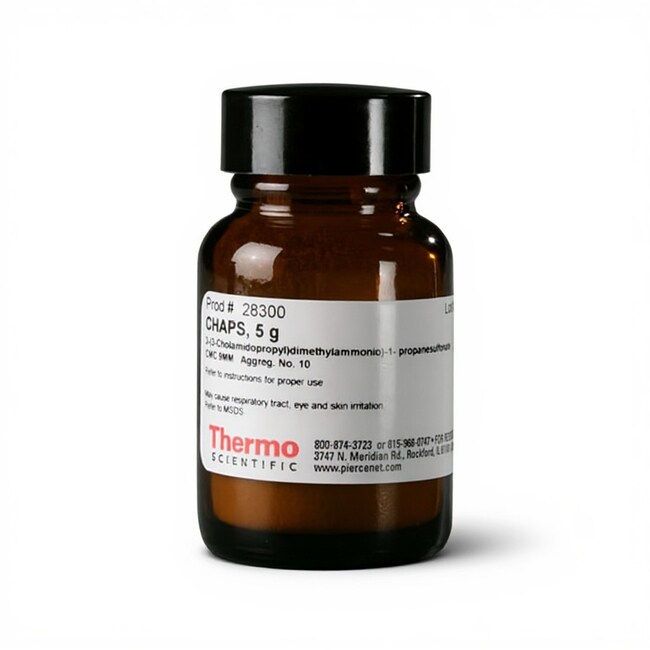
CHAPS 去污剂 (3-((3-胆酰胺丙基) 二甲基氨基丙基)-1-丙磺酸内盐)
Invitrogen17万+抗体限时买二赠一,靶点广,灵活用!
CHAPS 去污剂 (3-((3-胆酰胺丙基) 二甲基氨基丙基)-1-丙磺酸内盐)
Thermo Scientific™

CHAPS 去污剂 (3-((3-胆酰胺丙基) 二甲基氨基丙基)-1-丙磺酸内盐)

Thermo Scientific CHAPS 是一种兼性离子去污剂,尤其适用于保护蛋白质的天然状态。CHAPS 是胆酸的甜菜碱衍生物。当保持蛋白活性很重要时,这种兼性离子去污剂对细胞膜蛋白溶解很有用。CHAPS 在宽 pH了解更多信息
Have Questions?
更改视图buttonViewtableView
货号数量
283005 g
28299100 g
货号 28300
价格(CNY)
2,669.00
Each
添加至购物车
数量:
5 g
请求批量或定制报价
价格(CNY)
2,669.00
Each
添加至购物车
Thermo Scientific CHAPS 是一种兼性离子去污剂,尤其适用于保护蛋白质的天然状态。

CHAPS 是胆酸的甜菜碱衍生物。当保持蛋白活性很重要时,这种兼性离子去污剂对细胞膜蛋白溶解很有用。CHAPS 在宽 pH 值(2 至 12)范围内可溶,并且由于其具有高临界胶束浓度 (CMC),可采用透析轻松地从溶液中去除。

该缓冲液的特点:

•多功能兼性离子去污剂
• 可温和但有效地裂解培养的哺乳动物细胞
• 非变性且一般不会灭活蛋白功能
• 可使用透析从溶液中去除
• 通常用于等电聚焦 (IEF) 和 2D 电泳

应用:

•将大鼠脑细胞膜中的鸦片剂受体增溶,同时保留受体的可逆鸦片剂结合属性 1
• 纯化微粒体信号肽酶标作为复合物2
• 增溶脑组织中的多巴胺 D 2,3、毒蕈碱 4 和鸦片剂受体 5

CHAPS 已成功用于增溶内在膜蛋白和受体,并维持相关的蛋白的功能。CHAPS 也已与非离子去污剂结合使用,如 NP-40,以用于非变性凝胶电泳应用。CHAPS 已经在等电聚集 (IEF) 应用中大范围取代了 NP-40,它可以防止在中间 pH 范围形成条纹。CHAPS 的电中性及其解组特性被认为是获得改进的原因所在。

CHAPS 去污剂的属性:

•化学名称:3-[(3-胆酰胺丙基) 二甲基氨基丙基]-1-丙磺酸内盐
•分子量:614.88g
• 去污剂类型:兼性离子
• 积聚数量:10
•胶束分子量:6149g
• 临界胶束浓度 (CMC):8 至 10 mM(0.4920 至 0.6150%,w/v)
• 浊点:≥100°C
• 是否可透析:是

CHAPS 的规格:

• 外观:白色不流动粉末,无外来物质。
• 溶解度:10% (aq) 溶液为透明、无色。
• 鉴别:I.R.扫描必须只显示被测试化合物结构和功能基团的峰特征。
• 纯度:(TLC)一个主要点。一个小的、次级点是可接受的。

相关产品
Surfact-Amps™ 去污剂采样器
仅供科研使用。不可用于诊断程序。
规格
数量5 g
试剂类型去污剂(纯)
形式粉末
产品类型去垢剂
Unit SizeEach
内容与储存
室温保存

常见问题解答 (FAQ)

Are there mass spectrometry reagents for membrane proteins?

CHAPS (Cat. Nos. 28299, 28300), OTG (Cat. No. 28351) and Sodium Deoxycholate (Cat. Nos. 89904, 89905) are detergents often used to solubilize and extract membrane proteins from samples

Find additional tips, troubleshooting help, and resources within our Mass Spectrometry Support Center.

Are detergents denaturing or non-denaturing with respect to protein structure?

Ionic detergents, or those that carry a charge, are the most likely to be denaturing to proteins. Denaturing detergents can be anionic such as sodium dodecyl sulfate (SDS) or cationic such as ethyl trimethyl ammonium bromide. These detergents totally disrupt membranes and denature proteins by breaking protein-protein interactions through changes in the three-dimensional structure of the proteins. Nondenaturing detergents can be divided into nonionic detergents (i.e., Triton X-100), bile salts (i.e., cholate), and zwitterionic detergents (i.e., CHAPS).


Find additional tips, troubleshooting help, and resources within our Protein Purification and Isolation Support Center.

What are detergents?

Detergents are amphipathic molecules containing both a nonpolar “tail” having aliphatic or aromatic character, and a polar “head”. The ionic character of the polar head group forms the basis for broad classification of detergents as ionic, nonionic, or zwitterionic.

Find additional tips, troubleshooting help, and resources within our Protein Purification and Isolation Support Center.

How does detergent-based cell lysis work?

Detergents are amphipathic molecules, meaning they contain both a nonpolar “tail” having aliphatic or aromatic character and a polar “head”. Like the components of biological membranes, detergents have hydrophobic-associating properties as a result of their nonpolar tail groups. Nevertheless, detergents are themselves water soluble.

Consequently, detergent molecules allow the dispersion (miscibility) of water-insoluble, hydrophobic compounds into aqueous media, including the extraction and solubilization of membrane proteins. Detergent monomers solubilize membrane proteins by partitioning into the membrane bilayer. With increasing amounts of detergents, membranes undergo various stages of solubilization.

Find additional tips, troubleshooting help, and resources within our Protein Purification and Isolation Support Center.

What types of detergents are available for cell lysis?

Detergents can be denaturing or non-denaturing with respect to protein structure. Denaturing detergents can be anionic such as sodium dodecyl sulfate (SDS) or cationic such as ethyl trimethyl ammonium bromide. These detergents totally disrupt membranes and denature proteins by breaking proteinprotein interaction. These detergents are considered harsh. Non-denaturing detergents can be divided into nonionic detergents (i.e., Triton X-100), bile salts (i.e., cholate), and zwitterionic detergents (i.e., CHAPS). These detergents do not denature proteins and do not break protein-protein interactions. These detergents are considered mild.

Find additional tips, troubleshooting help, and resources within our Protein Purification and Isolation Support Center.