Pierce™ 16% 甲醛 (w/v),无甲醇
Invitrogen17万+抗体限时买二赠一,靶点广,灵活用!
Pierce™ 16% 甲醛 (w/v),无甲醇
Thermo Scientific™

Pierce™ 16% 甲醛 (w/v),无甲醇

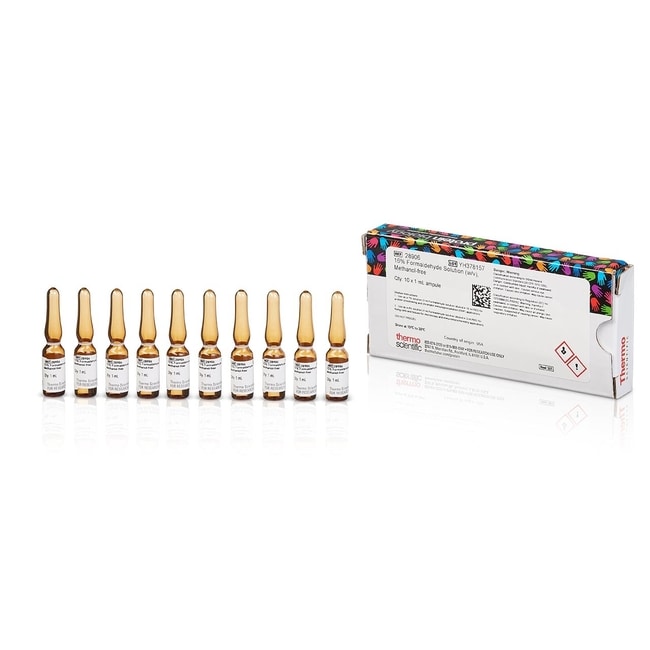
Thermo Scientific Pierce 甲醛安瓿为高质量无甲醇甲醛的样品瓶,可用作蛋白和核酸组织样品的一般 IHC 固定剂和可逆的胺交联剂。安瓿密封的高质量甲醛溶液可节省宝贵时间,并消除了直接从多聚甲醛制备溶液的必要和相关风险。Pierce 甲醛直接从颗粒多聚甲醛精心制备而成,并密封在 1了解更多信息
Have Questions?
更改视图buttonViewtableView
货号数量
2890610 x 1 mL
2890810 x 10 mL
货号 28906
价格(CNY)
877.00
Each
添加至购物车
数量:
10 x 1 mL
请求批量或定制报价
价格(CNY)
877.00
Each
添加至购物车
Thermo Scientific Pierce 甲醛安瓿为高质量无甲醇甲醛的样品瓶,可用作蛋白和核酸组织样品的一般 IHC 固定剂和可逆的胺交联剂。

安瓿密封的高质量甲醛溶液可节省宝贵时间,并消除了直接从多聚甲醛制备溶液的必要和相关风险。Pierce 甲醛直接从颗粒多聚甲醛精心制备而成,并密封在 1 mL 和 10 mL 安瓿中的惰性气体下。安瓿包装通过保护溶液免受空气氧化和光的影响来稳定制备,使得每次都能使用“新鲜”甲醛。

无甲醇 16% 甲醛安瓿的特点:

新鲜—甲醛溶液在琥珀色预先刻痕安瓿中保持稳定且无污染。
尺寸合适—包装尺寸适用于从培养物靶向细胞固定到基于蛋白的细胞内应用的各种应用。
便利的起始浓度—16% w/v 甲醛溶液可将稀释量简化至所需的工作浓度。
尽可能减少浪费—1 mL 和 10 mL 包装尺寸允许选择产品,从而减少浪费并尽可能地减少处置顾虑。

针对应用的安瓿包装
16% 甲醛溶液(福尔马林)提供针对小容量和大容量用户的包装尺寸。根据需要新鲜无甲醇甲醛溶液的较常见应用选择合适的包装尺寸。16% (w/v) 溶液可简化每个相应应用的稀释过程,而针对应用的包装则尽可能减少了浪费。

•1-mL 安瓿适合基于蛋白的细胞内应用,例如染色质免疫沉淀 (ChIP) 或蛋白相互作用的发现。
•10-mL 安瓿用于生物成像(高容量筛选/分析),如在图像分析前将细胞固定在培养板上。

密封在安瓿中“新鲜制备”
我们的甲醛溶液以溶于蒸馏水/去离子水中的 16% (w/v) 多聚甲醛(纯颗粒固体)溶液的形式制备。溶液稳定是很重要的,因为甲醛溶液会氧化为甲酸,最终重新聚合为多聚甲醛。大多数需要无甲醇甲醛的方案建议“新鲜制备”甲醛。该甲醛溶液在惰性气体下制备后立即密封在安瓿中。安瓿包装可稳定制备,使得每次都能使用“新鲜”甲醛。

为增加打开玻璃安瓿时的安全性,请考虑使用我们的安瓿开瓶器,这是一次性安全装置,用于在打开玻璃安瓿时保护手指。

仅供科研使用。不可用于诊断程序。
规格
化学名称或材料甲醛
建议的储存条件储存在原容器中,置于干燥、阴凉且通风良好的区域内,避免阳光直照。
物理形态液体
产品线Pierce™
数量10 x 1 mL
Unit SizeEach

常见问题解答 (FAQ)

我应该使用哪种固定剂来固定自己的细胞或组织,从而进行抗体标记?

醛类固定剂(例如甲醛、戊二醛)可与各种细胞成分交联,这有助于保持蛋白质和细胞的形态。但一些抗原可能会因交联而被掩藏,需要通过抗原修复的方式暴露掩藏的抗原结合位点。此外,醛类固定剂需要通过通透处理使抗体进入细胞。甲醇和丙酮等有机溶剂可凝聚蛋白质并通透细胞,但细胞形态会受到破坏。表面抗原无需固定即可标记。

Where do I find the expiry date of Pierce 16% Formaldehyde (w/v), Methanol-free (Cat. No. 28906)?

We guarantee the functionality of Pierce 16% Formaldehyde (w/v), Methanol-free for one year from date of shipment, if stored correctly. See Limited Warranties for consumables under the General Terms and Conditions of Sale.

Find additional tips, troubleshooting help, and resources within our Labeling Chemistry Support Center

What are the options for crosslinking proteins to nucleic acids, and what are the differences between them?

We offer the following crosslinkers for protein to nucleic acids: formaldehyde (Cat. No. 28906), SPB (Cat. No. 23013), SDAD (Cat. No. 26169), sulfo-SDAD (Cat. No. 26175), and sulfo-SBED (Cat. No. A39260).
Formaldehyde can be used for DNA-DNA crosslinking as well as DNA-protein crosslinking. While it is good for crosslinking proteins that are in direct contact with DNA, formaldehyde cannot link proteins that may be bound in a complex with other proteins but are not in direct contact with DNA. EGS or DSG can crosslink proteins to other proteins that are in direct contact with DNA and crosslinked to DNA by formaldehyde.
SPB, Sulfo-SDAD, and Sulfo-SBED are all photoreactive crosslinkers. SPB is an NHS-ester and psoralen heterobifunctional crosslinker that conjugates primary amines on proteins to DNA via photo-activated intercalation of psoralen to pyrimidine bases. The psoralen tricyclic planar ring system intercalates into double-stranded, and to a lesser extent, single-stranded DNA and RNA. The photoreactive psoralen group provides more selective covalent binding to nucleic acids than either phenyl azide or diazerine linkers, which makes SPB the best choice. The diazerine on sulfo-SDAD and the phenyl azide on sulfo-SBED are not selective for nucleic acids and can crosslink other biomolecules in the same besides any protein-DNA interactions. Sulfo-SBED involves biotin transfer rather than actual linking.

Find additional tips, troubleshooting help, and resources within our Protein Purification and Isolation Support Center.

What fixative should I use to fix my cells or tissues for antibody labeling?

Aldehyde-based fixatives (e.g., formaldehyde, glutaraldehyde) crosslink various cellular components, which helps retain proteins and cell morphology, but some antigens can be masked by the crosslinking, requiring antigen retrieval methods to unmask the antigen binding sites. Also, aldehyde-based fixation requires permeabilization to allow entry of antibodies. Organic solvents such as methanol and acetone condense proteins and permeabilize the cells, but cell morphology can be compromised. Surface antigens can be labeled without fixation.

Find additional tips, troubleshooting help, and resources within our Cell Analysis Support Center.

What is the difference between formalin and formaldehyde?

The terms “formalin” and “formaldehyde” are often used interchangeably, although the chemical composition of each fixative is different. Formalin is made with formaldehyde but the percentage denotes a different formaldehyde concentration than formaldehyde solutions. For example, 10% neutral-buffered formalin (NBF or simply formalin) is really a 4% formaldehyde solution; the basis for this difference is that historically, formalin was prepared with commercial-grade stock formaldehyde, which is 37 to 40% formaldehyde, by diluting it 1:10 in phosphate buffer.

Find additional tips, troubleshooting help, and resources within our Protein Purification and Isolation Support Center.