Search


引用和文献 (5)
Thermo Scientific™
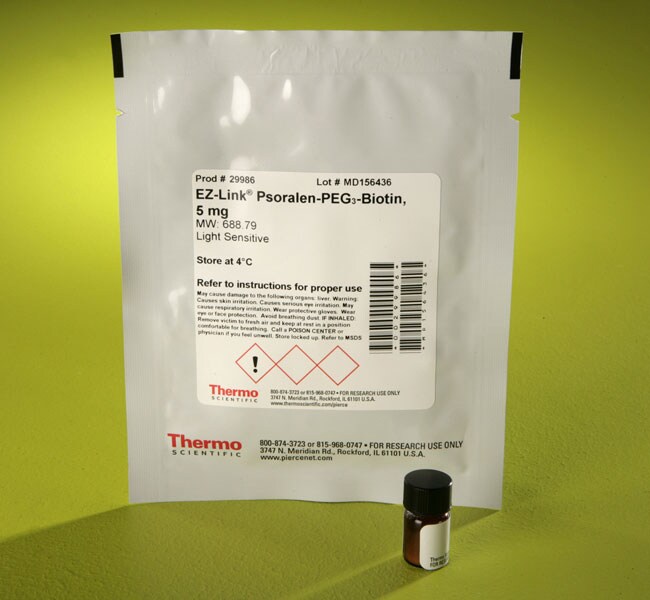
EZ-Link™ 补骨脂素-PEG3-生物素
Thermo Scientific EZ-Link 补骨脂素-PEG3-生物素能够通过补骨脂素基团与含胸腺嘧啶和其他嘧啶的碱基的紫外光活化嵌入(形成共价键)对 DNA 或 RNA 进行生物素化了解更多信息
| 货号 | 数量 |
|---|---|
| 29986 | 5 mg |
货号 29986
价格(CNY)
7,213.00
Each
数量:
5 mg
价格(CNY)
7,213.00
Each
Thermo Scientific EZ-Link 补骨脂素-PEG3-生物素能够通过补骨脂素基团与含胸腺嘧啶和其他嘧啶的碱基的紫外光活化嵌入(形成共价键)对 DNA 或 RNA 进行生物素化。
EZ-Link 补骨脂素-PEG3-生物素的特点:
•生物分子标记 — 对 DNA 或 RNA 进行生物素化(每 10 至 20 个碱基约 1 生物素),而不会干扰杂交
• 光反应性 — 在存在 10 至 30 分钟紫外光照 (∼350 nm) 的情况下发生共价结合
• 补骨脂素活化 — 通过环加成机制与含胸腺嘧啶和其他嘧啶的碱基中的 5,6 双键发生反应
• 聚乙二醇化 — 间隔臂含有亲水性、3 单元、聚乙二醇 (PEG) 基团
• 增强溶解度 — 聚乙二醇化使生物素化分子具有水溶性,有助于防止储存在溶液中的生物素化抗体的聚集
• 长距离 — 间隔臂(添加至靶标的总长度)为 36.9 埃,尽可能减少与链霉素亲和素发生结合相互作用的空间位阻
补骨脂素-PEG3-生物素是用于 DNA 或 RNA 生物素化的光活化试剂。使用紫外光 (∼350 nm) 进行活化后,补骨脂素基团与含胸腺嘧啶和其他嘧啶的碱基发生反应,形成共价键。亲水性聚乙二醇 (PEG) 间隔臂可赋予水溶性,将其转移至生物素化分子,从而减少储存在溶液中的标记蛋白的聚集。PEG 间隔臂还为该试剂提供了长而灵活的连接,以尽可能减少与亲和素分子结合时的空间位阻。
我们生产生物素试剂,以确保尽可能使预期研究应用的总体产品完整性、一致性和性能达到较高水平。
应用:
• 细胞表面蛋白的选择性标记(参考 1)
• 透明质酸的生物素化(参考 2)
•用于受体结合研究的内毒素的标记(参考 3)
EZ-Link 补骨脂素-PEG3-生物素的特点:
•生物分子标记 — 对 DNA 或 RNA 进行生物素化(每 10 至 20 个碱基约 1 生物素),而不会干扰杂交
• 光反应性 — 在存在 10 至 30 分钟紫外光照 (∼350 nm) 的情况下发生共价结合
• 补骨脂素活化 — 通过环加成机制与含胸腺嘧啶和其他嘧啶的碱基中的 5,6 双键发生反应
• 聚乙二醇化 — 间隔臂含有亲水性、3 单元、聚乙二醇 (PEG) 基团
• 增强溶解度 — 聚乙二醇化使生物素化分子具有水溶性,有助于防止储存在溶液中的生物素化抗体的聚集
• 长距离 — 间隔臂(添加至靶标的总长度)为 36.9 埃,尽可能减少与链霉素亲和素发生结合相互作用的空间位阻
补骨脂素-PEG3-生物素是用于 DNA 或 RNA 生物素化的光活化试剂。使用紫外光 (∼350 nm) 进行活化后,补骨脂素基团与含胸腺嘧啶和其他嘧啶的碱基发生反应,形成共价键。亲水性聚乙二醇 (PEG) 间隔臂可赋予水溶性,将其转移至生物素化分子,从而减少储存在溶液中的标记蛋白的聚集。PEG 间隔臂还为该试剂提供了长而灵活的连接,以尽可能减少与亲和素分子结合时的空间位阻。
我们生产生物素试剂,以确保尽可能使预期研究应用的总体产品完整性、一致性和性能达到较高水平。
应用:
• 细胞表面蛋白的选择性标记(参考 1)
• 透明质酸的生物素化(参考 2)
•用于受体结合研究的内毒素的标记(参考 3)
仅供科研使用。不可用于诊断程序。
规格
细胞渗透性细胞不可透过性
标签类型生物素& 类似物
产品线EZ-Link
产品类型补骨脂素-PEG3-生物素
数量5 mg
反应一部分补骨脂素
化学反应性光活化
标签或染料生物素
溶解度DMF(二甲基甲酰胺), DMSO(二甲亚砜), 水
间隔子超长,聚乙二醇化
Unit SizeEach
内容与储存
避光防潮储存在 4°C 下。在环境温度运输。
常见问题解答 (FAQ)
Is there an alternative to the discontinued Psoralen-Biotin Labeling Kit (Cat. No. AM1480)?
引用和文献 (5)
引用和文献
Abstract
ZCCHC3 is a co-sensor of cGAS for dsDNA recognition in innate immune response.
Journal:Nat Commun
PubMed ID:30135424
'Cyclic GMP-AMP synthase (cGAS) senses double-strand (ds) DNA in the cytosol and then catalyzes synthesis of the second messenger cGAMP, which activates the adaptor MITA/STING to initiate innate antiviral response. How cGAS activity is regulated remains enigmatic. Here, we identify ZCCHC3, a CCHC-type zinc-finger protein, as a positive regulator of
Low-cost cross-taxon enrichment of mitochondrial DNA using in-house synthesised RNA probes.
Journal:PLoS One
PubMed ID:30716066
'Hybridization capture with in-solution oligonucleotide probes has quickly become the preferred method for enriching specific DNA loci from degraded or ancient samples prior to high-throughput sequencing (HTS). Several companies synthesize sets of probes for in-solution hybridization capture, but these commercial reagents are usually expensive. Methods for economical in-house probe synthesis
The RNA-binding protein Mex3B is a coreceptor of Toll-like receptor 3 in innate antiviral response.
Journal:Cell Res
PubMed ID:26823206
'Recognition of viral dsRNA by Toll-like receptor 3 (TLR3) leads to induction of interferons (IFNs) and proinflammatory cytokines, and innate antiviral response. Here we identified the RNA-binding protein Mex3B as a positive regulator of TLR3-mediated signaling by expression cloning screens. Cells from Mex3b(-/-) mice exhibited reduced production of IFN-ß in
A Naturally Occurring Deletion in the Effector Domain of H5N1 Swine Influenza Virus Nonstructural Protein 1 Regulates Viral Fitness and Host Innate Immunity.
Journal:J Virol
PubMed ID:29563291
Nonstructural protein 1 (NS1) of influenza A virus regulates innate immune responses via various mechanisms. We previously showed that a naturally occurring deletion (the EALQR motif) in the NS1 effector domain of an H5N1 swine-origin avian influenza virus impairs the inhibition of type I interferon (IFN) in chicken fibroblasts and
Structural alteration of DNA induced by viral protein R of HIV-1 triggers the DNA damage response.
Journal:Retrovirology
PubMed ID:29338752
Viral protein R (Vpr) is an accessory protein of HIV-1, which is potentially involved in the infection of macrophages and the induction of the ataxia-telangiectasia and Rad3-related protein (ATR)-mediated DNA damage response (DDR). It was recently proposed that the SLX4 complex of structure-specific endonuclease is involved in Vpr-induced DDR, which