Search

Thermo Scientific™
Pierce™ 免疫扩散板,多模式
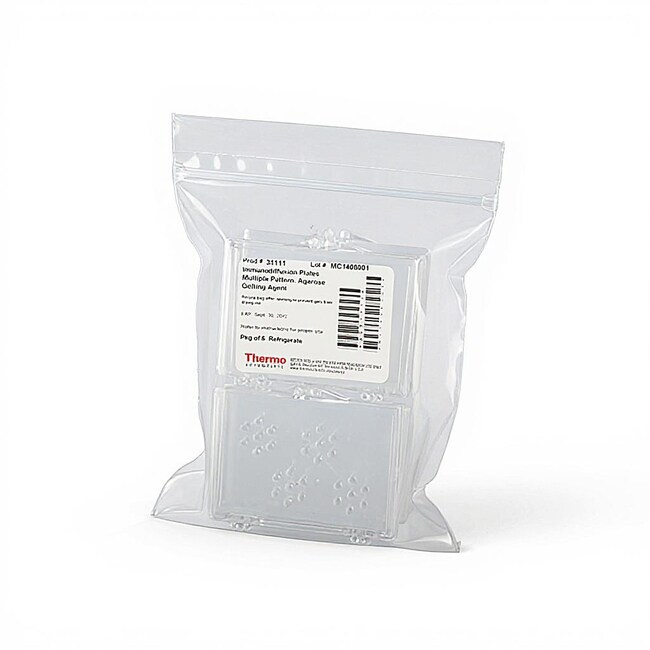
Thermo Scientific Pierce Immunodiffusion Plates are standard Ouchterlony gel plates containing patterns of six wells around one well for studying了解更多信息
| 货号 | 数量 |
|---|---|
| 31111 | 6 plates |
货号 31111
价格(CNY)
3,198.00
Each
数量:
6 plates
价格(CNY)
3,198.00
Each
Thermo Scientific Pierce Immunodiffusion Plates are standard Ouchterlony gel plates containing patterns of six wells around one well for studying and characterizing antibody-antigen binding interactions.
Features of Pierce Immunodiffusion Plates:
• Gelling agent contains precipitin brighteners for easy visualization
• Immunodiffusion plates contain diffusion enhancers to help speed the interaction process
• Excellent precipitin bands with antibodies from all species (including rabbit antibodies)
• Gels can be washed, dried and stained for a permanent record
Immunodiffusion (ID) is a classic technique for detecting antibody-antigen interactions based on the theory of double diffusion originally described by Oudin and Ouchterlony. Antigens and antibodies are placed into separate wells that are cut into a gel matrix and allowed to diffuse towards each other. If the reaction is positive, a precipitate forms that appears as an opaque line. The precipitation reaction occurs when the antigen and antibody concentrations are combined at near equivalent proportions.
When multivalent antigens combine with divalent antibodies in solution, three-dimensional lattices are formed that aggregate and precipitate. The amount of precipitate varies in proportion to the concentration of the antigen and antibody. At equivalent or optimal proportions almost all the antigen and antibody will precipitate. If there is an excess of antibody, the complexes formed with the antigen are insoluble. When there is an excess of antigen, the precipitate has a tendency to dissolve caused by the formation of soluble complexes.
Features of Pierce Immunodiffusion Plates:
• Gelling agent contains precipitin brighteners for easy visualization
• Immunodiffusion plates contain diffusion enhancers to help speed the interaction process
• Excellent precipitin bands with antibodies from all species (including rabbit antibodies)
• Gels can be washed, dried and stained for a permanent record
Immunodiffusion (ID) is a classic technique for detecting antibody-antigen interactions based on the theory of double diffusion originally described by Oudin and Ouchterlony. Antigens and antibodies are placed into separate wells that are cut into a gel matrix and allowed to diffuse towards each other. If the reaction is positive, a precipitate forms that appears as an opaque line. The precipitation reaction occurs when the antigen and antibody concentrations are combined at near equivalent proportions.
When multivalent antigens combine with divalent antibodies in solution, three-dimensional lattices are formed that aggregate and precipitate. The amount of precipitate varies in proportion to the concentration of the antigen and antibody. At equivalent or optimal proportions almost all the antigen and antibody will precipitate. If there is an excess of antibody, the complexes formed with the antigen are insoluble. When there is an excess of antigen, the precipitate has a tendency to dissolve caused by the formation of soluble complexes.
仅供科研使用。不可用于诊断程序。
规格
检测免疫扩散 (ID)
检测方法沉淀物
产品线Pierce
数量6 plates
靶标特异性无靶标特异性
技术免疫扩散 (ID)
类型多孔板
工作容积(公制)22 μl
颜色清除
直径(公制)3.2mm
高度(公制)2.8mm
孔数6
Unit SizeEach
内容与储存
收到产品后,在 4°C 下储存。板在室温下运输。请勿冷冻板或使其变干。