Search


引用和文献 (15)
Thermo Scientific™
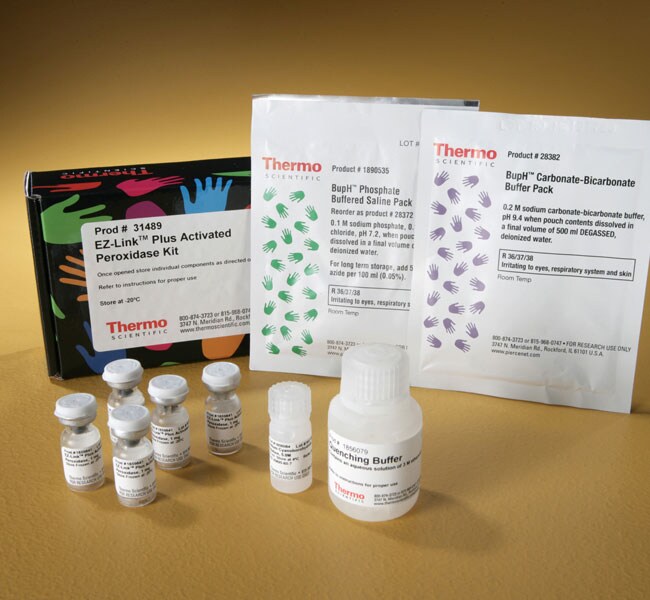
EZ-Link™ Plus 活化过氧化物酶试剂盒
Thermo Scientific Pierce Plus 活化过氧化物酶是胺反应性辣根过氧化物酶(horseradish peroxidase,以下简称 HRP),其偶联效率高于 95%了解更多信息
| 货号 | 数量 |
|---|---|
| 31489 | 1 孔板试剂盒 |
货号 31489
价格(CNY)
10,016.00
Each
数量:
1 孔板试剂盒
价格(CNY)
10,016.00
Each
Thermo Scientific Pierce Plus 活化过氧化物酶是胺反应性辣根过氧化物酶(horseradish peroxidase,以下简称 HRP),其偶联效率高于 95% 的抗体和其他蛋白。每个试剂盒含有 5 x 1 mg 冻干 HRP 和偶联 5 mg 免疫球蛋白 (IgG) 所需的足量氰基硼氢化钠溶液、淬灭缓冲液和缓冲液
Thermo Scientific Pierce Plus 活化过氧化物酶试剂盒的特点:
•活化 HRP–辣根过氧化物酶经过高碘酸盐氧化、醛基活化,可直接偶联到抗体和其他蛋白的伯胺(如赖氨酸)位点
•永久性偶联–与伯胺高效结合 (95%),经氰基硼氢化钠(包括在试剂盒中)还原后形成共价酰胺键
•高活性 HRP–酶活性为 120-200 U/mg;冻干粉,在 -20°C 下可稳定保存至少 12 个月
•方便用量–。每 1 mg 活性酶足以与 1 mg IgG 反应,产生约 0.5 mL 偶联物
•可定制–为达到不同水平的 HRP 和结合活性,可以改变摩尔比、反应缓冲液和 pH 值以及其他参数
Plus 活化过氧化物酶是辣根过氧化物酶(horseradish peroxidase,以下简称 HRP),其天然碳水化合物(糖)已经过高碘酸盐轻微氧化,形成了胺反应性醛基。Plus 活化过氧化物酶的这些羰基可自发有效地与抗体或其他蛋白质上的伯胺交联。该方法比其他胺反应性化学试剂的(如戊二醛偶联)偶联效率更高,戊二醛常常会导致聚合作用,偶联物失活程度更高。预活化酶避免了从头开始制备和验证活化过氧化物酶过程中所固有的困难。本试剂盒提供了酶、配套试剂和方案,易于产生高性能的偶联物,可在免疫印迹、ELISA 等检测技术中使用。
相关产品
EZ-Link™ Plus 活化过氧化物酶
Thermo Scientific Pierce Plus 活化过氧化物酶试剂盒的特点:
•活化 HRP–辣根过氧化物酶经过高碘酸盐氧化、醛基活化,可直接偶联到抗体和其他蛋白的伯胺(如赖氨酸)位点
•永久性偶联–与伯胺高效结合 (95%),经氰基硼氢化钠(包括在试剂盒中)还原后形成共价酰胺键
•高活性 HRP–酶活性为 120-200 U/mg;冻干粉,在 -20°C 下可稳定保存至少 12 个月
•方便用量–。每 1 mg 活性酶足以与 1 mg IgG 反应,产生约 0.5 mL 偶联物
•可定制–为达到不同水平的 HRP 和结合活性,可以改变摩尔比、反应缓冲液和 pH 值以及其他参数
Plus 活化过氧化物酶是辣根过氧化物酶(horseradish peroxidase,以下简称 HRP),其天然碳水化合物(糖)已经过高碘酸盐轻微氧化,形成了胺反应性醛基。Plus 活化过氧化物酶的这些羰基可自发有效地与抗体或其他蛋白质上的伯胺交联。该方法比其他胺反应性化学试剂的(如戊二醛偶联)偶联效率更高,戊二醛常常会导致聚合作用,偶联物失活程度更高。预活化酶避免了从头开始制备和验证活化过氧化物酶过程中所固有的困难。本试剂盒提供了酶、配套试剂和方案,易于产生高性能的偶联物,可在免疫印迹、ELISA 等检测技术中使用。
相关产品
EZ-Link™ Plus 活化过氧化物酶
仅供科研使用。不可用于诊断程序。
规格
标记规模0.5-1 mg
标记目标抗体(通用)、蛋白(通用)
标签或染料HRP(辣根过氧化物酶)
数量1 孔板试剂盒
足够用于5次酶标记反应
产品线EZ-Link
Unit SizeEach
内容与储存
足够用于:5 次酶标记反应,每次可与 1 mg 抗体 (IgG) 反应
•Plus 活化过氧化物酶,5 x 1 mg
• 氰基硼氢化钠溶液,1 x 0.5 mL
• 淬灭缓冲液,25 mL
• PBS 干混粉(可制备 500 mL),1 包
•碳酸氢盐缓冲液干混粉(可制备 500 mL),1 包
储存于 -20°C。
•Plus 活化过氧化物酶,5 x 1 mg
• 氰基硼氢化钠溶液,1 x 0.5 mL
• 淬灭缓冲液,25 mL
• PBS 干混粉(可制备 500 mL),1 包
•碳酸氢盐缓冲液干混粉(可制备 500 mL),1 包
储存于 -20°C。
引用和文献 (15)
引用和文献
Abstract
Method for Sorting and Pairwise Selection of Nanobodies for the Development of Highly Sensitive Sandwich Immunoassays.
Journal:
PubMed ID:26544909
Single domain heavychain binders (nanobodies) obtained from camelid antibody libraries hold a great promise for immunoassay development. However, there is no simple method to select the most valuable nanobodies from the crowd of positive clones obtained after the initial screening. In this paper, we describe a novel nanobody-based platform that
Generation and characterization of antibodies against Asian elephant (Elephas maximus) IgG, IgM, and IgA.
Journal:
PubMed ID:25658336
Asian elephant (Elephas maximus) immunity is poorly characterized and understood. This gap in knowledge is particularly concerning as Asian elephants are an endangered species threatened by a newly discovered herpesvirus known as elephant endotheliotropic herpesvirus (EEHV), which is the leading cause of death for captive Asian elephants born after 1980
A neutralizing monoclonal antibody-based competitive ELISA for classical swine fever C-strain post-vaccination monitoring.
Journal:BMC Vet Res
PubMed ID:31937302
'Virus neutralization test (VNT) is widely used for serological survey of classical swine fever (CSF) and efficacy evaluation of CSF vaccines. However, VNT is a time consuming procedure that requires cell culture and live virus manipulation. C-strain CSF vaccine is the most frequently used vaccine for CSF control and prevention.
A novel monoclonal antibodies-based sandwich ELISA for detection of serotype 4 fowl adenovirus.
Journal:Avian Pathol
PubMed ID:30621493
'As a major causative agent for hepatitis-hydropericardium syndrome (HPS) in chickens, serotype 4 fowl adenovirus (FAdV-4) has caused huge economic losses in the poultry industry globally. However, there is no commercial diagnostic test for FAdV-4 antigens. To generate a rapid approach for specific detection of FAdV-4, a monoclonal antibodies (mAbs)-based
A novel PSMA/GCPII-deficient mouse model shows enlarged seminal vesicles upon aging.
Journal:Prostate
PubMed ID:30256431
'Prostate-specific membrane antigen (PSMA), also known as glutamate carboxypeptidase II (GCPII), is an important diagnostic and therapeutic target in prostate cancer. PSMA/GCPII is also expressed in many healthy tissues, but its function has only been established in the brain and small intestine. Several research groups have attempted to produce PSMA/GCPII-deficient