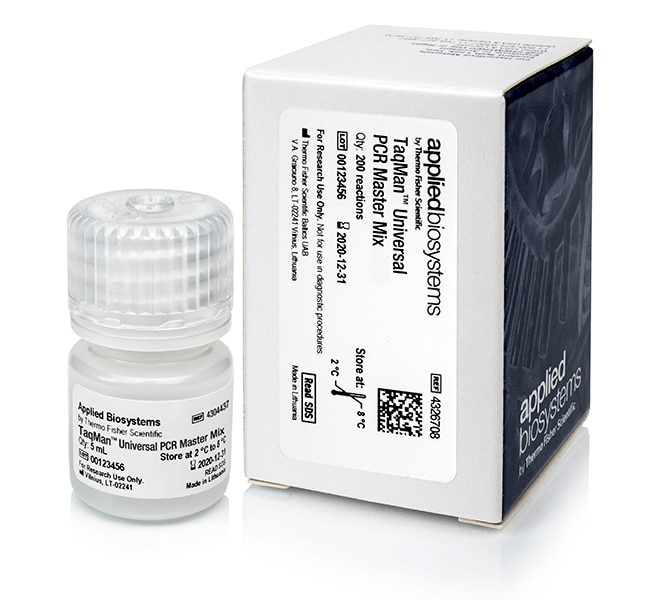
TaqMan™ Universal PCR 预混液
Applied Biosystems™

TaqMan™ Universal PCR 预混液

当您需要一种适用于多种5' 核酸酶 DNA 应用的预混液时,TaqMan Universal PCR 预混液便是理想的试剂溶液。Applied Biosystems 试剂已通过了解更多信息
Have Questions?
更改视图buttonViewtableView
货号数量
43044371 x 5 mL
43643405 x 5 mL
43643382 x 5 mL
430571910 x 5 mL
431815710 x 5 mL
43267081 x 50 mL
货号 4304437
价格(CNY)
7,265.00
Each
添加至购物车
数量:
1 x 5 mL
价格(CNY)
7,265.00
Each
添加至购物车
当您需要一种适用于多种5' 核酸酶 DNA 应用的预混液时,TaqMan Universal PCR 预混液便是理想的试剂溶液。Applied Biosystems 试剂已通过 TaqMan 检测和 Applied Biosystems 实时系统进行验证,以确保每次都能提供灵敏、准确和可靠的性能。

• 包含 AmpliTaq Gold DNA 聚合酶,与 AmpliTaq Gold DNA 聚合酶相比,可提供更高的产量和更稳健的5 核酸酶测定
• 包括一个基于专有 ROX 染料的被动内部参比,可在 Applied Biosystems 实时荧光定量 PCR 仪器上实现一流精确度
• 缓冲液增强保证了所有应用的性能和可靠性,即使是富含 G/C 的序列也一样
• AmpErase UNG 可防止后续从含有 dU 的 PCR 产物中再次扩增,从而尽量减少残留污染
• 提供了快速测定开发指南,以便尽量减少优化时间

替代产品:试用 TaqMan Fast Advanced 预混液,这是我们较高性能的探针预混液。借助 TaqMan Fast Advanced 预混液,我们已经能够充分发挥 TaqMan Universal PCR 预混液的优势,并为您的基因表达分析增加了更多功能。

仅供科研使用。不可用于诊断程序。
规格
适用于(设备)7000系统、7300系统、7500系统、7700系统、7900HT 系统、Applied Biosystems StepOnePlus™ Fast 实时荧光定量 PCR 系统、GeneAmp 9600、StepOne™、标准模式、StepOnePlus™、标准模式
试剂盒类型1 包
参比荧光染料ROX(预混)
聚合酶AmpliTaq Gold DNA 聚合酶
产品线TaqMan™
产品类型通用型 PCR 预混液
数量1 x 5 mL
样品类型DNA(基因组)、cDNA
容量5 mL
检测方法引物-探针
适用于(应用)基因表达, 基因分型, miRNA 分析
高 GC PCR 扩增效果
PCR 方法qPCR
反应速度标准
Unit SizeEach
内容与储存
以 2X 浓度提供。混合物含有 AmpliTaq Gold™ DNA 聚合酶、Uracil-DNA Glycosylase、含 dUTP 的 dNTP、惰性参比染料 1 和经优化的缓冲液组分。该包装含有一个 5 mL 管,足以进行 200 次总体积为 50 uL 的反应。在 2-8°C 下储存

保证的下限有效期为 60 天(确切的有效期已印在产品和 CofA 上)。

常见问题解答 (FAQ)

What master mix can I use with the TaqMan SNP Genotyping Assays?

We recommend using either the TaqPath ProAmp Master Mix or the TaqMan Genotyping Master Mix. The TaqMan Genotyping Master Mix has the advantage of proven performance with up to 3 days of pre- and post-PCR stability, allowing you to set up plates ahead of time or read the plates later (see the data here, https://tools.thermofisher.com/content/sfs/brochures/cms_039236.pdf) while the TaqPath ProAmp Master Mix can handle samples that may have inhibitors present.

What does it mean when a miRNA target entry has been removed (obsoleted) from miRBase?

miRBase continues to re-annotate the miRNA sequences as more information becomes available. A sequence that once mapped to a given species (e.g.: human) may no longer exist, so it is removed from miRBase. Accordingly, the original assay for that sequence no longer maps to an annotated miRNA, and as a result the annotation fields on the search results page on the Thermo Fisher Scientific portal are empty. An example of this is Assay “hsa-miR-505” (Assay ID 001049). miRBase continues to re-annotate the miRNA sequences as more information becomes available. A sequence that once mapped to a given species (e.g.: human) may no longer exist, so it is removed from miRBase. Accordingly, the original assay for that sequence no longer maps to an annotated miRNA, and as a result the annotation fields on the search results page on the Thermo Fisher Scientific portal are empty. An example of this is Assay “hsa-miR-505” (Assay ID 001049).

What is the TaqMan MicroRNA Assay?

A TaqMan MicroRNA Assay has two components: an RT reaction containing a miRNA specific stem-loop reverse-transcription primer and a separate specific TaqMan miRNA Assay. The RT stem-loop primer provides the specificity for the mature miRNA target; it does not detect its precursor. The formation of a RT primer/mature miRNA-chimera extends the length of the 5’ end of the miRNA. The longer RT product provides a miRNA specific cDNA template amenable to the TaqMan assay design.

What is mechanism of the TaqMan MicroRNA Assays?

There are 2 steps involved in using the TaqMan MicroRNA Assays:

1. RT step: total RNA to cDNA using miRNA-specific RT primers from the TaqMan MicroRNA Assays and the TaqMan MicroRNA Reverse Transcription Kit (P/N 4366596, 200 reactions or 4366597, 1000 reactions)

2. PCR step: cDNA to PCR products using primers and probe from the TaqMan MicroRNA Assays together with TaqMan Universal PCR Master Mix No AmpErase UNG (P/N 4324018).

Why are miRNAs so important?

MicroRNAs are believed to play an important role in post transcriptional gene regulation. A total of ~850 unique miRNAs have been discovered so far, including ~333 human miRNAs. They are relatively abundant, ranging from a few to as many as 50,000 molecules per cell. They account for approximately 1% of the predicted genes in animals and plants. The level of individual miRNAs varies dramatically across cell type and developmental stages. These differences in miRNA level are believed to be a key indicator of miRNA activity.

Recent research has implicated miRNAs in the following: cell development, differentiation, communication and cell death; DNA methylation and chromatin modification; metabolism; human cancer development; haematopoiesis; nervous system patterning; insulin secretion.