What is a spectral calibration?
A spectral calibration is an algorithm applied to raw data, which converts it into the component 4 or 5 dye data stored in the sample files. A spectral is created for a specific dye set (combination of dyes), array type (4 or 16 capillaries), and array length (36cm or 50cm). It is used to correct for the natural overlap of the fluorescent dyes.
Find additional tips, troubleshooting help, and resources within our Capillary Electrophoresis Instruments Support Center.
Which fragment analysis matrix standards can I use for my Applied Biosystems 3130 Series instrument?
DS-02 (Dye Set E5), DS-30 (Dye Set D), DS-31 (Dye Set D), DS-32 (Dye Set F), and DS-33 (Dye Set G5) are all supported on the Applied Biosystems 3130 Series systems. Please refer to the Applied Biosystems 3130/3130xl Genetic Analyzers Getting Started Guide (http://tools.thermofisher.com/content/sfs/manuals/cms_041468.pdf) for more information.
Find additional tips, troubleshooting help, and resources within our Capillary Electrophoresis Applications Support Center.
I am using only one dye for fragment analysis but I see peaks in other colors below my peak of interest. Why is this?
If the peaks in other colors are directly below the peak of interest, the issue could be that the fluorescent dye being used is not part of the selected dye set, the spectral calibration needs to be performed, or the peaks are offscale. Confirm that the dye set selected on the instrument is compatible with the dye being used, run a new spectral calibration if the correct dye set has been selected and, if the signal intensity is too high, decrease sample concentration during PCR or when preparing samples for electrophoresis.
Find additional tips, troubleshooting help, and resources within our Capillary Electrophoresis Applications Support Center.
Can I switch dyes during a fragment analysis project?
We do not recommend that you switch dyes in the middle of a project. Switching dyes may result in a shift in the allele sizes as dyes differ in their mobility. If dyes are switched in the middle of a project, it will be necessary to identify the size shift for all the markers/targets in the amplicon product range. The size shift will be consistent throughout the project and it is only necessary to make the adjustment once.
Find additional tips, troubleshooting help, and resources within our Capillary Electrophoresis Applications Support Center.
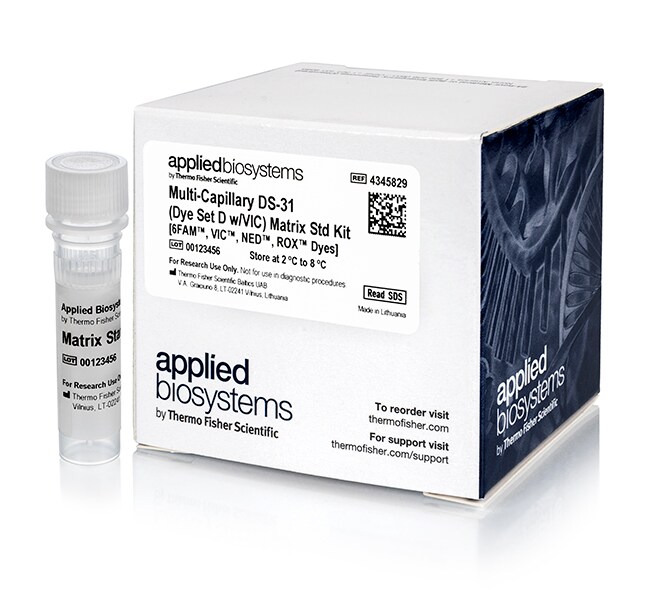
What is the difference between the matrix standards, DS-30 and DS-31? Why do they both belong to dye set D?
Both DS-30 and DS-31 matrix standards contain 6-FAM, NED and ROX. The difference is the dye used in the green channel where DS-30 contains the HEX dye versus DS-31 which contains the VIC dye. The VIC dye emits a stronger signal and is more stable than the HEX dye and we suggest that you use the VIC dye for weak amplicons. Both DS-30 and DS-31 are contained in dye set D, as both dyes have excitation and emission wavelengths that are quite similar and, upon the initial release of DS-31 on the Applied Biosystems 310 Genetic Analyzer, it was not necessary to change the filter set to run DS-30 and DS-31
Find additional tips, troubleshooting help, and resources within our Capillary Electrophoresis Applications Support Center.