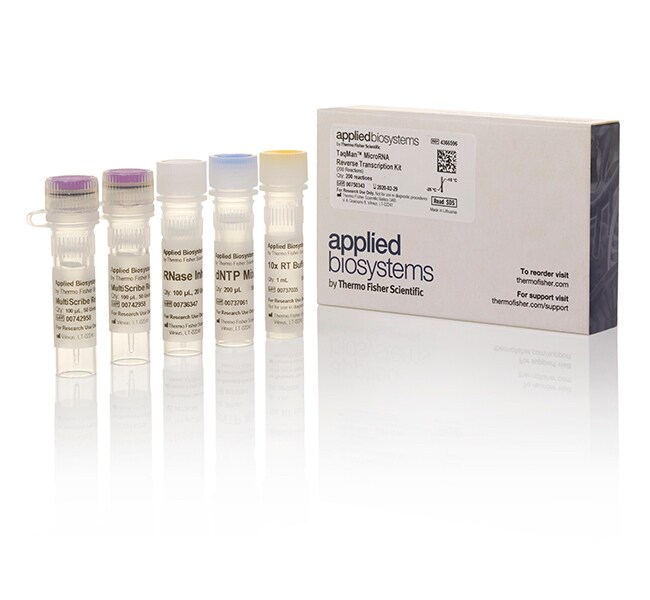
TaqMan™ MicroRNA 逆转录试剂盒
Applied Biosystems™

TaqMan™ MicroRNA 逆转录试剂盒

Applied Biosystems™ TaqMan™ MicroRNA 逆转录试剂盒可提供 TaqMan™ MicroRNA 检测试剂盒实现卓越性能所需的1000个反应组分。该试剂盒的组分与 TaqMan™了解更多信息
Have Questions?
更改视图buttonViewtableView
货号足够用于
4366596200 次反应
43665971000 次反应
货号 4366596
价格(CNY)
5,070.00
Each
添加至购物车
足够用于:
200 次反应
价格(CNY)
5,070.00
Each
添加至购物车
Applied Biosystems™ TaqMan™ MicroRNA 逆转录试剂盒可提供 TaqMan™ MicroRNA 检测试剂盒实现卓越性能所需的1000个反应组分。该试剂盒的组分与 TaqMan™ MicroRNA 检测试剂盒提供的 RT 引物共同用于将 miRNA 转换成 cDNA。

高特异性试剂盒,仅用于定量成熟 miRNA,排除前体 miRNA。一种保存有限样品的灵敏试剂盒,只需要 1-10 毫微克总 RNA。快速、简单、可放大,两步定量 RT-PCR 分析法可在3小时内产生高质量结果。
仅供科研使用。不可用于诊断程序。
规格
保真度(相对于 Taq)10 X
最终产品类型cDNA
适用于(设备)7500 System, 7500 Fast System, 7900HT System, StepOne™, StepOnePlus™, ViiA™ 7 System, QuantStudio™ 3, QuantStudio™ 5, QuantStudio™ 6 Flex, QuantStudio™ 7 Flex, QuantStudio 6 Pro, QuantStudio 7 Pro, QuantStudio™ 12k Flex, QuantStudio™ Absolute Q Digital PCR System
反应次数200 次反应
最佳反应温度42°C
产品线TaqMan™
产品类型MicroRNA 逆转录试剂盒
数量200 reactions
反应形式分离组分
逆转录酶MultiScribe™
样品类型RNA
运输条件干冰
尺寸(最终产品)200 bp 或更小
足够用于200 次反应
最大浓度10X
检测方法引物-探针
适用于(应用)miRNA 分析
高 GC PCR 扩增效果
PCR 方法两步法 RT-qPCR
反应速度快速
Unit SizeEach
内容与储存
含有能够进行200个反应的 10X RT 缓冲液、dNTP 混合物 w/dTTp(共 100M)、RNase 抑制剂 (20 U/μL) 和 MultiScribe™ RT 酶 (50 U/μL)。储存于 -15 到 -25°C。

常见问题解答 (FAQ)

How long can I store the cDNA from my reverse transcription step?

You can store your cDNA at 2-6 degrees C for up to 24 hours. For long-term storage, store the cDNA at -15 to -25 degrees C and add EDTA to a final concentration of 1 mM to prevent degradation.

What does it mean when a miRNA target entry has been removed (obsoleted) from miRBase?

miRBase continues to re-annotate the miRNA sequences as more information becomes available. A sequence that once mapped to a given species (e.g.: human) may no longer exist, so it is removed from miRBase. Accordingly, the original assay for that sequence no longer maps to an annotated miRNA, and as a result the annotation fields on the search results page on the Thermo Fisher Scientific portal are empty. An example of this is Assay “hsa-miR-505” (Assay ID 001049). miRBase continues to re-annotate the miRNA sequences as more information becomes available. A sequence that once mapped to a given species (e.g.: human) may no longer exist, so it is removed from miRBase. Accordingly, the original assay for that sequence no longer maps to an annotated miRNA, and as a result the annotation fields on the search results page on the Thermo Fisher Scientific portal are empty. An example of this is Assay “hsa-miR-505” (Assay ID 001049).

What is the TaqMan MicroRNA Assay?

A TaqMan MicroRNA Assay has two components: an RT reaction containing a miRNA specific stem-loop reverse-transcription primer and a separate specific TaqMan miRNA Assay. The RT stem-loop primer provides the specificity for the mature miRNA target; it does not detect its precursor. The formation of a RT primer/mature miRNA-chimera extends the length of the 5’ end of the miRNA. The longer RT product provides a miRNA specific cDNA template amenable to the TaqMan assay design.

What is mechanism of the TaqMan MicroRNA Assays?

There are 2 steps involved in using the TaqMan MicroRNA Assays:

1. RT step: total RNA to cDNA using miRNA-specific RT primers from the TaqMan MicroRNA Assays and the TaqMan MicroRNA Reverse Transcription Kit (P/N 4366596, 200 reactions or 4366597, 1000 reactions)

2. PCR step: cDNA to PCR products using primers and probe from the TaqMan MicroRNA Assays together with TaqMan Universal PCR Master Mix No AmpErase UNG (P/N 4324018).

Why are miRNAs so important?

MicroRNAs are believed to play an important role in post transcriptional gene regulation. A total of ~850 unique miRNAs have been discovered so far, including ~333 human miRNAs. They are relatively abundant, ranging from a few to as many as 50,000 molecules per cell. They account for approximately 1% of the predicted genes in animals and plants. The level of individual miRNAs varies dramatically across cell type and developmental stages. These differences in miRNA level are believed to be a key indicator of miRNA activity.

Recent research has implicated miRNAs in the following: cell development, differentiation, communication and cell death; DNA methylation and chromatin modification; metabolism; human cancer development; haematopoiesis; nervous system patterning; insulin secretion.