Search

Applied Biosystems™
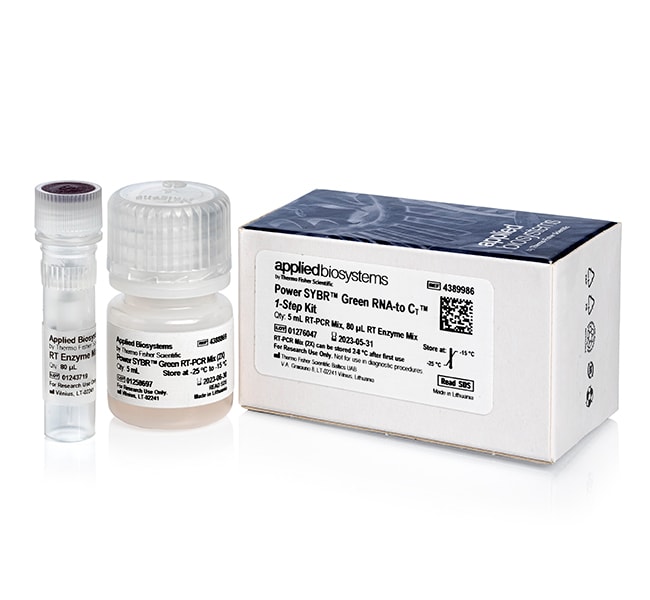
Power SYBR™ Green RNA-to-CT ™1Step 试剂盒
通过简单易用的一步法 qRT-PCR 反应获得高灵敏度和特异性的结果。Power SYBR™ Green RNA-to-CT™ 一步法试剂盒的制备方式可确保较大的灵敏度和可靠性。这种新型制备方式可减少引物二聚体引起的假阳性结果,显著提高数据准确性,并能可靠地检测低丰度靶标。其中包括:•AmpliTaq™了解更多信息
Have Questions?
更改视图

| 货号 | 反应次数 |
|---|---|
| 4389986 | 200 次反应 |
| 4391178 | 100 次反应 |
货号 4389986
价格(CNY)
9,994.00
Each
反应次数:
200 次反应
价格(CNY)
9,994.00
Each
通过简单易用的一步法 qRT-PCR 反应获得高灵敏度和特异性的结果。Power SYBR™ Green RNA-to-CT™ 一步法试剂盒的制备方式可确保较大的灵敏度和可靠性。这种新型制备方式可减少引物二聚体引起的假阳性结果,显著提高数据准确性,并能可靠地检测低丰度靶标。其中包括:
•AmpliTaq™ Gold DNA Polymerase UP 用于热启动 qPCR,可较大限度地减少非特异性产物形成
•ArrayScript™ UP 逆转录酶是一种经过工程设计的 RT,可以产生高产量的全长 cDNA
•一种可以减少引物二聚体形成,进而减少可产生假阳性信号的非特异性产物的添加剂
•RNase 抑制剂,防止 RNA 模板降解
•专用 ROX™ 染料是一种被动内参染料,可以用于使非 PCR 相关的荧光波动标准化,从而提高 Applied Biosystems™ 实时荧光定量 PCR 仪器的精密度。
•AmpliTaq™ Gold DNA Polymerase UP 用于热启动 qPCR,可较大限度地减少非特异性产物形成
•ArrayScript™ UP 逆转录酶是一种经过工程设计的 RT,可以产生高产量的全长 cDNA
•一种可以减少引物二聚体形成,进而减少可产生假阳性信号的非特异性产物的添加剂
•RNase 抑制剂,防止 RNA 模板降解
•专用 ROX™ 染料是一种被动内参染料,可以用于使非 PCR 相关的荧光波动标准化,从而提高 Applied Biosystems™ 实时荧光定量 PCR 仪器的精密度。
仅供科研使用。不可用于诊断程序。
规格
适用于(设备)7500 Fast 系统、7500 系统、7900HT 系统、QuantStudio™ 12k Flex、QuantStudio™ 3、QuantStudio™ 5、QuantStudio™ 6 Flex、QuantStudio™ 7、StepOne™、StepOnePlus™、ViiA™ 7 系统
反应次数200 次反应
参比荧光染料ROX(预混)
聚合酶AmpliTaq Gold DNA 聚合酶
产品线RNA-to-CT,SYBR
产品类型一步法 qRT-PCR 试剂盒
纯度或质量等级UP (Ultra Pure)
数量200 次反应
逆转录酶ArrayScript™ UP
运行时间标准
样品类型RNA
运输条件湿冰
足够用于200 Reactions at 20 μL
检测方法SYBR
适用于(应用)基因表达
标签或染料SYBR Green
PCR 方法一步法 RT-qPCR
反应速度标准
Unit SizeEach
内容与储存
Sufficient for 200 reactions at 20 μL reaction volume and includes:
• 1 x 5 mL tube of 2X master mix containing SYBR™Green 1 Dye, AmpliTaq Gold™ DNA Polymerase UP, dNTPs, Passive Reference 1,and optimized buffer components. Store at 2-8°C after opening.
• 1 x 80 μL tube of 125X RT enzyme mix containing ArrayScript™ UP Reverse Transcriptase, RNase Inhibitor. Store at -15 to -30°C.
Guaranteed minimum shelf life is 60 days (exact expiry date printed on product and CofA).
• 1 x 5 mL tube of 2X master mix containing SYBR™Green 1 Dye, AmpliTaq Gold™ DNA Polymerase UP, dNTPs, Passive Reference 1,and optimized buffer components. Store at 2-8°C after opening.
• 1 x 80 μL tube of 125X RT enzyme mix containing ArrayScript™ UP Reverse Transcriptase, RNase Inhibitor. Store at -15 to -30°C.
Guaranteed minimum shelf life is 60 days (exact expiry date printed on product and CofA).