Search


引用和文献 (3)
Invitrogen™
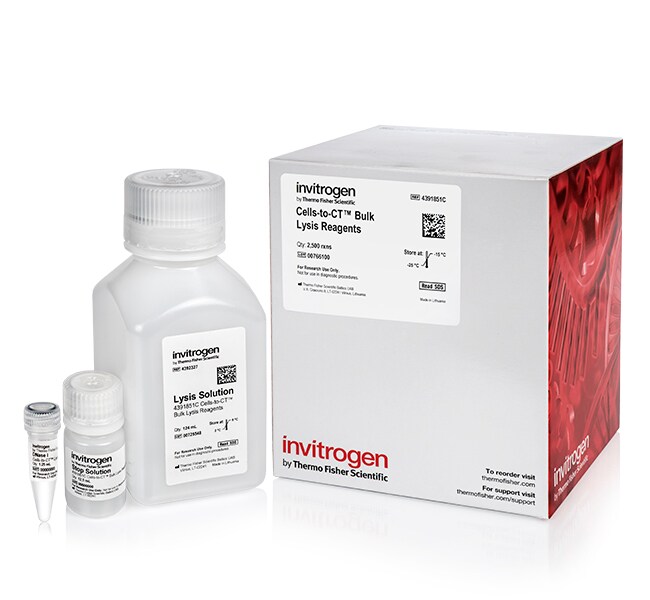
Cells-to-CT™ 大包装裂解试剂
Cells-to-CT™ 散装裂解试剂是 TaqMan™ Gene Expression Cells-to-CT™ 试剂盒的组成部分,若需要体积大于随试剂盒提供的体积,可单独购买。所含试剂包括:裂解液、终止液和 DNase了解更多信息
| 货号 | 数量 |
|---|---|
| 4391851C | 2,500 reactions |
货号 4391851C
价格(CNY)
159,400.00
Each
数量:
2,500 reactions
价格(CNY)
159,400.00
Each
Cells-to-CT™ 散装裂解试剂是 TaqMan™ Gene Expression Cells-to-CT™ 试剂盒的组成部分,若需要体积大于随试剂盒提供的体积,可单独购买。所含试剂包括:裂解液、终止液和 DNase。TaqMan™ Gene Expression Cells-to-CT™ 试剂盒使研究人员可以使用培养细胞轻松地进行表达分析,无需纯化 RNA。
仅供科研使用。不可用于诊断程序。
规格
反应次数2500 reactions
产品线Cells-to-CT
产品类型细胞裂解缓冲液
数量2,500 reactions
运输条件干冰
Unit SizeEach
内容与储存
该试剂盒包含以下组成部分:
裂解液 (124 mL):储存于 4°C 条件下
终止液 (12.5 mL):储存于 -20°C 条件下
DNase (1.25 mL):在 -20°C 下储存
裂解液 (124 mL):储存于 4°C 条件下
终止液 (12.5 mL):储存于 -20°C 条件下
DNase (1.25 mL):在 -20°C 下储存
常见问题解答 (FAQ)
完成Cells-to-CT实验后,在没有反转录的阴性对照中出现PCR产物。这表示什么?
完成Cells-to-CT实验后,在无模板PCR对照中出现PCR产物。可能有哪些原因?
进行了Cells-to-CT实验之后我没获得PCR产物或获得了预期之外的PCR产物。可能有哪些原因?
Cells-to-CT实验中的终止液用完了。能否单独购买?
我的Cells-to-CT反应中有基因组DNA污染,该如何除去污染?
引用和文献 (3)
引用和文献
Abstract
Genome-wide siRNA-based functional genomics of pigmentation identifies novel genes and pathways that impact melanogenesis in human cells.
Journal:PLoS Genet
PubMed ID:19057677
'Melanin protects the skin and eyes from the harmful effects of UV irradiation, protects neural cells from toxic insults, and is required for sound conduction in the inner ear. Aberrant regulation of melanogenesis underlies skin disorders (melasma and vitiligo), neurologic disorders (Parkinson''s disease), auditory disorders (Waardenburg''s syndrome), and opthalmologic disorders
N-methylpurine DNA glycosylase and DNA polymerase beta modulate BER inhibitor potentiation of glioma cells to temozolomide.
Journal:Neuro Oncol
PubMed ID:21377995
'Temozolomide (TMZ) is the preferred chemotherapeutic agent in the treatment of glioma following surgical resection and/or radiation. Resistance to TMZ is attributed to efficient repair and/or tolerance of TMZ-induced DNA lesions. The majority of the TMZ-induced DNA base adducts are repaired by the base excision repair (BER) pathway and therefore
Accurate RT-qPCR gene expression analysis on cell culture lysates.
Journal:Sci Rep
PubMed ID:22355736
'Gene expression quantification on cultured cells using the reverse transcription quantitative polymerase chain reaction (RT-qPCR) typically involves an RNA purification step that limits sample processing throughput and precludes parallel analysis of large numbers of samples. An approach in which cDNA synthesis is carried out on crude cell lysates instead of