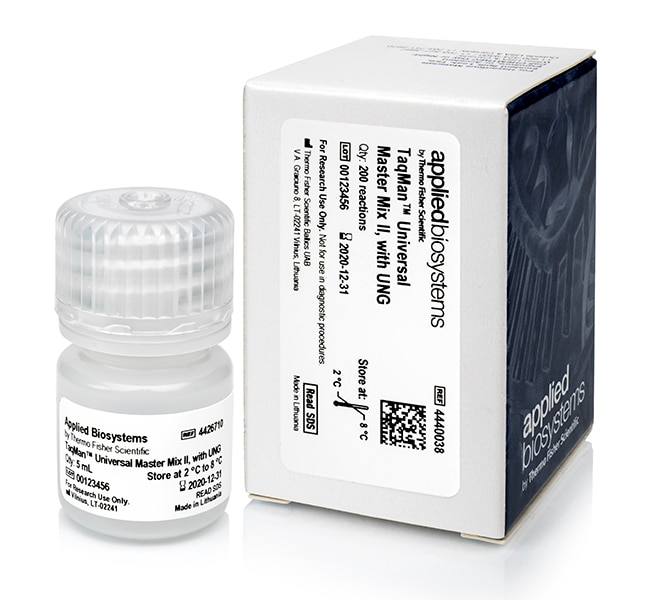
TaqMan™ Universal 预混液 II,含UNG
Applied Biosystems™

TaqMan™ Universal 预混液 II,含UNG

TaqMan Universal 预混液 II 将执行实时聚合酶链反应 (PCR) 所必需的组分(引物、探针、模板和水除外了解更多信息
Have Questions?
更改视图buttonViewtableView
货号数量
44400381 x 5 mL
44400421 x 1 mL
44400442 x 5 mL
44400455 x 5 mL
444004610 x 5 mL
44400391 x 50 mL
货号 4440038
价格(CNY)
7,050.00
Each
添加至购物车
数量:
1 x 5 mL
价格(CNY)
7,050.00
Each
添加至购物车
TaqMan Universal 预混液 II 将执行实时聚合酶链反应 (PCR) 所必需的组分(引物、探针、模板和水除外)混合在一起,十分便利。在多种应用,包括定量和基因分型,可将 TaqMan Universal 预混液 II 用于扩增互补 DNA (cDNA) 和 DNA 靶标。

这种 TaqMan Universal 预混液 II 作为一种2X 浓缩物提供,并含有:
AmpliTaq Gold DNA 聚合酶 UP(超纯)
• dNTP(加入了 dUTP)
• ROX Passive Reference
• 尿嘧啶-N-糖基化酶 (UNG)
• 优化的缓冲液组分

注:这种 TaqMan Universal 预混液 II 含有尿嘧啶-N-糖基化酶 (UNG)。请参阅所有 TaqMan Universal 预混液 II 产品的完整列表(含和不含 UNG)。

TaqMan Universal 预混液 II 已经过优化,可与已根据赛默飞世尔科技指南设计的引物和 TaqMan 探针一起使用。该预混液可用于通过我们的定制检测服务提供的定制 TaqMan 检测,或预优化的检测,例如:
•TaqMan 基因表达检测
• TaqMan microRNA 检测
• TaqMan 药物代谢基因分型检测
• TaqMan SNP 基因分型检测

对于 RNA 定量实验,TaqMan Universal 预混液 II 用于两步法逆转录/聚合酶链反应 (RT-PCR) 方案的第二步。可使用赛默飞世尔科技公司提供的 cDNA 合成试剂盒在逆转录反应中生成与预混液一起使用的 cDNA 模板。

替代产品:试用 TaqMan Fast Advanced 预混液,这是我们较高性能的探针预混液。借助 TaqMan Fast Advanced 预混液,我们已经能够充分发挥 TaqMan Universal 预混液 II 的优势,并为您的基因表达分析增加了更多功能。

仅供科研使用。不可用于诊断程序。
规格
保真度(相对于 Taq)2 X
适用于(设备)7300系统,7500系统,7900系统, HT 系统,Applied Biosystems StepOnePlus™ Fast 实时荧光定量 PCR 系统,StepOne™,标准模式,StepOnePlus™,标准模式,ViiA™ 7 系统
参比荧光染料ROX(预混)
聚合酶AmpliTaq Gold DNA 聚合酶
产品线TaqMan™
产品类型通用型预混液 II
纯度或质量等级UP (Ultra Pure)
数量1 x 5 mL
样品类型DNA(基因组)、cDNA
运输条件湿冰
容量5 mL
最大浓度2X
检测方法引物-探针
适用于(应用)基因表达, 基因分型, miRNA 分析
高 GC PCR 扩增效果
PCR 方法qPCR
反应速度标准
Unit SizeEach
内容与储存
4°C 储存

保质期至少60天(确切的有效期已印在产品和分析证书上)。

常见问题解答 (FAQ)

What does it mean when a miRNA target entry has been removed (obsoleted) from miRBase?

miRBase continues to re-annotate the miRNA sequences as more information becomes available. A sequence that once mapped to a given species (e.g.: human) may no longer exist, so it is removed from miRBase. Accordingly, the original assay for that sequence no longer maps to an annotated miRNA, and as a result the annotation fields on the search results page on the Thermo Fisher Scientific portal are empty. An example of this is Assay “hsa-miR-505” (Assay ID 001049). miRBase continues to re-annotate the miRNA sequences as more information becomes available. A sequence that once mapped to a given species (e.g.: human) may no longer exist, so it is removed from miRBase. Accordingly, the original assay for that sequence no longer maps to an annotated miRNA, and as a result the annotation fields on the search results page on the Thermo Fisher Scientific portal are empty. An example of this is Assay “hsa-miR-505” (Assay ID 001049).

What is the TaqMan MicroRNA Assay?

A TaqMan MicroRNA Assay has two components: an RT reaction containing a miRNA specific stem-loop reverse-transcription primer and a separate specific TaqMan miRNA Assay. The RT stem-loop primer provides the specificity for the mature miRNA target; it does not detect its precursor. The formation of a RT primer/mature miRNA-chimera extends the length of the 5’ end of the miRNA. The longer RT product provides a miRNA specific cDNA template amenable to the TaqMan assay design.

What is mechanism of the TaqMan MicroRNA Assays?

There are 2 steps involved in using the TaqMan MicroRNA Assays:

1. RT step: total RNA to cDNA using miRNA-specific RT primers from the TaqMan MicroRNA Assays and the TaqMan MicroRNA Reverse Transcription Kit (P/N 4366596, 200 reactions or 4366597, 1000 reactions)

2. PCR step: cDNA to PCR products using primers and probe from the TaqMan MicroRNA Assays together with TaqMan Universal PCR Master Mix No AmpErase UNG (P/N 4324018).

Why are miRNAs so important?

MicroRNAs are believed to play an important role in post transcriptional gene regulation. A total of ~850 unique miRNAs have been discovered so far, including ~333 human miRNAs. They are relatively abundant, ranging from a few to as many as 50,000 molecules per cell. They account for approximately 1% of the predicted genes in animals and plants. The level of individual miRNAs varies dramatically across cell type and developmental stages. These differences in miRNA level are believed to be a key indicator of miRNA activity.

Recent research has implicated miRNAs in the following: cell development, differentiation, communication and cell death; DNA methylation and chromatin modification; metabolism; human cancer development; haematopoiesis; nervous system patterning; insulin secretion.

What are miRNAs?

MicroRNAs (miRNAs) are endogenous non-coding RNAs, about 22 nucleotides in length, that play an important role in post-transcriptional gene regulation in animals and plants by targeting messenger RNA (mRNA) for degradation or translational repression. The miRNA precursors are transcribed from individual genes but are not translated into proteins. The primary transcript is processed in the nucleus to give one or more hairpin precursors that is exported to the cytoplasm. The mature miRNA is excised from the hairpin precursor. The mature miRNA is the biologically active form and regulates the expression of mRNA transcripts by binding to complementary sites on target mRNAs and inhibiting translation or, when there is perfect complementarity to the target sequence, inducing mRNA cleavage. In animals, translational repression, not transcript degradation, is the dominant miRNA mode of action.