Search

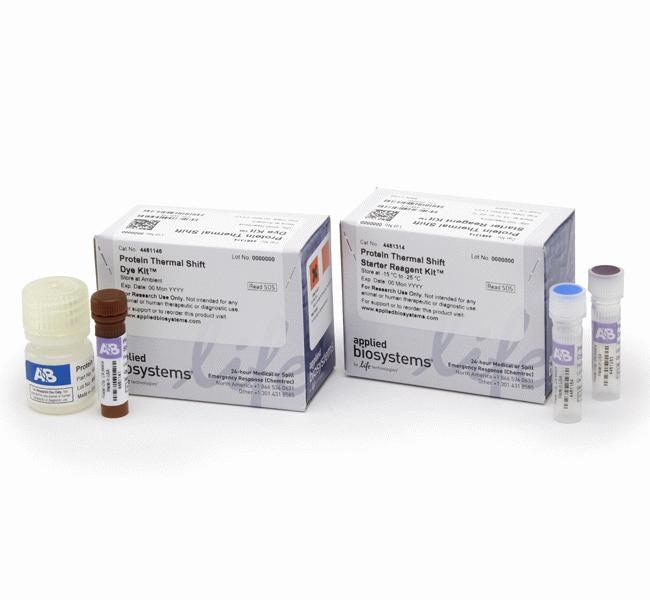
Protein Thermal Shift™ 启动试剂盒
Applied Biosystems™ Protein Thermal Shift™ 试剂盒使用户可利用与暴露的疏水残基结合的染料,通过实时荧光定量 PCR 仪器来监测蛋白质的热稳定性,从而鉴定使目标蛋白稳定的缓冲液条件或筛选配体库以寻找与目标蛋白结合的化合物。 节省样品筛查所花费的时间和费用了解更多信息
| 货号 | 数量 |
|---|---|
| 4462263 | 1,000 reactions |
货号 4462263
价格(CNY)
6,853.00
Each
数量:
1,000 reactions
价格(CNY)
6,853.00
Each
Applied Biosystems™ Protein Thermal Shift™ 试剂盒使用户可利用与暴露的疏水残基结合的染料,通过实时荧光定量 PCR 仪器来监测蛋白质的热稳定性,从而鉴定使目标蛋白稳定的缓冲液条件或筛选配体库以寻找与目标蛋白结合的化合物。
节省样品筛查所花费的时间和费用
与现有方法相比,这一解决方案可大幅减少样品筛选相关的时间和成本。在我们的实时 PCR 系统上运行的 Protein Thermal Shift™ 产品可帮助研究人员经济高效地:
• 筛选样品以监测相对蛋白热稳定性
• 以高通量的方式筛选分子(例如小分子候选药物、基于片段的文库和抗体)中与蛋白质结合的配体
• 筛选样品以监测蛋白点突变或修饰后的稳定性变化
• 系统地鉴定测量蛋白-配体相互作用、生产稳定的蛋白制剂、蛋白结晶以及蛋白储存的合适⁄最佳缓冲液条件
• 对蛋白制备进行快速质量控制,以确保蛋白的完整性和⁄或纯度
有两种试剂盒可供选择
Protein Thermal Shift™ 染料试剂盒含有进行蛋白热转移实验的染料和缓冲液,足够用于多达1000次反应。Protein Thermal Shift™ 入门试剂盒包含染料试剂盒以及一种对照蛋白质和对照配基,用于测试实验和故障排除。为使试剂配方具有极大灵活性,Protein Thermal Shift™ 入门试剂盒组分分装在两个盒子中,一个在 -20°C 下储存,另一个在 4°C 下储存。
使用 Protein Thermal Shift™ 软件简化分析
完整的 Protein Thermal Shift™ 解决方案包括分析软件,该软件与我们的五种实时荧光定量 PCR 系统生成的运行文件兼容:StepOne™ 实时荧光定量 PCR 系统、StepOnePlus™ 实时荧光定量 PCR 系统、7500 Fast 实时荧光定量 PCR 系统和 ViiA™7 实时荧光定量 PCR 系统。
节省样品筛查所花费的时间和费用
与现有方法相比,这一解决方案可大幅减少样品筛选相关的时间和成本。在我们的实时 PCR 系统上运行的 Protein Thermal Shift™ 产品可帮助研究人员经济高效地:
• 筛选样品以监测相对蛋白热稳定性
• 以高通量的方式筛选分子(例如小分子候选药物、基于片段的文库和抗体)中与蛋白质结合的配体
• 筛选样品以监测蛋白点突变或修饰后的稳定性变化
• 系统地鉴定测量蛋白-配体相互作用、生产稳定的蛋白制剂、蛋白结晶以及蛋白储存的合适⁄最佳缓冲液条件
• 对蛋白制备进行快速质量控制,以确保蛋白的完整性和⁄或纯度
有两种试剂盒可供选择
Protein Thermal Shift™ 染料试剂盒含有进行蛋白热转移实验的染料和缓冲液,足够用于多达1000次反应。Protein Thermal Shift™ 入门试剂盒包含染料试剂盒以及一种对照蛋白质和对照配基,用于测试实验和故障排除。为使试剂配方具有极大灵活性,Protein Thermal Shift™ 入门试剂盒组分分装在两个盒子中,一个在 -20°C 下储存,另一个在 4°C 下储存。
使用 Protein Thermal Shift™ 软件简化分析
完整的 Protein Thermal Shift™ 解决方案包括分析软件,该软件与我们的五种实时荧光定量 PCR 系统生成的运行文件兼容:StepOne™ 实时荧光定量 PCR 系统、StepOnePlus™ 实时荧光定量 PCR 系统、7500 Fast 实时荧光定量 PCR 系统和 ViiA™7 实时荧光定量 PCR 系统。
仅供科研使用。不可用于诊断程序。
规格
适用于(设备)7500 Fast 系统,7500 系统,StepOne™,StepOnePlus™,ViiA™ 7系统
试剂盒类型启动套装
反应次数1000 次反应
产品线Protein Thermal Shift
数量1,000 reactions
样品类型蛋白质
靶标特异性无靶标特异性
技术荧光强度
检测方法引物-探针
适用于(应用)Protein Thermal Shift
PCR 方法qPCR
Unit SizeEach
内容与储存
在 18° 至 25°C 下储存染料和缓冲液
在 -15° 至 -25°C 下储存对照配体和对照蛋白。
在 -15° 至 -25°C 下储存对照配体和对照蛋白。