Search

Applied Biosystems™
利用 castPCR™ 技术的 TaqMan™ 突变检测试剂盒
Applied Biosystems TaqMan 突变检测试剂盒以竞争性等位基因特异性 TaqMan castPCR 技术为支持,以检测和测量癌症研究相关基因的体细胞突变。castPCR 技术具有较高的特异性和灵敏度,可以在含有大量正常野生型 DNA了解更多信息
Have Questions?
更改视图

| 货号 | 数量 |
|---|---|
| 4465807 | 基因参考试剂盒(75次反应),现货库存 |
| 4465804 | 突变等位基因(75次反应),现货库存 |
货号 4465807
价格(CNY)
8,914.00
Each
数量:
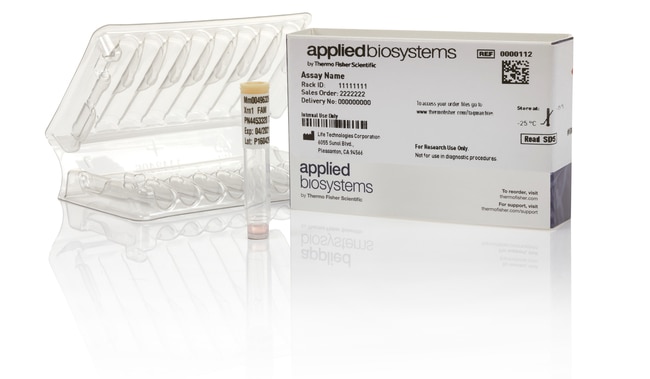
基因参考试剂盒(75次反应),现货库存
Applied Biosystems TaqMan 突变检测试剂盒以竞争性等位基因特异性 TaqMan castPCR 技术为支持,以检测和测量癌症研究相关基因的体细胞突变。castPCR 技术具有较高的特异性和灵敏度,可以在含有大量正常野生型 DNA 的样品中检测到数量稀少的突变 DNA。这些检测试剂盒适用于多种样品类型,如细胞系、福尔马林固定石蜡包埋 (FFPE) 组织和新鲜冷冻组织样品。
castPCR 技术
竞争性等位基因特异性 TaqMan PCR 采用等位基因特异性引物进行突变体等位基因检测,这种引物可与 MGB 阻滞剂寡核苷酸竞争抑制野生型基因。
体细胞突变检测
结合 TaqMan 和 castPCR 技术,TaqMan 突变检测试剂盒可以提供:
•特异性较高—设计用于封闭野生型,仅扩增突变体
•灵敏度较高—设计用于检测体细胞突变,在 1,000 个正常细胞中能检测出 1 个癌细胞
•工作流程更快—从加入样品到获得结果仅需 3 小时
对目前可用的 47 种已知癌症基因(如 KRAS、BRAF、KIT、JAK2)进行了 819 次检测,TaqMan 突变检测试剂盒为癌症研究提供了一种创新工具。
所有 TaqMan 突变检测试剂盒均已经过广泛的检测,以确保具有高灵敏度和特异性。
castPCR 技术
竞争性等位基因特异性 TaqMan PCR 采用等位基因特异性引物进行突变体等位基因检测,这种引物可与 MGB 阻滞剂寡核苷酸竞争抑制野生型基因。
体细胞突变检测
结合 TaqMan 和 castPCR 技术,TaqMan 突变检测试剂盒可以提供:
•特异性较高—设计用于封闭野生型,仅扩增突变体
•灵敏度较高—设计用于检测体细胞突变,在 1,000 个正常细胞中能检测出 1 个癌细胞
•工作流程更快—从加入样品到获得结果仅需 3 小时
对目前可用的 47 种已知癌症基因(如 KRAS、BRAF、KIT、JAK2)进行了 819 次检测,TaqMan 突变检测试剂盒为癌症研究提供了一种创新工具。
所有 TaqMan 突变检测试剂盒均已经过广泛的检测,以确保具有高灵敏度和特异性。
规格
保真度(相对于 Taq)10 X
产品规格管装
产品线TaqMan
产品类型突变检测测定试剂
数量基因参考试剂盒(75次反应),现货库存
运输条件室温
容量150 μL
最大浓度10X
检测方法引物-探针
形式冷冻
高 GC PCR 扩增效果高
PCR 方法qPCR
反应速度快速
Unit SizeEach
内容与储存
1管中包含10 X 未标记 PCR 引物和 TaqMan MGB 探针
商店( -15 至25° - C )的混合物
商店( -15 至25° - C )的混合物