Search

Ion Torrent™
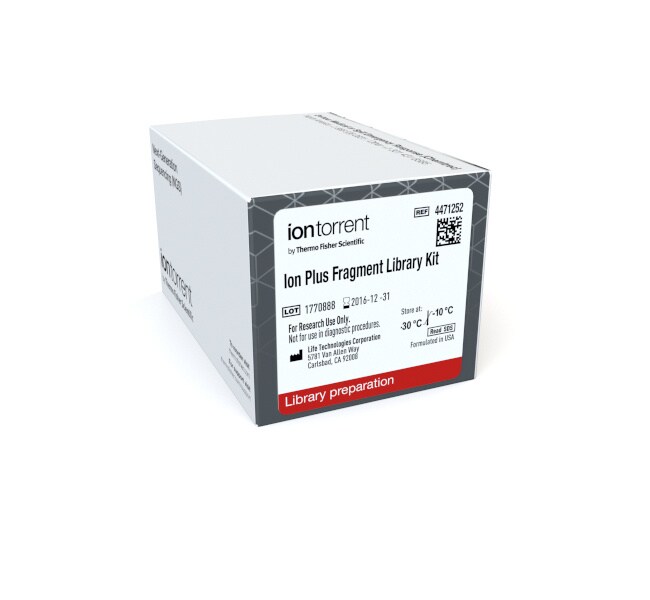
Ion Plus 片段文库试剂盒
As an integral component of the Personal Genome Machine™ sequencing platform, the Ion Plus Fragment Library Kit is designed to produce high quality DNA libraries via multiple possible workflows.
| 货号 | 数量 |
|---|---|
| 4471252 | 10 次反应 |
货号 4471252
价格(CNY)
-
数量:
10 次反应
As an integral component of the Personal Genome Machine™ sequencing platform, the Ion Plus Fragment Library Kit is designed to produce high quality DNA libraries via multiple possible workflows. The economically priced Ion Plus Fragment Library Kit provides low cost sample preparation, bringing next generation sequencing to every lab. This revolutionary kit allows completion of library preparation in as little as 2 hours for gDNA and amplicon libraries when combined with either physical shearing methods or our proprietary Ion Shear™ enzymatic fragmentation technology (Ion Xpress Plus Library Kit, Cat. No. 4471269), thus saving time and cost. With significantly higher yields than other library construction techniques, high quality libraries can be attained with as little as 100 ng input DNA. In addition, this highly efficient library construction process enables the creation of 'amplification-free' libraries from <1 μg input material. This kit is also extremely flexible in that it is compatible with multiple physical shearing and library size selection methods.
作为 Personal Genome Machine™ 测序平台的一个一体式组成部分,Ion Plus 片段文库试剂盒设计用于通过多个可能的工作流程生成高质量 DNA 文库。经济实惠的 Ion Plus 片段文库试剂盒提供了低成本的样品制备,可在每个实验室进行下一代测序。这款革命性试剂盒可结合物理剪切方法或我们专有的 Ion Shear™ 酶促片段化技术(Ion Xpress Plus 文库试剂盒,货号 4471269),在短短2小时内完成 gDNA 和扩增子文库的文库制备,从而可节省时间和成本。相对于其他文库构建技术,其产量明显更高,只需 100 ng 的 DNA 起始量即可获得高质量的文库。此外,这一高效的文库构建过程使您能够使用 <1 μg 的起始材料创建“无扩增”文库。这款试剂盒还非常灵活,可与多种物理剪切方法和文库规格选择方法兼容。
Ion Plus 片段文库试剂盒含有样品制备试剂,可针对多达 20 种 DNA 文库(取决于输入 DNA 类型和数量)进行文库构建,用于半导体测序。在 -20°C 下储存组分。
Ion Plus 片段文库试剂盒可提供:
• 起始量更低,起始材料可低至 100 ng
• 快速而灵活的工作流程,生产含有不同大小插入片段的 Ion 片段文库,并提供可选的混合和匹配工作流程
• 适用于自动化文库制备系统(包括 AB Library Builder™ 系统)的可扩展方法
单日工作流程:测序革命的下一阶段
Ion Plus 片段文库试剂盒的周转时间较短,可将 Ion 测序工作流程缩短至单个工作日,让您能够在比以往更短的时间内完成对样品的全面分析。此外,Ion Plus 片段文库试剂盒可与多种 DNA 剪切和文库规格选择方法兼容,可使您根据项目需求定制工作流程。
仅供研究使用。不得用于人或动物的治疗或诊断用途。
Ion Plus 片段文库试剂盒含有样品制备试剂,可针对多达 20 种 DNA 文库(取决于输入 DNA 类型和数量)进行文库构建,用于半导体测序。在 -20°C 下储存组分。
Ion Plus 片段文库试剂盒可提供:
• 起始量更低,起始材料可低至 100 ng
• 快速而灵活的工作流程,生产含有不同大小插入片段的 Ion 片段文库,并提供可选的混合和匹配工作流程
• 适用于自动化文库制备系统(包括 AB Library Builder™ 系统)的可扩展方法
单日工作流程:测序革命的下一阶段
Ion Plus 片段文库试剂盒的周转时间较短,可将 Ion 测序工作流程缩短至单个工作日,让您能够在比以往更短的时间内完成对样品的全面分析。此外,Ion Plus 片段文库试剂盒可与多种 DNA 剪切和文库规格选择方法兼容,可使您根据项目需求定制工作流程。
仅供研究使用。不得用于人或动物的治疗或诊断用途。
仅供科研使用。不可用于诊断程序。
规格
适用于(应用)Post-Light™ Ion 半导体测序
适用于(设备)Ion PGM™ 系统、Ion OneTouch™ 系统
高通量能力兼容高通量应用,多通路(技术)
库片段文库
产品线Ion Torrent, Ion Xpress
数量10 次反应
样品类型DNA
测序类型基因组 & DNA 测序
运输条件干冰
工作流程步骤文库生成
Unit SizeEach
内容与储存
5× 末端修复缓冲液,1 管,400 µL,–°C 至 –10°C
末端修复酶,1 管,20 µL,–°C 至 –10°C
10× 连接酶缓冲液,1 管,200 µL,–°C 至 –10°C
DNA 连接酶,1 管,40 µL,–°C 至 –10°C
接头,1 管,100 µL,–°C 至 –10°C
Platinum™ PCR SuperMix High Fidelity,2 管,1 mL,–°C 至 –10°C
文库扩增引物混合物,1 管,100 µL,–°C 至 –10°C
缺口修复聚合酶,1 管,160 µL,–°C 至 –10°C
dNTP 混合物,1 管,40 µL,–°C 至 –10°C
低 TE,2 管,1.5 mL,15 至 °C 或
–°C 至 –10°C
末端修复酶,1 管,20 µL,–°C 至 –10°C
10× 连接酶缓冲液,1 管,200 µL,–°C 至 –10°C
DNA 连接酶,1 管,40 µL,–°C 至 –10°C
接头,1 管,100 µL,–°C 至 –10°C
Platinum™ PCR SuperMix High Fidelity,2 管,1 mL,–°C 至 –10°C
文库扩增引物混合物,1 管,100 µL,–°C 至 –10°C
缺口修复聚合酶,1 管,160 µL,–°C 至 –10°C
dNTP 混合物,1 管,40 µL,–°C 至 –10°C
低 TE,2 管,1.5 mL,15 至 °C 或
–°C 至 –10°C