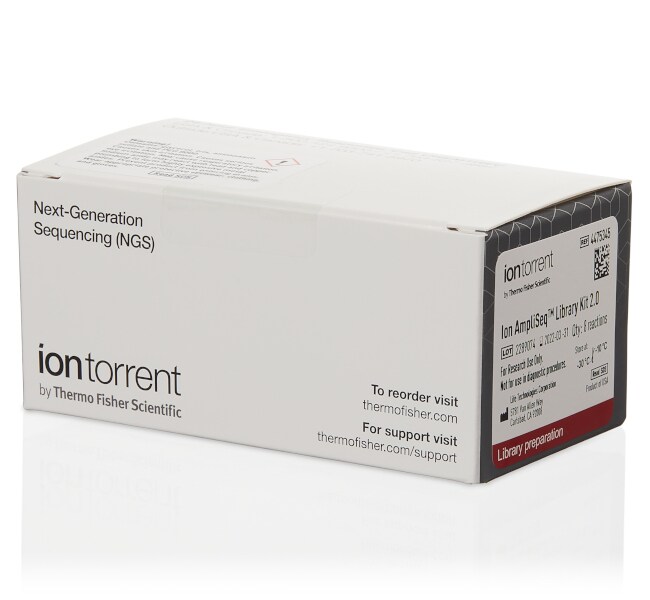
When should I consider designing my own amplicons versus using the Ion Ampliseq Designer and Ion AmpliSeq technology?
The Ion AmpliSeq Designer (www.ampliseq.com) supports custom designs for targets in the human and mouse genomes. There are two design option sizes 125-175 bp, recommended for degraded DNA samples, and 125-275 bp, recommended for standard DNA input. Ion Ampliseq technology is a simple, fast, and affordable targeted sequencing strategy based on ultrahigh-multiplex PCR. The library preparation is completed in as little as 3.5 hours using 10 ng of DNA per PCR. To learn more about Ion Ampliseq technology, please review the Ion Ampliseq FAQs.
For other genomes (non-human or non-mouse) or applications requiring longer reads (up to 400-base reads), we recommend designing your own amplicons.
Find additional tips, troubleshooting help, and resources within our Next-Generation Sequencing Support Center.
What is the difference between a DNA fragment library and a DNA amplicon library?
A DNA fragment library is constructed from whole genomic DNA and is commonly used for whole genome resequencing or de novo sequencing. Briefly, the whole genomic DNA is fragmented or sheared, ligated with Ion-specific adapter sequences, and then size-selected for the library fragments of the desired length.
Amplicon libraries are constructed from PCR-amplified DNA fragments and are used for targeted sequencing (e.g., investigating variants at known genomic locations). There are two types of amplicon libraries, short and long.
A short amplicon library contains DNA fragments (targets) with lengths that are compatible with the Ion template preparation kits without any further shearing or fragmentation during library preparation. Additionally, no size-selection step is required, as the amplicons are already within the desired size range.
A long amplicon library contains DNA fragments (targets) with lengths that are longer than those compatible with the Ion template kits and requires further shearing or fragmentation during library preparation. The library preparation protocol for long amplicons is similar to fragment libraries.
Find additional tips, troubleshooting help, and resources within our Next-Generation Sequencing Support Center.
Is the Ion Library Equalizer Kit compatible with Ion Ampliseq libraries?
The Ion Library Equalizer Kit (Cat. No. 4482298) is recommended for use with Ion AmpliSeq libraries and provides an alternative to library quantification methods by using bead-based technology to normalize the final library concentration to ~100 pM.
The Ion Library Equalizer Kit is fast and cost-effective compared to traditional quantification methods; however, it may be not be the right choice for all users. Briefly, the library is amplified with the Ion Equalizer Primers, captured onto Equalizer Beads, and the normalized library is eluted from the beads using a specially formulated Equalizer Elution Buffer. The final library is normalized to ~100 pM, but there is no quality control information (e.g., measured concentration or size distribution) that can be obtained, which is possible if using the recommended library quantification kits: Ion Library Quantitation Kit (qPCR), Qubit dsDNA HS Assay Kit (Qubit 2.0 Fluorometer), or Agilent High Sensitivity DNA Kit (Agilent Bioanalyzer instrument).
Find additional tips, troubleshooting help, and resources within our Next-Generation Sequencing Support Center.
How should I dilute my library for template preparation? How much volume of the diluted library is required?
For template preparation, Ion AmpliSeq libraries are diluted to 100 pM, and the volume required for template preparation will vary depending on the template preparation kit used. Please see the Ion AmpliSeq Library Preparation User Guide for details regarding library dilutions and input into template preparation.
Find additional tips, troubleshooting help, and resources within our Next-Generation Sequencing Support Center.
How long can I store my diluted Ion Ampliseq library?
Long-term storage of diluted libraries is not recommended and can result in decreased/suboptimal performance due to the adherence of DNA to the tube. In general, it is best to make fresh dilutions from the library stock for template preparation as needed. Libraries diluted for template preparation may be stored in a sealed plate or 0.2 mL PCR tube at 4-8 degrees C for up to 48 hours.
Find additional tips, troubleshooting help, and resources within our Next-Generation Sequencing Support Center.